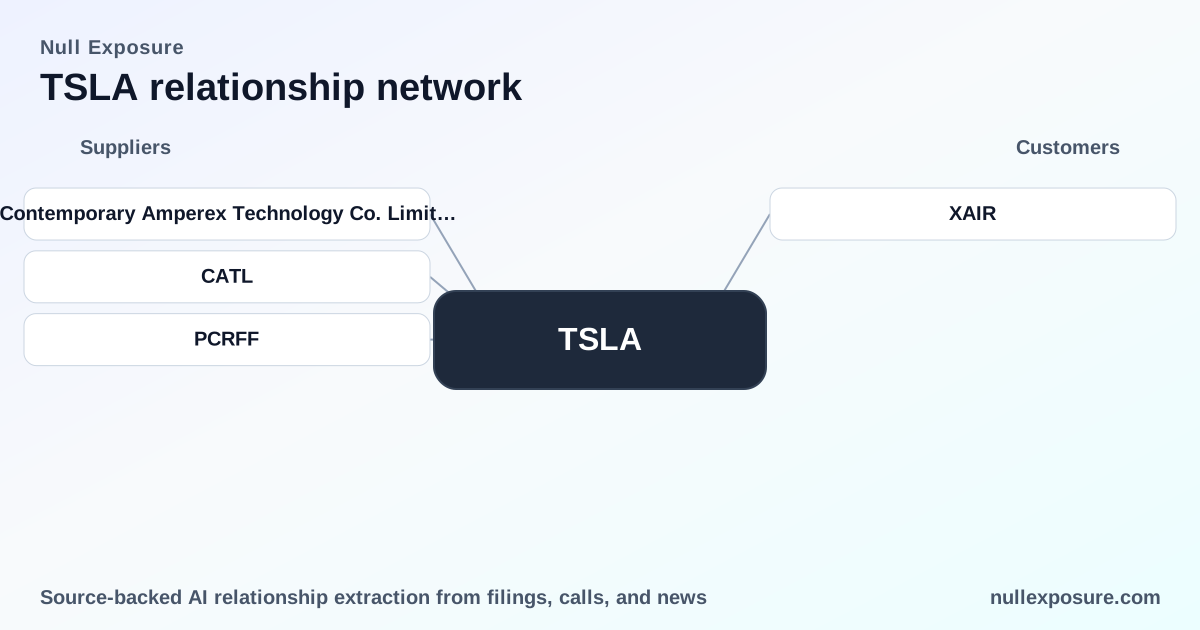
Tesla’s supplier posture: batteries, concentration, and where investor attention should go
Tesla builds and sells electric vehicles and energy products and monetizes through vehicle sales, energy storage and solar product sales, software and services, and regulatory credits. Battery cells are central to Tesla’s product economics and production cadence, and supplier contracts for those cells directly influence margins, delivery volumes and capital allocation decisions. For investors evaluating supplier risk, the core question is not whether Tesla uses external battery suppliers, but how concentrated, contractual and material those relationships are to production and margin outcomes. Explore supplier-level exposures and tools at https://nullexposure.com/ for deeper diligence.
Why supplier relationships drive Tesla’s unit economics
Tesla’s business model converts large-scale battery procurement into competitive range, cost and manufacturing throughput advantages. Battery cell supply determines vehicle production rate, input cost and even product architecture decisions (pack chemistry, format, and thermal management). That creates a direct transmission mechanism from supplier performance to Tesla’s revenue recognition cadence and gross margin profile.
Operationally, Tesla combines long-term supplier commitments, in-house cell engineering and vertical integration at the gigafactory level. Supplier selection therefore functions as both a sourcing decision and a strategic lever: locking in capacity and chemistry for multiple product generations. Investors should treat supplier contracts as operating capital: they constrain growth when tight and protect margin when favorable.
Supplier-by-supplier: what filings and coverage record
Contemporary Amperex Technology Co. Limited (CATL) — 10‑K mention
Tesla’s FY2025 Form 10‑K explicitly lists Contemporary Amperex Technology Co. Limited (CATL) among the external suppliers Tesla relies on for battery cells. This establishes CATL as a recognized source of cells within Tesla’s documented procurement universe (Tesla FY2025 Form 10‑K).
CATL — market reaction and recent press
Market commentary in March 2026 linked CATL’s earnings performance to positive re‑rating in Tesla stock, with coverage noting “Tesla stock rises on strong earnings from battery supplier CATL.” That press coverage underscores how supplier financial results and investor perception of supplier capacity translate into equity moves for Tesla (Longbridge news, March 10, 2026).
Panasonic — 10‑K mention
Tesla’s FY2025 Form 10‑K names Panasonic alongside CATL as a supplier for battery cells, signaling Panasonic’s continued role in Tesla’s cell supply footprint and historical technology partnerships (Tesla FY2025 Form 10‑K; Panasonic referenced in filing).
Operating constraints and what they reveal about Tesla’s sourcing posture
Tesla’s own disclosures identify supplier dependency as a material operational constraint. The filing language—stating dependence on suppliers, including single‑source suppliers, and the risk that suppliers fail to deliver components “in a timely manner at prices, quality levels and volumes acceptable to us”—constitutes a company‑level signal that supplier performance is both critical and material to results (Tesla FY2025 Form 10‑K).
Interpreting that language leads to a set of operational characteristics investors should treat as constraints rather than statistics:
- Contracting posture: Tesla negotiates at scale but accepts single‑source relationships where technology or capacity requirements dictate, which creates asymmetric dependence on key suppliers.
- Concentration: A small number of cell providers (e.g., CATL and Panasonic) implies supply concentration. Concentration elevates exposure to idiosyncratic supplier disruptions and pricing shifts.
- Criticality: Battery cells are mission‑critical inputs; shortages or quality issues translate into direct production throttles and potential warranty or recall costs.
- Maturity and counterpart risk: Suppliers listed are established battery manufacturers, which reduces developmental risk but preserves capacity and geopolitical risk as constraints on ramp speed.
If you want a structured view of supplier criticality and concentration across Tesla’s supply chain, start your analysis at https://nullexposure.com/.
Investment implications: exposures, catalysts and what to monitor
Investors and operators should prioritize a short checklist that links supplier signals to near‑term operational outcomes:
- Capacity versus committed demand. Confirm whether supplier earnings releases or filings show capacity buildouts aligned with Tesla’s announced production targets.
- Pricing trajectory and pass‑through. Battery raw material inflation or deflation transmits into Tesla’s cost of goods sold; monitor supplier margins for signs of pricing pressure.
- Contracting cadence and exclusivity. Look for multi‑year supply agreements, take‑or‑pay clauses, or single‑source provisions that lock Tesla into specific counterparties.
- Geopolitical and logistics exposures. Suppliers headquartered in regions with export controls, tariffs or logistics bottlenecks present concentrated operational risk.
- Vertical integration signals. Tesla’s cell development or in‑house gigafactory expansions change counterparty risk from supply to execution risk on scale‑up.
Key catalyst watchlist: supplier quarterly earnings, Tesla’s procurement disclosures, regulatory filings that disclose single‑source dependencies, and plant ramp commentary from suppliers and Tesla executives.
At the portfolio level, quantify exposure by mapping supplier concentration against production sensitivity; our platform at https://nullexposure.com/ provides tools and signals to operationalize that mapping.
Bottom line and recommended actions
Tesla’s reliance on a handful of major cell suppliers is a structural feature of its operating model and a material risk factor for production and margins. CATL and Panasonic are explicitly named in Tesla’s FY2025 10‑K, and market coverage shows that supplier earnings and capacity signals drive investor reactions in Tesla equity. Investors should treat supplier disclosures as primary risk indicators and prioritize timely monitoring of supplier capacity, contract terms and pricing dynamics.
For disciplined investors and operators, the next steps are clear: build a supplier exposure map, track supplier earnings and filings quarterly, and stress‑test production plans against supplier outage scenarios. Begin that work from the supplier insights hub at https://nullexposure.com/ for direct access to supplier relationship data and monitoring tools.
Action: If you need a focused report linking supplier concentration to production risk scenarios, start your review at https://nullexposure.com/ and construct a supplier stress test tailored to your position.