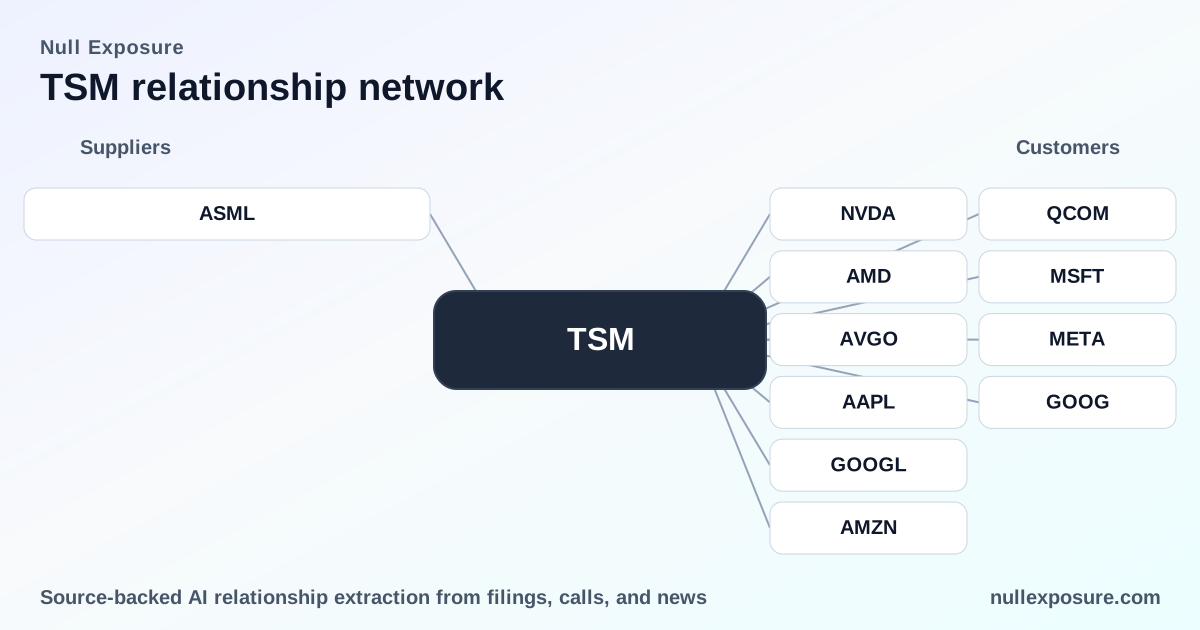
TSMC Supplier Analysis: ASML's Strategic Role and Operational Constraints
Taiwan Semiconductor Manufacturing Company (TSMC) is a pure‑play foundry that monetizes by converting enormous capital expenditure into wafer fabrication services for global fabless customers, charging premium pricing for leadership nodes and specialty processes. The company's economics are driven by scale, technology leadership, and multi‑year capacity commitments, which convert into very high gross and operating margins and predictable free cash flow. For investors and operators assessing supplier risk, the critical question is how TSMC’s dependence on a handful of advanced equipment suppliers, notably ASML, concentrates operational risk while underwriting ongoing technological advantage. Read more company-wide supplier intelligence at Null Exposure.
Why a single equipment supplier reshapes the economics of chipmaking
TSMC’s business model turns capital intensity into competitive advantage. The foundry requires the world’s most advanced lithography systems to produce leading‑edge nodes; those systems are complex, scarce, and supplied by very few vendors. That supplier concentration creates both a high barrier to entry for competitors and a single point of operational dependency for TSMC. Public reporting in 2026 highlights the asymmetric relationship: when TSMC expands capacity—especially for AI chips—its suppliers capture direct upside; conversely, any disruption to those suppliers transmits rapidly to wafer output and industry pricing.
A 247wallst report from February 2026 noted that ASML, the Dutch maker of extreme ultraviolet (EUV) lithography tools, stands to benefit directly from TSMC’s capacity expansion into AI chip production in Japan, underscoring the revenue link between foundry capital plans and equipment orders. According to that article, increased TSMC activity translates into incremental ASML demand (247wallst, Feb 2026).
The documented supplier relationships you should know
ASML — equipment supplier; demand linked to TSMC capacity expansion (FY2026)
A 247wallst article covering TSMC’s expansion of AI chip production to Japan described ASML as the supplier of critical EUV lithography systems and concluded that ASML stands to capture direct demand as TSMC scales production (247wallst, Feb 2026). This linkage is an explicit commercial transmission mechanism: TSMC capex plans become ASML revenue.
ASML — cited as a concentrated supplier risk in investor commentary (FY2026)
A separate investor note from SahmCapital in February 2026 highlighted long‑term geopolitical and concentration risks, calling out TSMC’s reliance on a limited number of advanced equipment suppliers such as ASML as a structural vulnerability to both supply disruption and pricing pressure (SahmCapital, Feb 2026). The piece frames ASML not only as a beneficiary of demand but as a critical dependency for node leadership.
Company-level operating characteristics that shape supplier risk
There are no formal supplier constraints captured in the constraints feed for TSMC; nonetheless, public evidence and market behavior reveal clear operating‑model characteristics that investors must internalize:
- Contracting posture — capital‑intensive, long‑lead procurement. TSMC executes extended equipment purchase cycles with OEMs, locking in multi‑year production capacity and delivery schedules that require forecast accuracy and financial commitment.
- Concentration — a small number of suppliers for mission‑critical tools. The EUV supply chain is effectively oligopolistic, creating vendor power for tool makers and concentrated counterparty exposure for TSMC.
- Criticality — single‑source dependency for advanced nodes. ASML’s EUV systems are not fungible; their availability directly controls TSMC’s ability to produce leading‑edge wafers.
- Maturity — a cash‑generative, defensive franchise with cyclical demand. TSMC’s margins and returns on capital are classically high for a market leader, but cyclical semiconductor demand and geopolitical shocks create episodic volatility.
These company‑level signals explain why equipment relationships are not just supplier line items but core strategic levers for TSMC’s economics.
Read deeper supplier intelligence and scenario analysis at Null Exposure.
What this means for investors and operators
TSMC’s financials validate the commercial strength that flows from its supplier relationships: very high gross and operating margins (gross profit and operating margin metrics are among the highest in the industry) and substantial free cash generation that funds both dividends and relentless capex. TSMC’s market capitalization and scale provide negotiating leverage, but the technical uniqueness of suppliers like ASML constrains that leverage in practice.
Key investment implications:
- Upside capture for equipment vendors is direct and material. When TSMC expands capacity—particularly for AI workloads—ASML benefits in the near term through additional tool orders.
- Operational risk is concentrated and time‑sensitive. Delays or restrictions affecting ASML’s tool shipments translate into wafer shortfalls that cannot be remedied quickly by alternate suppliers.
- Valuation and risk premium should reflect supplier concentration. TSMC’s premium multiples and target prices account for technology leadership, but investors must price geopolitical and supplier‑availability risk into long‑dated scenarios.
TSMC’s five‑year macro posture is visible in its public metrics: substantial revenue and profitability, and continued analyst conviction—consensus targets and buy ratings indicate the market values node leadership even as supplier concentration persists. For active portfolio managers or corporate procurement teams, the ASML–TSMC linkage is a first‑order risk to model.
Practical takeaways and next steps
- Operational teams should incorporate lead‑time and contingency planning tied to ASML deliveries into capacity forecasts.
- Investors should treat TSMC’s supplier concentration as a scenario driver for both upside (accelerated node adoption) and downside (supply disruption).
- Risk managers should map counterparty exposures to ASML and related equipment flows across production sites, including cross‑jurisdictional capacity shifts (for example, Japan expansions referenced in 2026 coverage).
For a consolidated supplier risk dashboard and evidence‑based briefs, visit Null Exposure.
Final assessment
ASML is simultaneously a growth beneficiary and a systemic dependency for TSMC. Public reporting in 2026 confirms that ASML’s EUV systems are the bottleneck through which TSMC’s most valuable production flows. Investors should price both the revenue transmission to ASML and the concentrated operational risk back into TSMC’s valuation models. Operators should prioritize contractual clarity, delivery guarantees, and contingency capacity as part of capital‑planning governance.