Tyson Foods (TSN): Supplier and capital-market relationships that shape execution risk
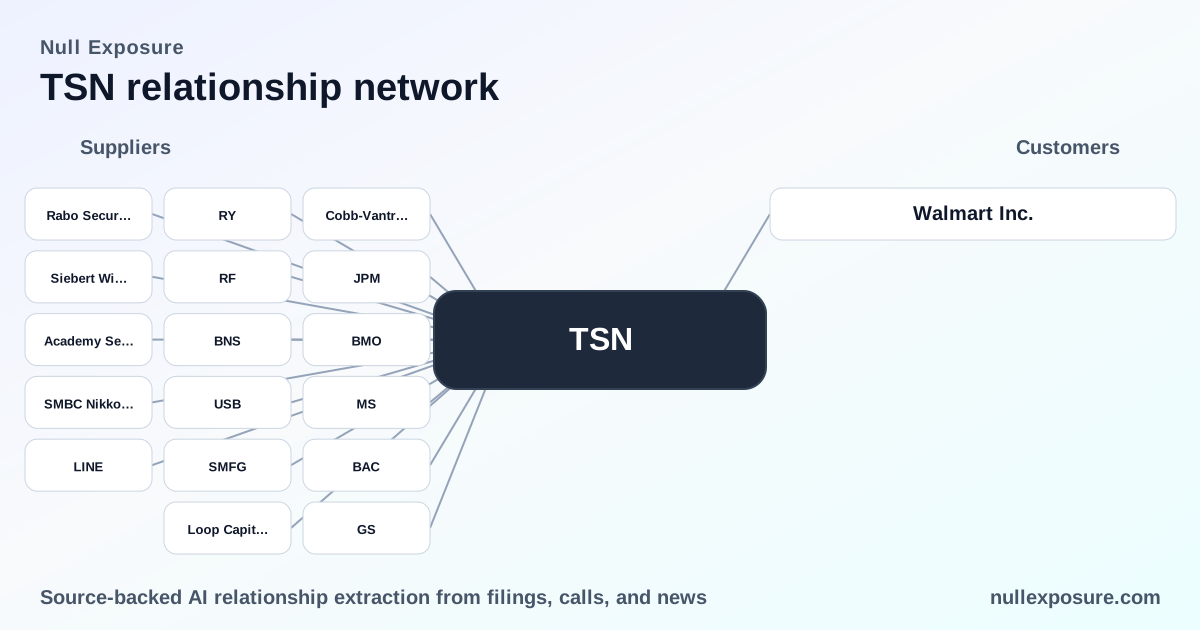
Tyson Foods operates as an integrated protein supplier that both buys and raises livestock inputs through subsidiaries and programs, and monetizes through branded and commodity protein sales across retail, foodservice and international channels. Revenue flows are underpinned by large, multiyear purchase commitments for commodities and long-term service agreements on logistics, while capital markets relationships provide access to debt financing through syndicates of global banks. Investors evaluating supplier risk should focus on contract tenor, counterparty mix and the firm’s dual role as buyer and payment facilitator for livestock suppliers. For an expanded supplier map and transaction history, see https://nullexposure.com/.
What to watch in one sentence
Tyson combines short-cycle operational payables with meaningful long-term purchase obligations and structured cash-flow assistance for suppliers; that combination creates both working-capital leverage and locked-in commodity exposure that drive margin sensitivity.
Where the relationships live — underwriters, co-managers and trading partners
Below I document every supplier- and financing-related relationship reported in the recent references and give a plain-English take on each.
Cobb‑Vantress
Cobb‑Vantress is a wholly‑owned Tyson subsidiary and a leading global supplier of poultry breeding stock, giving Tyson internal control over genetic inputs that support its poultry business. This is disclosed in Tyson’s FY2025 10‑K (filed September 2025). (Source: Tyson FY2025 10‑K, filed Sep 27, 2025)
J.P. Morgan Securities LLC
J.P. Morgan served as a joint book‑running manager on Tyson’s senior notes offering, providing underwriting and distribution for debt issuance in early 2026. (Source: press release on GlobeNewswire, Feb 10, 2026; related coverage Feb 11, 2026)
BMO Capital Markets Corp.
BMO Capital Markets is listed as a co‑manager on the senior notes offering, indicating participation in syndicate distribution and secondary liquidity for the deal. (Source: GlobeNewswire press release, Feb 10, 2026)
Morgan Stanley & Co. LLC
Morgan Stanley acted as a joint book‑running manager on the senior notes, supporting placement among institutional fixed‑income investors. (Source: SahmCapital coverage and GlobeNewswire, Feb 10–11, 2026)
BofA Securities, Inc.
BofA Securities is a joint book‑runner on Tyson’s senior notes, handling pricing and primary distribution responsibilities for the transaction. (Source: GlobeNewswire and SahmCapital, Feb 2026)
RBC Capital Markets, LLC
RBC is in the joint book‑running group for Tyson’s debt offering, contributing capital markets distribution capabilities. (Source: GlobeNewswire and SahmCapital, Feb 2026)
Goldman Sachs & Co. LLC
Goldman Sachs appears as a joint book‑running manager on the senior notes, consistent with large‑cap issuance syndicates. (Source: GlobeNewswire and SahmCapital, Feb 2026)
Scotia Capital (USA) Inc.
Scotia Capital joined the underwriting syndicate as a book‑runner, broadening distribution reach across North American credit desks. (Source: GlobeNewswire and SahmCapital, Feb 2026)
Rabo Securities USA, Inc.
Rabo Securities is listed among joint book‑running managers on the senior notes offering, representing specialized coverage of agricultural and commodity-related corporate credit. (Source: GlobeNewswire, Feb 10, 2026)
Regions Securities LLC
Regions acted as a co‑manager on the offering, a role consistent with regional bank distribution into fixed‑income investor networks. (Source: GlobeNewswire, Feb 10, 2026)
Academy Securities, Inc.
Academy Securities is named among co‑managers for portions of the offering, reflecting the expanded syndicate used to place the senior notes. (Source: GlobeNewswire, Feb 10, 2026)
Loop Capital Markets LLC
Loop Capital served as a co‑manager on portions of the notes offering, assisting placement across municipal and institutional channels where relevant. (Source: GlobeNewswire, Feb 10, 2026)
Siebert Williams Shank & Co., LLC
Siebert Williams Shank is listed among co‑managers for the transaction, supporting distribution into specialist investor segments. (Source: GlobeNewswire, Feb 10, 2026)
U.S. Bancorp Investments, Inc.
U.S. Bancorp Investments is identified as a senior co‑manager on the offering, a role that typically includes active book management and allocation responsibilities. (Source: SahmCapital coverage, Feb 11, 2026)
SMBC Nikko Securities America, Inc.
SMBC Nikko acted as a senior co‑manager in the deal, providing Asian and global fixed‑income client access for the offering. (Source: GlobeNewswire and SahmCapital, Feb 2026)
Lineage, Inc.
Lineage initiated a greenfield cold‑storage build under an arrangement with Tyson in Dallas and expanded a facility in the Netherlands, reflecting Tyson’s outsourcing of cold‑storage capacity to third‑party logistics specialists. (Source: Lineage SEC filing reported on TradingView, March 2026)
What the contract signals tell investors
Tyson’s public filings and offering disclosures reveal a mixed contractual profile that has direct implications for liquidity, margin volatility and supplier concentration.
- Tyson reports long‑term purchase commitments for grains, livestock contracts and long‑term cold‑storage service agreements, which are enforceable and specify quantities, prices or timing — a structural constraint that locks the company into input exposure over multiple years. (Source: Tyson FY2025 10‑K, Sep 27, 2025)
- Payment terms across certain supplier programs run up to 120 days, establishing a significant working‑capital window where trade payables and receivables cadence influences short‑term liquidity. (Source: Tyson FY2025 10‑K, Sep 27, 2025)
- Tyson functions both as a buyer of commodities and as a seller of cash‑flow assistance to livestock suppliers, creating receivable-backed exposures where Tyson advances funds that are later repaid or netted against market settlements. (Source: Tyson FY2025 10‑K, Sep 27, 2025)
- The company disclosed a potential maximum obligation of approximately $240 million related to cash‑flow assistance programs as of September 27, 2025, which places supplier finance risk inside the company’s balance‑sheet envelope. (Source: Tyson FY2025 10‑K, Sep 27, 2025)
Taken together, these are not isolated metrics; they describe an operating model with material contract maturity (multi‑year purchase commitments), mixed counterparty roles (buyer and lender), and mid‑hundreds‑of‑millions contingent exposures that move with commodity cycles and working capital execution.
Mid‑article note: for a full supplier and financing relationship map, visit https://nullexposure.com/.
Investment implications and headline risks
- Margin sensitivity to commodity prices is structural because of long‑term purchase commitments and livestock programs that create lagged cost recognition. Earnings volatility will track throughput and input price swings.
- Liquidity and refinancing risk is mitigated by deep banking relationships—the breadth of joint book‑runners and co‑managers on the senior notes offering indicates strong market access for debt issuance; primary distribution included global banks (J.P. Morgan, Goldman, Morgan Stanley, BofA) and regional/co‑manager partners. (Sources: GlobeNewswire & SahmCapital, Feb 2026)
- Operational concentration risks exist in logistics; Tyson is actively transacting third‑party cold storage arrangements (for example, with Lineage) and sold certain Tyson‑owned storage facilities while entering long‑term service agreements, shifting capital expenditure to OPEX and introducing counterparty service risk. (Sources: Tyson FY2025 10‑K and Lineage filing via TradingView, FY2026)
Final take and what investors should do next
Tyson’s supplier posture is hybrid: it locks in volumes and prices over long horizons while carrying working‑capital and supplier‑finance exposures that are prone to commodity cycles. The company’s access to a wide underwriter syndicate reduces refinancing risk for near‑term funding, but operating execution—grain and livestock procurement, cold‑storage outsourcing, and receivables management—remains the core vector for margin and liquidity outcomes.
For deeper counterparty lists and to model supplier concentration effects on cash flow, start your analysis at https://nullexposure.com/. Investors and operators who need tailored exposure analysis and relationship maps should evaluate supplier contract tenors and the $240 million referenced program liability as part of any valuation or covenant stress test.
Keep monitoring filings and transaction press releases; these relationships update capital structure and execution risk in real time. For the full supplier relationship index, visit https://nullexposure.com/.