TSRS: Supplier Map and What It Means for Investors
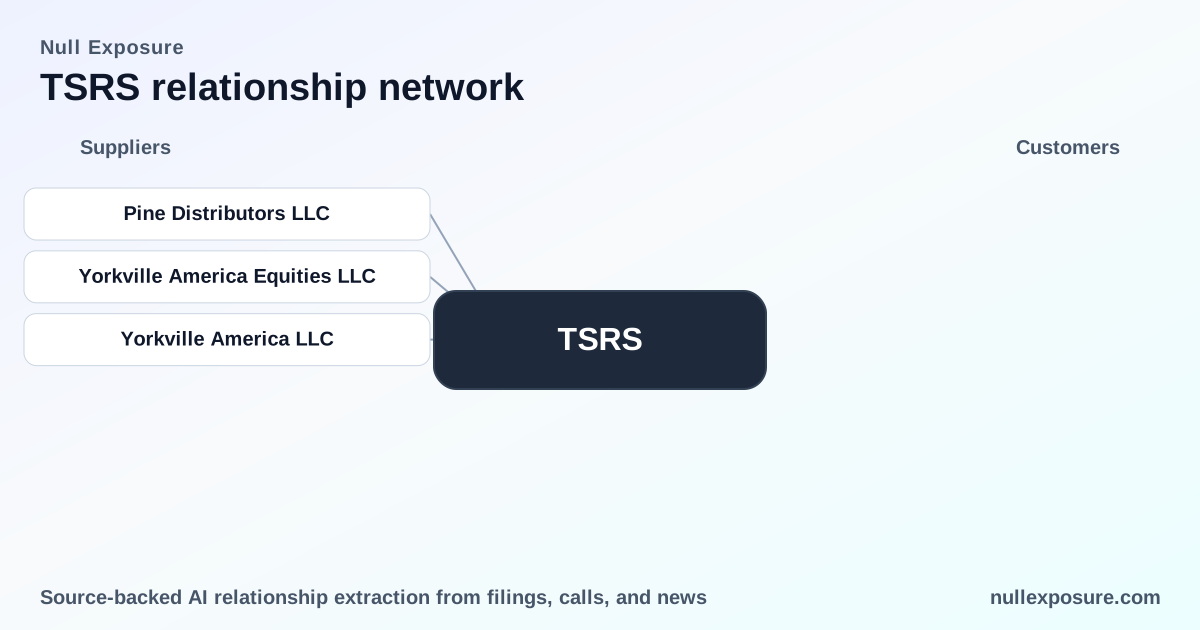
TSRS operates as a capital-markets vehicle that issues securities through a small, connected supplier base: an issuer entity, an advisor, and a distributor. The company monetizes through capital issuance and ongoing advisory/placement fees, with execution concentrated across a few counterparties that handle issuance, distribution, and advisory functions. For investors evaluating counterparty risk and operational resilience, the supplier footprint is compact and highly centralized — a structural feature that drives both cost efficiency and concentration risk.
For more detailed supplier intelligence and monitoring, visit https://nullexposure.com/.
The supplier picture in plain English
The public reporting around TSRS in FY2026 identifies three named counterparties that together support issuance and market placement. These relationships reflect a classic sponsor-advisor-distributor arrangement: one entity issues shares, another provides primary advisory services, and a third handles distribution. That configuration underpins the vehicle’s go-to-market model and explains how TSRS converts underlying exposures into tradable securities and fee income.
Relationship rundown: the three counterparties you must know
- Pine Distributors LLC — Distributor. Pine Distributors LLC is listed as the distributor responsible for placing TSRS securities in the market, which positions it as the commercial gateway to investors and the channel for primary market liquidity. According to TradingView’s AMEX-TSRS page (FY2026 reporting), Pine Distributors LLC is identified explicitly as “Distributor Pine Distributors LLC” (noted March 10, 2026).
- Yorkville America Equities LLC — Primary advisor. Yorkville America Equities LLC is cited as the primary advisor, which implies responsibility for structuring, pricing advice, and ongoing portfolio oversight tied to TSRS’s issued shares. TradingView’s AMEX-TSRS entry (FY2026) records this relationship as “Primary advisor Yorkville America Equities LLC” (March 10, 2026).
- Yorkville America LLC — Issuer of shares. TSRS shares are issued by Yorkville America LLC, making that entity the formal originator of the securities and the legal counterparty on issuance documentation. TradingView’s AMEX-TSRS page (FY2026) states “TSRS shares are issued by Yorkville America LLC” (March 10, 2026).
What these three relationships collectively reveal
The supplier set reflects an integrated, sponsor-led issuance model rather than a broad, broker-dealer network. Yorkville functions as both issuer and advisor through related entities, while a third-party distributor executes placements. This structure delivers several investment-relevant consequences:
- Concentration of control: Issuance and advisory responsibilities are concentrated with Yorkville-affiliated entities, creating a single point of governance for product design, risk decisions, and contractual terms.
- Distribution dependency: Market access and primary liquidity flow through a small distributor network; performance of Pine Distributors LLC directly affects initial placement and retail/institutional uptake.
- Fee capture path: Revenue accrues via issuance-related fees and advisory mandates rather than via a wide-selling broker pool, implying predictable fee flows but higher counterparty exposure.
For ongoing monitoring and deeper supplier analysis, see https://nullexposure.com/.
Operational posture, maturity, and risk signals
From a contracting and operational standpoint, TSRS exhibits centralized contracting, high counterparty concentration, and a supplier footprint consistent with a mature boutique issuance platform rather than a diversified bank-led underwriting syndicate. These are company-level signals derived from the supplier map:
- Contracting posture: Legal and commercial arrangements are likely centralized with the issuer-advisor relationship at the center, enabling swift decision-making and tight alignment between product economics and distribution strategy.
- Concentration risk: A small number of counterparties increases operational and reputational vulnerability; a single advisor or distributor dispute or failure would have an outsized impact on issuance cadence and investor access.
- Criticality of counterparties: Each named supplier performs a mission-critical role — issuance, advisory, and distribution — that leaves limited redundancy in the event of counterparty stress.
- Maturity indicators: The use of distinct affiliated entities for issuing and advisory functions suggests an established go-to-market playbook typical of specialty issuers and asset-management sponsors rather than an ad-hoc capital-raising arrangement.
Key risk takeaway: The business model’s efficiency comes at the price of concentrated counterparty exposure; investors should treat supplier due diligence as material to valuation and liquidity assessments.
How this should shape investor diligence
Given the supplier profile, investors and operators evaluating TSRS should prioritize the following checks:
- Counterparty credit and operational health of the issuer/advisor combined, including legal structure, capitalization, and regulatory standing.
- Distribution capacity and relationships of Pine Distributors LLC, since primary placement quality affects secondary-market liquidity and initial pricing.
- Contractual termination rights, fee waterfalls, and escalation mechanisms between issuer, advisor, and distributor to assess continuity risk.
These items are not theoretical — they flow directly from the supplier roles documented in FY2026 reporting and should inform covenants, monitoring thresholds, and scenario analysis in underwriting or portfolio construction.
Closing assessment and next steps
TSRS runs a lean, sponsor-centric issuance model where Yorkville-affiliated entities control issuance and advisory functions and a named distributor executes market placements. That design supports predictable fee capture and tight execution, while simultaneously creating single-point-of-failure risks that investors must price and monitor.
For investors who require ongoing supplier surveillance or bespoke counterparty analysis, start with a focused review of contractual arrangements and counterparties named in disclosure. Explore further supplier intelligence and continuous monitoring at https://nullexposure.com/.
Bold final takeaway: TSRS’s concentrated supplier map is a material driver of both its cost efficiency and its counterparty risk profile — evaluate the issuer/advisor and distributor relationships as first-order risks when valuing or underwriting TSRS exposure.