Trane Technologies (TT): supplier posture, strategic partners, and what investors should price in
Trane Technologies builds and sells commercial and residential HVAC equipment and related aftermarket services, monetizing through equipment sales, recurring parts & service contracts, and controls/efficiency upgrades. The company's global manufacturing footprint and service network convert installed units into long-duration revenue streams, while product upgrades and technology collaborations aim to sustain pricing power and margin expansion.
For a deeper supplier-risk profile and partner tracking, visit https://nullexposure.com/ for structured coverage and alerts.
Business model in plain language: where the cash comes from and why suppliers matter
Trane is a large diversified industrial in building products: market capitalization roughly $93.5 billion and trailing twelve‑month revenue of about $21.3 billion. Profitability is healthy for the sector with an operating margin near 15.5% and a profit margin of 13.7%, reflecting both scale in OEM manufacturing and profitable aftermarket service economics. The company leverages its installed base to generate recurring revenues from maintenance, retrofits, and controls, which also makes supplier continuity and component innovation critical to product performance and customer retention.
Suppliers supply critical components for high‑value capital equipment and ongoing service parts, so procurement dynamics directly influence gross margins, lead times, and the pace of new‑product introductions.
Supplier posture: short-term contracts, global sourcing, big-ticket spend
A review of company disclosures and supplier excerpts indicates clear procurement characteristics that shape operational risk:
- Contracting posture is short-term: the firm reported purchase obligations of $1,245.1 million at December 31, 2025, primarily payable within 12 months, signaling a cycle of near‑term commitments rather than long locked‑in supply contracts. This structure gives Trane flexibility to renegotiate or re-source but increases sensitivity to commodity price swings and near‑term market disruptions.
- Sourcing is global: the principal commodities are purchased from multiple independent sources “around the world, primarily within the region where the products are manufactured,” creating geographic diversification but exposure to logistics and regional supply shocks.
- Role is buyer with extended payment terms: Trane operates supplier programs with payment terms generally up to 120 days, indicating buyer leverage in working capital management and supplier financing dynamics.
- Procurement is material: purchase obligations over $1.2 billion imply a spend band well above $100 million, so single‑sourcing decisions, supplier failures, or component shortages would have material operational and financial impacts.
Together, these signals indicate a procurement model that balances negotiating leverage and flexibility against exposure to short‑term input cost volatility—an important lens for investors modeling margin sensitivity.
What’s new on the partner front: Garrett Motion and compressor integration
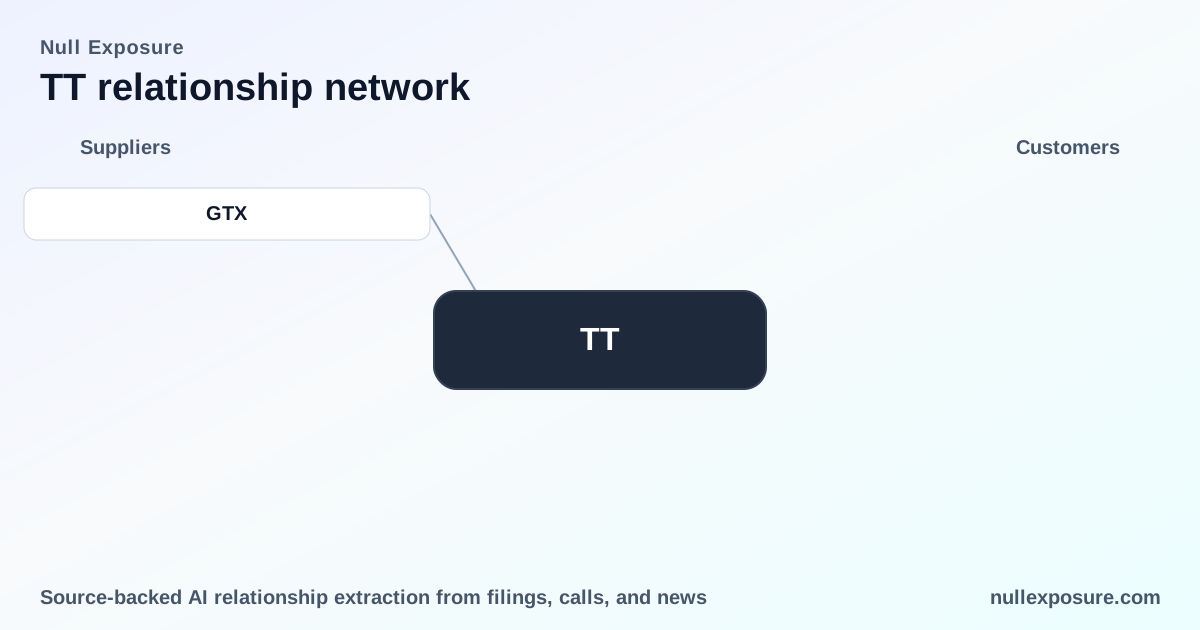
Trane’s product road map emphasizes efficiency and decarbonization; compressor technology is a core differentiator for chillers and rooftop units. Recent press indicates a strategic collaboration with Garrett Motion to integrate Garrett’s next‑generation oil‑free, high‑speed centrifugal compressors into Trane commercial HVAC portfolios, a development that could shift equipment performance characteristics and aftermarket service requirements.
A mid‑cycle technology partner like Garrett expands Trane’s supplier mix in ways that could improve unit economics (higher efficiency, lower maintenance), but also creates implementation and qualification risk during ramp.
Reported supplier relationships (complete coverage)
- Garrett Motion Inc. — According to a Q4 2025 earnings‑call transcript published on InsiderMonkey, Trane launched a strategic collaboration to integrate Garrett’s next‑generation oil‑free, high‑speed centrifugal compressors into Trane’s commercial HVAC applications, with extensive testing in Trane labs confirming performance benefits relative to incumbent solutions (InsiderMonkey, Q4 2025 earnings call transcript, published Mar 10, 2026).
- Garrett Motion Inc. — A PrimaryIgnition report dated February 6, 2026 described the core of the alliance as integrating Garrett’s oil‑free centrifugal compressor technology into Trane’s HVAC systems, emphasizing a move by Garrett beyond automotive markets into industrial HVAC (PrimaryIgnition, Feb 6, 2026).
Both entries document the same counterparty collaboration from different reporting angles—one a company transcript citation and the other a focused news narrative—underscoring the strategic nature of the engagement.
Why the Garrett tie matters to investors
The Garrett collaboration is strategically relevant for three reasons: (1) product differentiation—oil‑free compressors can reduce lifecycle maintenance and improve efficiency; (2) supply diversity—adding a technology supplier outside traditional HVAC OEMs reduces single‑vendor dependence for key subsystems; and (3) execution risk—new integrations require manufacturing qualification, service training, and supply assurance. Market upside comes if the technology improves unit economics and accelerates retrofit demand; downside arrives if qualification delays or supplier capacity constraints slow commercialization.
Operational constraints and how they influence valuation and risk
From a corporate perspective, the procurement profile—short‑term purchase obligations, global supplier base, buyer payment leverage, and material spend—translates into four valuation and operational inputs investors should model explicitly:
- Margin sensitivity: short‑term contracting increases exposure to raw‑material and freight cost swings; model a higher margin volatility assumption versus peers with longer‑term supply contracts.
- Supply continuity risk: global sourcing reduces single‑country risk but increases exposure to geopolitical and logistical disruptions—include scenario stress tests for lead‑time increases.
- Working capital efficiency: longer supplier payment windows support free cash flow but can conceal supplier liquidity stress; monitor supplier financing programs and receivable sales that affect vendor stability.
- Technology transition execution: strategic supplier integrations (like Garrett) are revenue‑growth levers that require capex and R&D support—adjust product‑mix assumptions and the timing of service revenue inflection accordingly.
Bottom line and investor action
Trane is a market leader in HVAC with scale, healthy margins, and a clear path to upgrade installed‑base economics through technology partnerships. Supplier dynamics are a central risk/return axis: short-term contracts and large, global spend make procurement agility a competitive advantage but create measurable margin and supply chain volatility.
For ongoing monitoring and supplier‑relationship intelligence, check coverage and alerts at https://nullexposure.com/. If you are modeling TT, incorporate sensitivity to supplier cost swings and ramp timing for new compressor integrations.
For an institutional view of supplier exposures and event monitoring linked to Trane Technologies, visit https://nullexposure.com/ to subscribe to supplier signals and relationship reports.