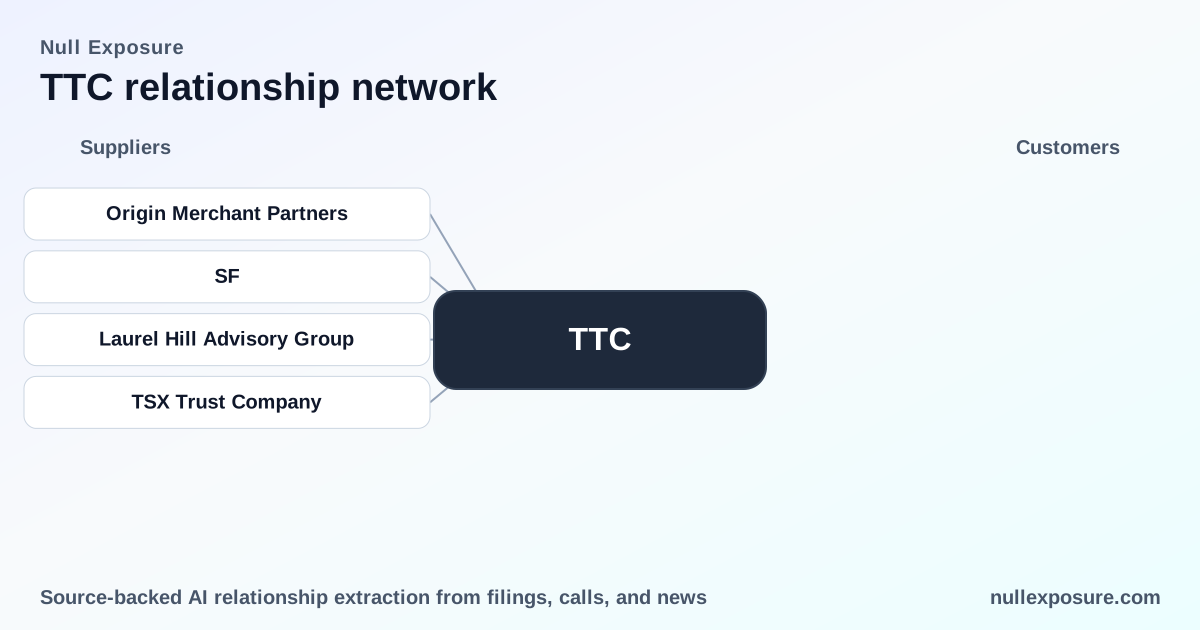
The Toro Company (TTC) — Supplier Relationships and Strategic Implications
Toro designs, manufactures and markets professional and residential outdoor equipment and monetizes through product sales, replacement parts, and aftermarket services worldwide. Its operating model depends on a global network of commodities and component suppliers, select third‑party manufacturers and service providers, and transactional counterparties when executing strategic deals; these supplier relationships directly influence cost structure, aftermarket availability, and execution risk for growth or M&A activity. For investors evaluating counterparty exposure and operational resilience, the supplier and advisor relationships detailed below reveal a diversified sourcing footprint, routine use of specialist service providers, and transactional counterparties engaged during a 2026 arrangement. Explore supplier-focused intelligence at https://nullexposure.com/.
Quick financial context for a supplier evaluation
Toro is a mid‑to‑large industrial with roughly $4.55 billion in trailing revenue and $9.26 billion market capitalization, operating margins near 9.8% and a return on equity of 23% (latest reported TTM). Those metrics underpin the company’s ability to fund supplier commitments and absorb commodity cost cycles, but they also underscore the importance of managing input cost volatility and third‑party execution across global sourcing channels.
What the recent press activity is telling investors
The relationships surfaced in public filings and press releases all relate to activity around a proposed plan of arrangement in FY2026; the counterparties acting in advisory, depositor, and proxy capacities illuminate the type of external vendors Toro engages for transactions and shareholder processes. Below I cover every relationship returned in the supplier search with concise takeaways.
Origin Merchant Partners — fairness opinion provider
Origin Merchant Partners provided one of the fairness opinions reviewed by the Special Committee and the Board in connection with the proposed arrangement announced in FY2026, serving as a transaction valuation adviser. According to the Tornado press release dated March 10, 2026, Origin’s opinion was delivered alongside that of Stifel. Source: press release on DelmarvaNow (March 10, 2026).
Stifel Nicolaus Canada Inc. — fairness opinion provider
Stifel Nicolaus Canada acted as a fairness adviser and delivered a fairness opinion to the Special Committee and Board for the same FY2026 arrangement, signaling Toro’s use of established investment banking partners for deal validation. The role is documented in the March 10, 2026 press release on DelmarvaNow referencing both advisers. Source: press release on DelmarvaNow (March 10, 2026).
Laurel Hill Advisory Group — proxy and voting services
Laurel Hill Advisory Group was listed as a contact for voting assistance and proxy support related to the arrangement, indicating Toro’s reliance on proxy solicitors to handle shareholder communications and vote aggregation for transactional approvals. The contact details and voting instructions are included in the March 10, 2026 press release. Source: press release on DelmarvaNow (March 10, 2026).
TSX Trust Company — depositary and shareholder inquiry handler (entry 1)
TSX Trust Company is acting as depositary for the arrangement and is the point of contact for depositary shareholders with questions about submitting securities in connection with the transaction; this role underscores the cross‑border execution elements when Canadian securities are involved in a U.S. acquirer transaction. Source: press release on GreenvilleOnline referencing the arrangement announcement (March 10, 2026).
TSX Trust Company — transactional processing and proxy facilitation (entry 2)
A separate notice in the FY2026 filings lists TSX Trust Company as the recipient of completed proxy forms and as a facilitator for facsimile returns, demonstrating the administrative functions TSX Trust executes across proxy deposits and recordkeeping for the deal. Source: press release on DelmarvaNow (March 10, 2026).
Operational supplier signals investors should weigh
The relationship results are transaction‑focused vendors, but the company‑level supplier constraints and excerpts provide broader operational signals:
- Global sourcing and commodity exposure are material. Toro purchases steel, aluminum, petroleum‑based resins, linerboard, copper, rubber, engines, transmissions, hydraulics and electrification components from multiple suppliers around the world, which makes commodity price dynamics and logistics risk central to gross‑margin management.
- Hybrid manufacturing posture. Toro uses both in‑house production and third‑party manufacturers to produce certain end products, a structure that reduces fixed capital intensity but increases vendor management and quality oversight requirements.
- Specialist service providers are standard. The company uses third‑party financing partners to provide customer financing and engages cybersecurity firms for penetration testing, indicating routine outsourcing of specialized capabilities rather than internal development.
- Spend scale is significant but managed. Public disclosures show approximately $6.9 million of noncancelable purchase commitments as of October 31, 2025, placing certain supplier engagements in a spend band consistent with mid‑contract commitments rather than large, single‑supplier lock‑in.
These signals together describe an operating model that is diversified, commercially mature, and dependent on specialized external partners for both production and transactional execution; investors should treat supplier relationships as operational levers rather than binary single‑point risks.
Key risk and concentration observations
- Commodity sensitivity is a primary margin risk. Given the mix of metal, polymer, and engine inputs, input price shocks will flow to margins unless offset by pricing pass‑through or productivity gains.
- Outsourced manufacturing and services increase counterparty operational risk. Third‑party production and financing partners expand the vendor footprint that requires active governance and contingency planning.
- Transaction counterparties reveal governance discipline. The use of recognized financial advisers and depositary agents for FY2026 transaction activity shows a conventional approach to market and shareholder processes, reducing execution risk for corporate actions.
Explore how supplier fingerprints affect portfolio companies at https://nullexposure.com/.
What investors should do next
- Validate commodity exposure hedging and pass‑through mechanisms in the latest filings and analyst calls.
- Confirm the geographic dispersion and concentration of key component suppliers for engines, hydraulics and electrification parts.
- Review vendor agreements for critical outsourced manufacturing lines and financing partners to assess operational continuity risk.
For deeper supplier intelligence and to map counterparty concentration across your holdings, visit https://nullexposure.com/.
Bottom line
Toro operates with a diversified global supplier base, routine use of third‑party manufacturers and specialist service providers, and transactional counterparties engaged for corporate actions—a profile that supports scalable growth but requires active vendor governance and commodity risk management. The FY2026 transaction disclosures highlighted here are a useful lens into the types of external partners Toro contracts with for both strategic and administrative functions.