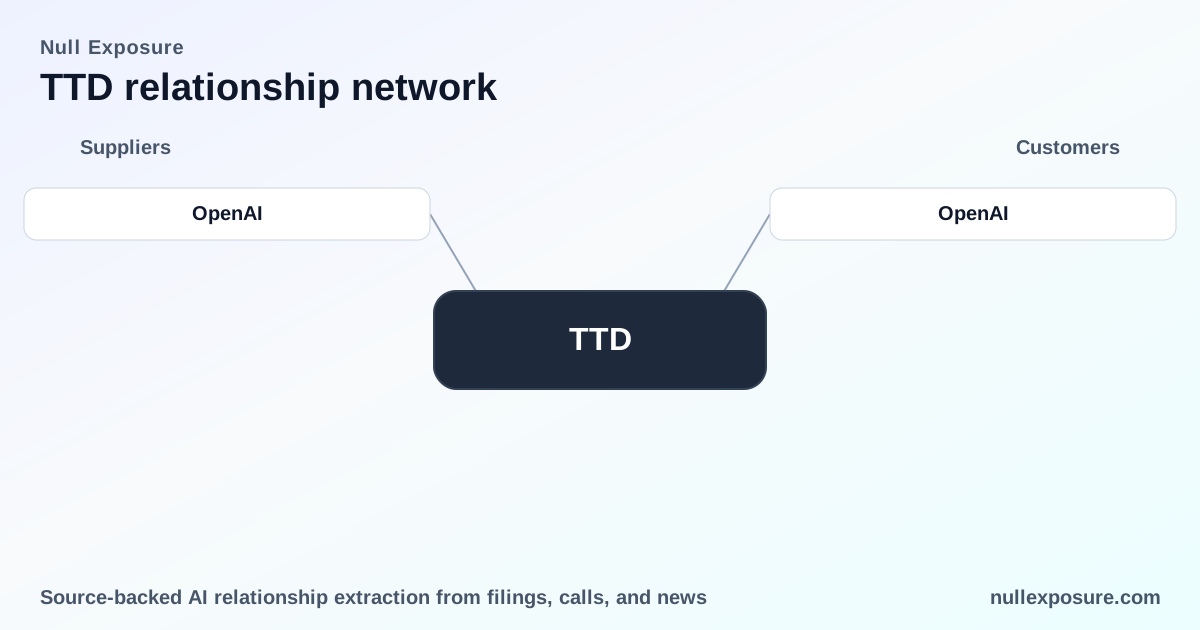
Trade Desk (TTD) — supplier relationships and what they mean for investors
Trade Desk operates a cloud-based advertising buying platform that monetizes by selling software and data-driven media-buying tools to advertisers and agencies, taking platform fees on ad spend and value-added services. With $2.896B revenue TTM and a $12.9B market capitalization, the company combines scale, high gross margins, and platform-led pricing power to maintain negotiating leverage with media suppliers and technology partners. For investors evaluating counterparty risk and supplier strategies, the OpenAI relationship is the single material new public supplier interaction documented in recent open sources; understanding its economics and the company’s supplier posture is essential. Learn more about our research and supplier intelligence at https://nullexposure.com/.
Quick read: the headline on the OpenAI tie-up
A March 2026 news report captured market attention: Trade Desk announced a partnership to sell ads on ChatGPT, triggering a share-price spike as investors priced potential new revenue streams into the platform business. The reported arrangement positions Trade Desk as a commercial sales channel for conversational ad inventory associated with OpenAI’s ChatGPT product line. According to the Bitget news post dated March 10, 2026, that development drove investor optimism and higher trading activity.
Known supplier relationships — one public tie to OpenAI
OpenAI — ChatGPT ad sales partnership (FY2026)
Trade Desk has entered a commercial partnership with OpenAI to sell ads on ChatGPT, which positions Trade Desk as an ad sales conduit for conversational inventory and potentially expands its addressable ad formats beyond traditional display, video, and connected-TV. The market reaction to the announcement in FY2026 was immediate and positive, reflecting investor expectations for incremental revenue. Source: Bitget news post, March 10, 2026.
How supplier relationships fit into Trade Desk’s operating model
Trade Desk is a software-first platform with high gross margins (about $2.277B gross profit TTM) and platform economics that favor scale. From a supplier-management perspective this produces several structural characteristics:
- Contracting posture: Trade Desk operates with the bargaining leverage of a large demand-side platform—buyers rely on its marketplace for reach and measurement—so the company can secure favorable commercial terms with many technology and inventory providers. However, new supply channels such as conversational inventory require contract and product integration work that shifts costs to product and engineering teams.
- Concentration and criticality: Trade Desk is not generally dependent on a single inventory supplier for core revenue, but new partnerships that unlock materially different ad formats (e.g., conversational AI) become strategically critical to growth stories and investor sentiment. The OpenAI tie-up is an example where a single supplier relationship can disproportionately influence perception of future revenue optionality.
- Maturity of supplier relationships: Many of Trade Desk’s supplier interactions are mature program relationships with exchanges, publishers, and SSPs; relationships with emerging platform providers (like OpenAI) are earlier-stage commercial deals that require new integration and go-to-market coordination.
- Security and third-party services: Company disclosures reference the use of third-party service providers for cybersecurity monitoring and penetration testing, and regulatory-required auditor consents are on file, signaling an organized approach to vendor risk management and compliance.
These signals combine to show a company that manages a diversified set of supplier relationships while selectively forming high-impact strategic partnerships to expand ad inventory and modalities.
What the OpenAI partnership implies for revenue and risk
The OpenAI partnership is a growth vector with clear upside and manageable operational risks:
- Upside: Access to conversational ad placements can expand the firm’s addressable market and allow advertisers to buy new contextual formats through familiar Trade Desk interfaces and reporting. Investors priced this optionality into forward expectations following the FY2026 announcement.
- Integration risk: Conversational inventory requires product, measurement, and privacy workstreams; Trade Desk’s existing engineering scale and margins reduce execution risk but do not eliminate it. The company’s use of third-party cybersecurity providers reduces operational exposure when integrating with new platforms.
- Concentration risk: If the commercial economics for conversational inventory prove superior and revenue scales quickly, dependence on a small number of large platform partners could increase counterparty concentration — a strategic tradeoff that investors should monitor.
Supplier constraints and company-level signals
Trade Desk’s public disclosures and evidence excerpts reveal a consistent vendor governance posture. The company document set references reliance on third-party service providers for cybersecurity monitoring and penetration testing and includes standard auditor consent language in filings. These items indicate:
- Controlled vendor risk practices — contractually managed third-party security controls and regular testing.
- Operational maturity — the company uses established external auditors and compliance artifacts, which supports scaling new supplier integrations.
- No single constraint excerpt names OpenAI directly, so these are company-level governance signals rather than relationship-specific limitations.
Taken together, these constraints show a deliberate supplier governance program that supports both routine inventory partnerships and strategic tie-ups such as the OpenAI arrangement.
What investors and operators should watch next
- Monitor quarter-to-quarter revenue disclosures and product commentary for explicit ad revenue attribution to OpenAI/ChatGPT; the size and growth rate will determine whether the partnership is symbolic or materially accretive.
- Track any regulatory or privacy discussions tied to conversational ad placements; privacy and measurement rules will influence monetization and contract terms with large platform suppliers.
- Watch vendor concentration indicators and amendments to seller agreements disclosed in SEC filings; rapid revenue growth from a small set of platform partners elevates counterparty risk.
If you need a deeper counterparty map and risk assessment for Trade Desk’s supplier relationships, visit https://nullexposure.com/ to request structured supplier intelligence.
Bottom line — actionable investor takeaways
- OpenAI is Trade Desk’s most visible new supplier relationship in the public record for FY2026, and it is priced by markets as a meaningful growth lever.
- Trade Desk’s scale, margins, and vendor governance reduce execution risk, but investors should track revenue attribution and privacy/regulatory developments that affect conversational ad economics.
- Supplier concentration risk increases if conversational inventory becomes a large revenue source, making disclosure of vendor-level revenue and contract terms a key monitoring metric.
For investors focused on counterparty risk and supplier strategy, continuous monitoring of partner revenue attribution and contract disclosures is essential. Explore tailored supplier risk reports and ongoing monitoring at https://nullexposure.com/.