TechTarget (TTGT): Supplier relationships that shape GTM plug‑ins and balance‑sheet dependence
TechTarget operates a subscription- and services‑driven go‑to‑market platform for technology vendors, monetizing through marketing and sales enablement products, lead generation services, and commercial partnerships that embed vendor integrations and licensing. Revenue is driven by recurring commercial relationships and embedded integrations with third‑party GTM tools, while the balance sheet and intercompany arrangements with Informa materially influence financial flexibility. For a concise vendor-supplier intelligence view and supplier risk scoring, visit https://nullexposure.com/.
Quick read: what this supplier map tells investors
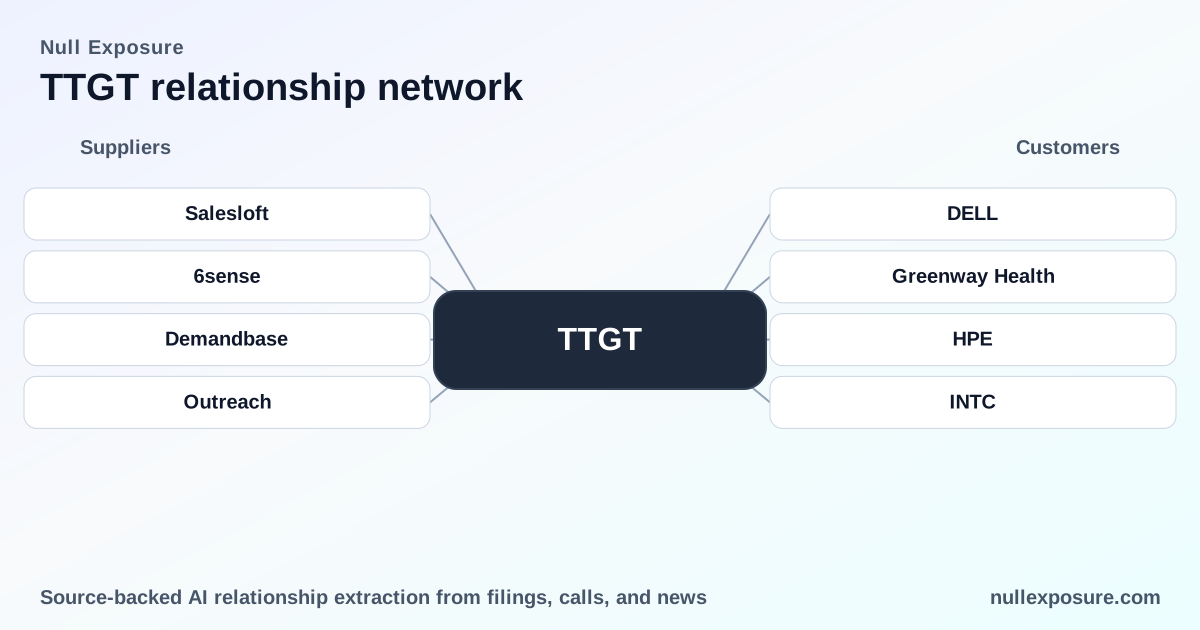
TechTarget’s supplier footprint is focused on go‑to‑market integrations with enterprise sales and marketing platforms—6sense, Demandbase, Outreach, and Salesloft—while its corporate arrangements with the Informa group create both operational support and financial exposure. The vendor integrations are commercially strategic for product stickiness; the Informa relationships create concentrated services and financing dependency that are material to forecasts and risk modeling.
Supplier integrations that matter to customers and revenue
The dataset identifies four named partners in TechTarget’s GTM ecosystem. Each is mentioned on company channels in connection with product integrations that support client activation and lead flow.
6sense
TechTarget lists 6sense among its product integrations on its site and event pages, signaling a GTM linkage that channels account‑level intent data into TechTarget’s marketing products and client workflows. An Informatechtarget webinar/event page (Mar 10, 2026) lists 6sense as an integration partner, confirming this commercial tie.
Demandbase
TechTarget enumerates Demandbase alongside other ABM and intent platforms as an integration partner, which supports enterprise buyers that require account‑based targeting combined with TechTarget’s content and intent layers. The company blog and event pages (Mar 10, 2026) reference Demandbase in the integration list.
Outreach
Outreach appears as a named integration for sales engagement workflows, aligning TechTarget’s lead signals with sales execution platforms to shorten pipeline velocity. This integration is documented on Informatechtarget’s event and blog pages dated March 10, 2026.
Salesloft
Salesloft is listed among sales engagement partners in the same company event and blog materials, indicating parallel functionality to Outreach for GTM orchestration and CRM activation. The mention is reflected on Informatechtarget pages published Mar 10, 2026.
Each integration reference is operationally modest as a public acknowledgement rather than a detailed contractual disclosure; nevertheless, these partnerships are important product differentiators that support retention and cross‑sell.
Company‑level constraints and what they reveal about operations
TechTarget’s filings and disclosures surface several constraints that define the company’s operating posture and supplier economics.
- Long‑term related‑party financing: The company disclosed a $250 million unsecured five‑year revolving credit facility provided by Informa Group Holdings Limited, effective December 2, 2024, that remained undrawn as of year‑end 2024. This is a material financing backstop that affects liquidity, covenant exposure, and strategic optionality (company disclosure, Dec 2024).
- Brand licensing and global reach: A Brand License Agreement grants TechTarget a non‑exclusive, royalty‑free license to use “Informa” as part of its co‑branded name globally, which signals deeper corporate integration of identity and marketing positioning (company disclosure).
- Service provider relationships and transitional support: TechTarget entered a Transitional Services Agreement with Informa Group Limited for IT, accounting, HR, payroll, property and other business support services for generally up to 18 months post‑closing at a disclosed monthly fee level, creating near‑term operational dependence while integrations complete (company disclosure).
- Spend concentration and magnitude: Related‑party expense allocations to Tech Digital Business from the parent were reported at approximately $29.9 million for the year ended 2024, while smaller secondment and related payments totaled in the low‑to‑mid single millions ($0.5M of related party payables; $0.3M cost of revenues; $0.2M G&A; and $1.7M of services in 2024). These figures indicate meaningful recurring service spend with the parent and significant concentration of support services (company disclosure, FY2024).
- Contract mix: Evidence shows a combination of long‑term financing, licensing, and service arrangements rather than short ad‑hoc vendor buys—this is a company‑level signal about contracting posture and maturity.
Taken together, these constraints indicate a company that is operationally integrated with a corporate parent for support and financing while simultaneously building product differentiation through third‑party GTM integrations.
What investors should watch: risk and upside vectors
- Balance‑sheet dependency: The $250M facility and multi‑million related‑party service allocations create financial and operational concentration risk; any change in the Informa relationship or pricing could be material to free cash flow and operating costs.
- Product stickiness through integrations: The public listings of 6sense, Demandbase, Outreach, and Salesloft reinforce TechTarget’s route to embed into customers’ GTM stacks—a tailwind for retention and revenue per customer.
- Transition execution: The transitional services and secondment arrangements shorten near‑term operational disruption risk but also create a dependency window; investors should model step‑down costs and potential re‑procurement expenses when transitional agreements expire.
- Visibility and disclosure: The public mentions of integrations are useful signals but do not substitute for contractual revenue disclosure; buyers should treat the integration mentions as product positioning rather than direct revenue commitments.
For more supplier mapping, contract signals, and exposure scoring tailored to investor diligence, see https://nullexposure.com/.
Actionable conclusions
- Positive commercial thesis: TechTarget’s GTM integrations with market leaders in intent and sales engagement are strategic assets that enhance product value and customer retention.
- Caution on governance and concentration: The Informa‑related financing and services are material and require active diligence in scenarios where cost allocation or credit posture changes.
- Modeling recommendation: Stress‑test scenarios where transitional service fees reprice or the parent facility is limited, and quantify incremental costs to replace in‑house services when transition agreements lapse.
If you are evaluating supplier risk or preparing an investment memo on TechTarget, start with a structured exposure scan at https://nullexposure.com/ and request tailored supplier concentration analysis to quantify the operational downside.