Tetra Technologies (TTI): Brine-to-battery optionality and service cashflow — an investor roadmap
Tetra Technologies operates as a diversified oilfield services and chemical supplier with a growing and strategically important foothold in brine minerals. The company monetizes through legacy completion fluids and chemical sales, services to upstream operators, and increasingly by capturing value from brine mineral rights—where TTI is the designated operator of the Evergreen brine unit and holds a majority economic interest. Investors should value TTI as a hybrid services cash generator with project optionality in lithium and magnesium extraction that can materially re-rate the stock if commercial contracts and FID milestones progress. For deeper supplier-relationship intelligence and deal-tracking, visit https://nullexposure.com/.
Why the Evergreen position changes the investment conversation
TTI’s business mixes steady service revenue with project-like upside. Core industrial metrics show $631m of trailing revenue and positive EBITDA, while market multiples reflect both a services discount and project optionality (EV/EBITDA ~15.5). The corporate operating model carries three important characteristics that drive investor framing:
- Contracting posture: The company operates under long-term supply relationships in its chemicals business and uses operator status on key brine assets to control development timing and economics; TTI disclosed long-term supply arrangements (company filing language) as part of its commercial posture.
- Concentration and criticality: Owning 65% of the brine minerals at Evergreen and acting as designated operator concentrates project execution risk and value capture with TTI; successful commercialization would shift revenue mix materially toward minerals-derived product streams.
- Maturity and stage: The Evergreen development is in a progressed pre-FID stage with explicit dependencies on upstream schedules and board approval; at the same time, the Completion Fluids & Products Division runs established manufacturer relationships that supply the near-term cash flow base.
Key takeaway: TTI is not a pure services play; the market should price both robust near-term cash generation and the asymmetric upside (and execution risk) of turning brine minerals into lithium and magnesium revenue streams. Learn more about TTI’s supplier ecosystem at https://nullexposure.com/.
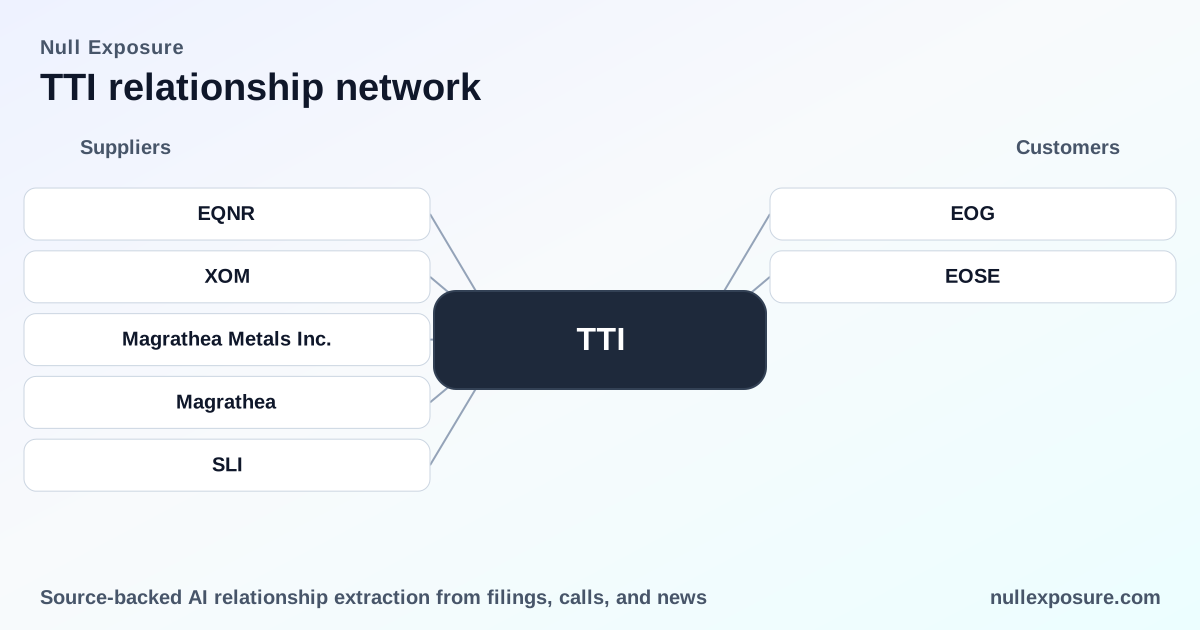
Relationships that matter — what TTI has reported to the market
Below are the specific relationship mentions disclosed in TTI documents and coverage. Each entry is a concise, plain-English summary with source context.
Equinor — 2025 Q4 earnings call (operator scheduling and upstream dependency)
TTI told investors that finalizing the upstream wellfield schedule with Equinor’s Reynolds unit is a gating item before the company seeks board approval and a final investment decision for the Evergreen project. Source: 2025 Q4 earnings call transcript (TTI), reported March 2026.
ExxonMobil — Evergreen ownership split and operator status (2025 Q4 earnings call)
TTI confirmed it is the designated operator of the Evergreen brine unit and owns 65% of the brine minerals, while ExxonMobil holds the remaining 35%, establishing a clear economic and operational leadership role for TTI in the project. Source: 2025 Q4 earnings call transcript (TTI), published March 2026.
Magrathea Metals Inc. — term sheet for electrolytic magnesium integration (news release)
TTI signed a term sheet with Magrathea Metals to evaluate incorporating Magrathea’s electrolytic magnesium technology into the Evergreen Project, positioning TTI to monetize magnesium concentration in the Smackover brine alongside lithium initiatives. Source: Arkansas Business coverage of TTI press release, March 2026.
Equinor — press distribution of earnings call summary (media re-publication)
The company reiterated the same upstream schedule dependency with Equinor’s Reynolds Unit in press distributions of the Q4 call, underlining the public consistency of the FID gating items. Source: Globe and Mail press transcription of TTI Q4 2025 earnings call, March 2026.
Magrathea — JV negotiations for on-site magnesium production (earnings call press summary)
TTI described progress toward finalizing joint-venture terms with Magrathea to produce magnesium metal from the rich magnesium concentration on TTI’s 40,000 acres in Arkansas, signaling active commercialization discussions beyond initial term-sheet stage. Source: Globe and Mail press transcription of TTI Q4 2025 earnings call, March 2026.
Standard Lithium — upstream coordination for post-lithium brine deliveries (2025 Q4 earnings call)
TTI reported ongoing coordination with Standard Lithium on the upstream wellfield schedule that will deliver post-lithium-extracted brine to TTI’s processing path, making Standard Lithium a direct upstream commercial interface for feedstock supply. Source: 2025 Q4 earnings call transcript (TTI), March 2026.
Standard Lithium — press summary reiteration of feedstock plan (press distribution)
The company repeated the operational plan involving Standard Lithium and Equinor in public press distributions, emphasizing that upstream scheduling is the critical path item before a board-approved FID. Source: Globe and Mail press transcription of TTI Q4 2025 earnings call, March 2026.
Constraints and what they reveal about TTI’s operating model
Available constraint excerpts deliver company-level signals rather than relationship-specific guarantees. TTI’s filings reference long-term supply agreements for raw-material bromine, and the Completion Fluids & Products Division routinely contracts with manufacturers—this confirms a stable, contract-driven supply base that supports near-term cash flows. The filing language also discusses active negotiations for bridging bromine supplies to give flexibility on timing for plant start-up, which signals a pragmatic approach to staged commercial ramp and liquidity management. These are company-level indicators of a mixed model: steady manufacturer relationships underpin current profits while project-stage negotiations define the growth trajectory.
Risk checklist investors should run before underwriting upside
- FID dependency: The Evergreen timeline hinges on upstream wellfield schedules and board approval; any upstream delays directly defer value crystallization.
- Execution concentration: As operator and majority mineral owner, TTI bears execution risk; cost or schedule overruns concentrate downside on the company.
- JV and technology integration: Term sheets and JV negotiations (e.g., with Magrathea) are promising but require definitive contracts and scale-up validation before they move to material revenue.
- Supply and contracting discipline: Long-term supply arrangements underpin the chemicals business, but bridging negotiations for bromine indicate flexibility that protects liquidity at the expense of potential short-term supply premium.
Investors should weigh TTI’s current services-derived cash generation against a path-dependent development payoff for brine minerals.
For ongoing tracking of how these supplier and JV relationships evolve, return to https://nullexposure.com/ for curated updates.
Bottom line and next steps
Tetra is a hybrid value proposition: a cash-flowing oilfield services and chemicals company with asymmetric upside from its Evergreen brine assets and magnesium/lithium commercialization pathways. The company’s operator status and majority mineral ownership are compelling levers, but value realization is contingent on upstream schedules, JV closings, and final investment decisions. For investors and operators prioritizing supplier relationships and execution signals, monitor surgical milestones—upstream FID gating items, definitive JV agreements with Magrathea, and binding feedstock contracts with Standard Lithium/Equinor.
If you want ongoing alerts and supplier-level intelligence on TTI’s commercialization progress, visit https://nullexposure.com/ to subscribe and receive structured monitoring.