Take-Two Interactive (TTWO): Supplier posture and what counterparties tell investors
Take-Two operates as a dual-label video game publisher (Rockstar Games and 2K) that monetizes through premium title sales, digital distribution, live-service content, and recurring in-game purchases, supplemented by long-term IP licensing deals and third‑party development relationships. For investors and operators assessing supplier risk, the company’s commercial model is defined by multi-year licensing commitments, concentrated IP economics, and an ecosystem of external studios and service providers that execute and sustain live engagement. Explore more supplier intelligence at https://nullexposure.com/.
Why supplier relationships matter for TTWO’s cashflows
Take-Two’s economics pivot on marquee franchises and the company’s ability to sustain engagement over product cycles. Licenses and management agreements lock in both cost and access to IP, while third-party developers and platform partners determine speed to market and the revenue mix between boxed sales and recurring monetization. That configuration creates two core investment levers: (1) the upside from scaled digital monetization if content distribution assumptions hold, and (2) downside from licensing or service failures that interrupt live revenues or delay launches.
Key takeaway: investor returns are tightly correlated with the company’s ability to manage long-term licensing costs and coordinate external development and distribution partners.
What the public record says about Take-Two’s contracting posture
Company disclosures and the extracted constraints show a clear supplier model orientation:
- Licensing is a fundamental contract type. Take-Two pays and guarantees rights to IP holders (notably for sports products), and these licenses often run across multiple titles and years; that structure increases fixed obligations across release cycles. According to filing text, “Licenses consist of payments and guarantees… Certain licenses, especially those related to our sports products, extend over multi‑year periods and encompass multiple game titles.”
- Contracts skew long‑term. The firm documents agreements that include explicit expiry dates and automatic renewal mechanics, and Take-Two also retains multi‑year management arrangements for strategic support. One filing notes an agreement that “expires on March 31, 2026, with automatic one‑year renewal terms thereafter,” and a separate management agreement with ZelnickMedia runs through March 31, 2029.
- Counterparties include large enterprise banks for hedging. Take-Two’s FX and financial risk mitigation relies on multinational commercial banks; the company represents that counterparty nonperformance risk is not material given partner creditworthiness.
- Service providers are core operational partners. The company pays third‑party developers under multi‑term development agreements and requires security controls of its providers, framing these suppliers as critical operational dependencies.
These constraints combine into a predictable supplier profile: long-tenor, high-commitment licensing and managed third‑party development, supported by high‑credit financial counterparties for treasury operations. Learn more supplier insights at https://nullexposure.com/.
Supplier relationships on record (what’s been observed)
Below is every supplier or supplier-adjacent relationship captured in the available results and the plain-English implication for Take-Two.
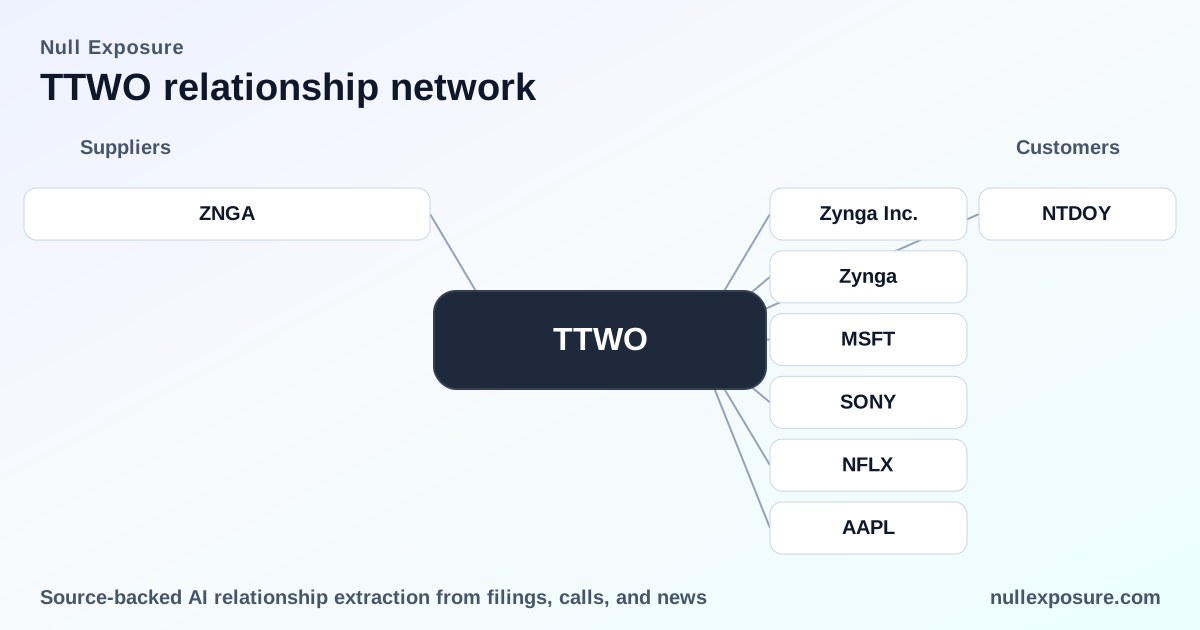
- Zynga (ZNGA) — A recent broker-note citation linked Zynga’s web store developments to improved assumptions for Take-Two’s content distribution and user monetization; analysts (Wedbush, cited by Meyka) retained a positive view on Take‑Two’s revenue and engagement outlook into FY2026. This suggests cross-market distribution developments at Zynga are seen as supportive of Take‑Two’s digital monetization strategy. Source: Meyka blog summarizing Wedbush coverage, March 10, 2026 (https://meyka.com/blog/wedbush-maintains-outperform-on-take-two-interactive-ttwo-march-2026-0403/).
(That is the complete set of supplier relationships shown in the dataset.)
Operational constraints translated into investor risk and opportunity
Translate the constraint signals above into practical vantage points for investors and operators:
- Concentration and criticality: Multi‑year licenses (particularly for sports titles) create predictable cost structures but also concentrate downside if a major license is renegotiated or lost; this amplifies the importance of IP ownership (Rockstar/2K) as a de‑risking factor.
- Contracting posture and optionality: Automatic renewals and long‑dated management agreements (e.g., with ZelnickMedia through 2029) indicate operational stability but reduce short‑term flexibility to cut costs during cyclical revenue declines.
- Counterparty credit risk is mitigated but present: Use of multinational banks for FX hedges lowers settlement risk but ties treasury execution to bank counterparty health and liquidity conditions.
- Execution risk resides with service providers: Third‑party development agreements and the enforced security controls point to outsized operational dependence on vendors for delivery quality and cadence.
Major investment implication: the business is structurally geared for durable cash generation when live-service engagement grows, but it carries non-trivial fixed contractual commitments that compress leverage during downturns.
What to watch next (practical monitoring for investors)
- Track renewal timelines for major licenses and any public negotiation disclosures; renegotiations change cost structure and margin leverage quickly.
- Monitor analyst and market commentary around platform storefronts (for example, Zynga’s web store moves) that affect distribution economics and take-rates.
- Watch the cadence of third‑party release schedules and any security or compliance incidents among service providers; both affect time-to-revenue and reputational tail risk.
- Follow treasury counterparty statements and any material changes in FX hedging disclosures ahead of earnings periods.
For a deeper supplier risk brief on TTWO and comparable coverage across the sector, visit https://nullexposure.com/.
Bottom line for investors and operators
Take‑Two is a high‑quality franchisor whose revenue profile trades off between durable IP-driven upside and contractual inflexibility. The company’s reliance on long‑term licenses and external development partners creates predictable obligations while enabling scaled digital monetization. Investors should value the growth runway of live services alongside the structural risk that multi‑year licensing and managed third‑party relationships introduce to margins and execution.
If you want ongoing supplier-level monitoring, detailed counterparty summaries, and constraint-driven alerts for TTWO, explore the platform at https://nullexposure.com/ and request a tailored supplier risk brief.