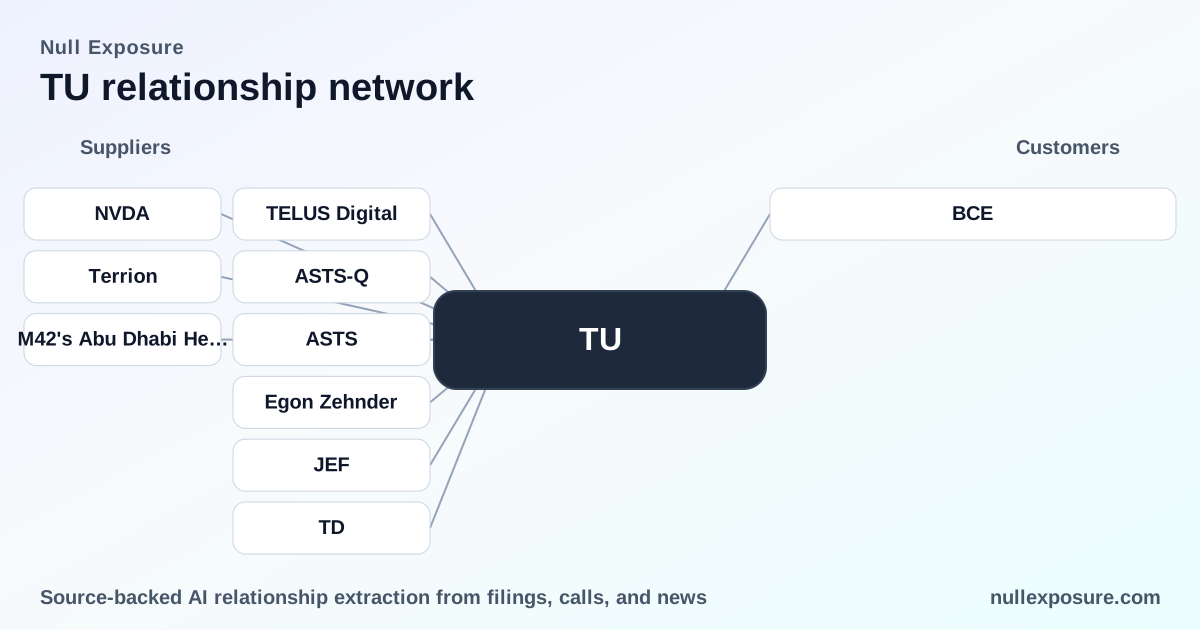
TELUS Corp (TU) — supplier relationships that reshape network strategy and commercialization
TELUS is a Canadian telecommunications and IT operator that monetizes through mobile and fixed-line subscriptions, enterprise IT and health services, wholesale network access, and strategic asset partnerships. Its commercial strategy blends capex-efficient network expansion (including satellite connectivity and tower partnerships) with advanced software and AI capabilities to drive higher service ARPU and new enterprise revenue streams. For investors evaluating supplier exposure, TELUS’s partner mix reveals a deliberate pivot from pure-network operator to a platform orchestrator that outsources specialized capabilities while retaining customer-facing control. Learn more at https://nullexposure.com/.
What to watch in TELUS’s supplier posture
TELUS’s supplier set signals a hybrid operating model: internal capability build (TELUS Digital, AI engines) paired with selective external partnerships for specialized hardware, capital projects, and go‑to‑market acceleration. Important company-level characteristics for underwriters and operators:
- Contracting posture: TELUS combines in-house development with strategic vendor agreements and equity stakes; the balance reduces dependency on single suppliers for critical services but increases complexity in vendor governance.
- Concentration: Partnerships with a small number of strategic providers (satellite, chipsets, tower operators, and financial advisors) concentrate execution risk at those nodes while enabling scale benefits.
- Criticality: Suppliers tied to core connectivity (AST SpaceMobile, Terrion) and compute (NVIDIA) are strategically critical to national coverage and AI cost curves.
- Maturity: Relationships encompass both mature services (investment banks for monetization) and nascent technologies (LEO satellite integration, generative-AI engines), creating asymmetric upside and integration risk.
These are company-level signals intended to guide supplier-risk assessment and contracting negotiation strategies. For targeted research and verification, visit https://nullexposure.com/.
Active supplier and partner relationships (what the market reported)
Below are the supplier and partner relationships surfaced in recent coverage; each item includes a short plain-English summary and a concise source note.
TELUS Digital
TELUS Digital operates the Fuel iX™ generative AI engine and processed over 2 trillion tokens in 2025 across internal models used by the parent company, indicating significant in-house AI consumption and operational scale. According to Finviz coverage tied to Mobile World Congress 2026, this is a material internal capability driving AI-enabled product delivery (FY2026).
AST SpaceMobile, Inc.
TELUS has taken an equity stake and entered a commercial partnership with AST SpaceMobile to deliver space-based cellular services that will allow existing smartphones to send messages, call, and use data in remote Canadian regions by late 2026. The Globe and Mail reported the equity stake and strategic intent, and multiple market outlets including Finviz and InsiderMonkey covered the commercial agreement (March 2026 / FY2026).
Egon Zehnder
TELUS’s board engaged Egon Zehnder as an executive search advisor during a CEO succession process, reflecting active board-level governance and use of top-tier search firms. The Globe and Mail described the board’s external candidate search in its CEO transition coverage (FY2026).
Jefferies Securities
TELUS retained Jefferies Securities to run the process to monetize its health-care unit, signaling a structured, bank-driven sale or partnership strategy for its health business. That engagement was reported by The Globe and Mail in March 2026 (FY2026).
TD Securities
Alongside Jefferies, TD Securities has been retained as an adviser on TELUS’s plan to monetize its healthcare division, indicating a dual-adviser approach to maximize buyer reach and transaction structure options. The Globe and Mail covered the joint retention (March 2026 / FY2026).
NVIDIA
TELUS announced a strategic technology partnership with NVIDIA that secures chip access and favorable economics, supporting TELUS’s AI compute needs and cost efficiency as its AI footprint expands. InsiderMonkey summarized comments from TELUS’s Q4 2025 earnings call describing the strategic arrangement with NVIDIA (FY2026).
Terrion (wireless tower infrastructure operator)
TELUS announced a partnership with La Caisse and Terrion to operate dedicated wireless tower infrastructure, enabling wholesale access and colocation that supports TELUS’s move toward asset-partnered tower economics. This infrastructure arrangement was referenced in TELUS’s earnings commentary and reported in InsiderMonkey (FY2026).
M42’s Abu Dhabi Health Data Services
TELUS disclosed a strategic joint commercial initiative with M42's Abu Dhabi Health Data Services aimed at expanding health-related offerings into international, high-growth markets — part of its global health strategy. PR Newswire published the company’s announcement in the Q4/2025 disclosure (FY2026).
How these relationships change the investment calculus
These partnerships collectively de-risk capital intensity while accelerating capability where TELUS lacks scale or specialization. AST SpaceMobile materially expands addressable coverage and value per subscriber in remote geographies; NVIDIA and TELUS Digital push down AI unit costs and enable differentiated services; Terrion and La Caisse free capital and create wholesale revenue streams; Jefferies/TD signal an active monetization track for the health unit; Egon Zehnder’s involvement signals disciplined governance in the CEO transition. All are consistent with a platform-oriented telecom that outsources non-core assets and doubles down on customer-facing capabilities.
- Upside: Faster go-to-market for satellite-backed coverage, improved AI-driven product margins, and potential capital returns from health-unit monetization.
- Downside: Execution risk from integrating nascent satellite tech, supplier concentration on critical inputs (chips, towers), and transition risk associated with asset monetization.
Visit https://nullexposure.com/ for deeper supplier-risk modeling and contract-playbook guidance tailored to telecom operators.
Investment posture and final takeaway
TELUS’s supplier pattern is purposeful: build proprietary software and AI scale internally, and secure strategic external partners for capital‑intensive or highly specialized functions. For investors and operators, that means assessing not only the counterparty credit and performance history but also the integration plan and contractual protections around availability, pricing, and IP.
If your mandate is to underwrite telecom exposure or to evaluate vendor concentration, start with the AST constellation timeline, NVIDIA compute commitments, and the terms of the tower partnership and health-unit advisory mandates. For transaction or operational support, learn more and request supplier-specific intelligence at https://nullexposure.com/.
Final verdict: TELUS executes a hybrid operator model that reduces capital intensity while preserving strategic control of customer experience, but the upside is conditional on timely integration of satellite services, effective monetization of its health assets, and stable supplier economics for AI compute and tower access. Explore tailored analysis and supplier monitoring at https://nullexposure.com/.