Bloomia Holdings (TULP): supplier relationships that shape a seasonal specialty agribusiness
Bloomia Holdings monetizes a vertically-focused horticulture model: it secures and markets seasonal tulip bulb supply, contracts with growers, and leverages rights offerings and public listing mechanics to fund inventory and growth. The company's cash flow and inventory risk are driven by purchase commitments with growers and a concentrated supplier base in the Netherlands, while corporate actions (rights offering and re-listing) rely on service providers such as subscription agents and market venues. For a concise feed of supplier and counterparty signals relevant to underwriting or partner diligence, visit https://nullexposure.com/.
What Bloomia actually does and how suppliers matter
Bloomia operates as a specialty agricultural merchant and manager of bulb investments, sourcing tulips and related inventory from a small set of global producers and selling into retail and wholesale channels. Revenue generation depends on securing year-round supply (Northern and Southern Hemisphere) and managing timing between procurement outlays and seasonal sales. The firm’s working capital and capital-raising cadence therefore make its supplier contracts and financing partners strategically critical.
Relationships that matter right now
Below I list every relationship surfaced in recent disclosures and press coverage, with plain-English summaries and source context.
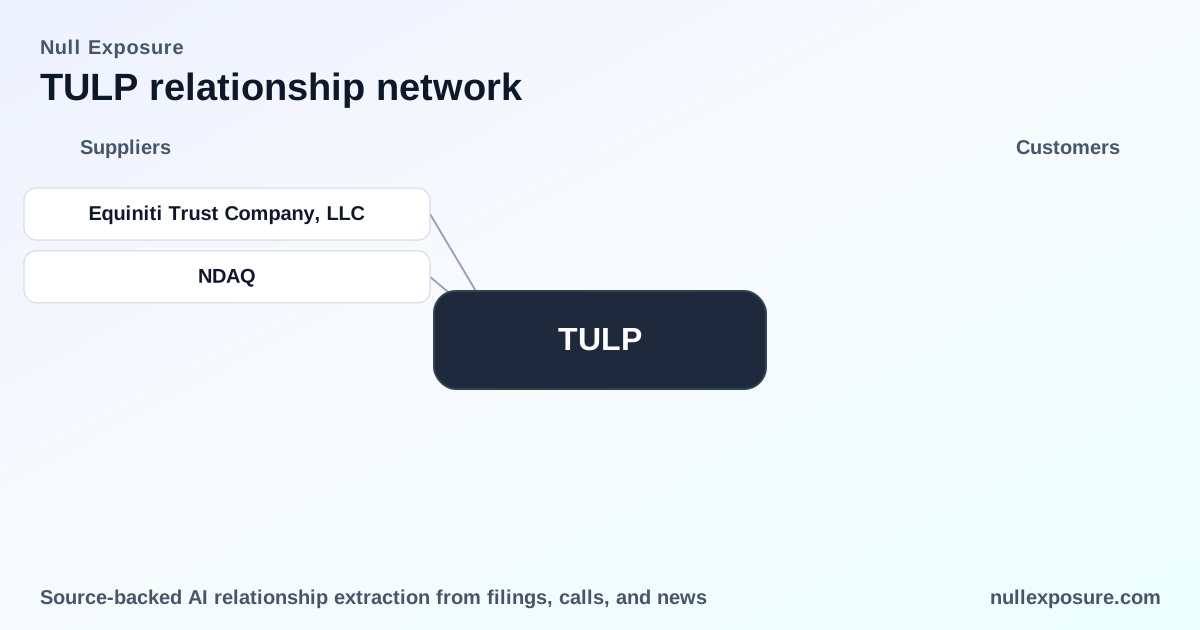
Equiniti Trust Company, LLC
Bloomia engaged Equiniti Trust Company, LLC as the subscription agent for a rights offering, and updated the offering expiration to 5:00 p.m. Central Time on March 27, 2026 to satisfy Equiniti’s requirements. This role is operationally important because the subscription agent coordinates investor subscriptions and procedural compliance for the capital raise. According to Bloomia press releases distributed March 10, 2026 via AccessWire and reporting on Futunn and TradingView, Equiniti acted in that subscription-agent capacity for the FY2026 rights offering (press releases dated March 2026).
Nasdaq Capital Market
Bloomia’s common stock changed its public trading identity effective February 2, 2026, relisting on the Nasdaq Capital Market under the new name Bloomia Holdings, Inc. and ticker TULP, replacing the prior Lendway/LDWY listing. The name and ticker change is a structural event for shareholder liquidity and market signaling; trading venue confirmation was included in the company’s March 10, 2026 press release carried on AccessWire and aggregated on trading platforms (AccessWire/Financial news, March 2026).
How the disclosed constraints shape operational risk and supplier strategy
Bloomia’s public disclosures and filings expose a mixed contracting posture that is critical for investors assessing supplier risk and capital needs.
-
Contracting posture: The company holds at least one explicit long-term purchase obligation: on July 1, 2023 it committed to purchase 25% of a third party’s annual production of tulip bulbs through 2028 at $1,650,000 per year, totaling approximately $8,000,000 over the contract term. This is a material, multi-year purchase commitment that fixes a meaningful portion of procurement spend. Company disclosures document that commitment (disclosed July 2023).
-
Short-term sourcing behavior alongside long relationships: The bulk of Bloomia’s grower purchase contracts—particularly with Dutch producers—are short-term in tenor, though the company retains a long history with most suppliers. This implies flexibility in spot pricing and sourcing, but also exposure to seasonal price swings and availability risk. The company’s financial notes as of year-end 2023–2024 describe these contract dynamics.
-
Concentration and geography: Bloomia sources approximately 80% of bulbs from the Netherlands and 20% from the Southern Hemisphere, and reports that 80% of supply comes from roughly 20% of suppliers. This high concentration creates single-region and supplier-cluster risk that directly affects production continuity and price negotiation leverage.
-
Spend and materiality: The disclosed multi-year purchase commitment falls into a $1M–$10M annual spend band, a scale that is material to a small-cap specialty grower merchant and will affect liquidity planning and working capital cycles.
-
Relationship maturity and supplier type: Despite many short-term contracts, supplier relationships are described as mature—Bloomia has a long history with growers—and the counterparty mix includes large enterprise producers among the top sources, which implies operational resilience provided those large partners remain committed.
-
Corporate operating leases: Separately, Bloomia has a small short-term operating lease for headquarters with monthly payments of $375 through September 30, 2025, reflecting limited fixed-cost exposure at the corporate office level (company filings, FY2023–FY2024 notes).
Taken together, these signals present a company that deliberately balances short-term sourcing flexibility with targeted multi-year purchase commitments to lock in a portion of seasonal supply.
For a centralized view of these supplier signals and to monitor changes in counterparties or contract posture, go to https://nullexposure.com/.
What investors and operators should watch next
Strategic and risk-monitoring priorities flow directly from the relationships and constraints above. First, the rights offering execution—administered with Equiniti as subscription agent—is a funding event; successful subscription processing impacts inventory financing and the company’s ability to honor bulking commitments through the season. Second, supply concentration in the Netherlands means geopolitical, logistics, or crop-specific shocks in that region will have outsized effect on gross margins and fulfilment rates. Third, the multi-year $1.65M annual commitment is both a price and volume hedge that reduces spot procurement risk for a meaningful slice of production but increases committed cash outflows irrespective of sales timing.
Operational diligence should focus on counterparty credit and capacity among the largest growers, the company’s inventory financing cadence tied to capital raises, and the practical flow of logistics across hemispheres that enable year-round supply.
Risk framing and investment takeaway
Bloomia’s model is supply-sensitive and capital-dependent. The combination of concentrated sourcing, a material multi-year purchase obligation, and reliance on capital markets (rights offering administered by Equiniti; Nasdaq listing under TULP) creates a profile where operational success tracks directly to supplier continuity and funding execution. If the rights offering is executed cleanly and grower relationships hold, Bloomia de-risks seasonal inventory funding while preserving margin upside; failure in either dimension constrains working capital and elevates execution risk.
To review supplier-level signals and monitor counterparties in a single interface, visit https://nullexposure.com/. For active due diligence, track: (1) disclosures around the rights offering settlement and subscription uptake, (2) seasonal inventory positions versus committed purchase volumes, and (3) any shifts in sourcing mix away from the Netherlands.
Final call to action: for a succinct supplier risk dashboard and ongoing counterparty alerts that affect Bloomia’s trading and financing profile, see https://nullexposure.com/.