Turbo Energy (TURB): Banked on Spain, Betting on Tokenization
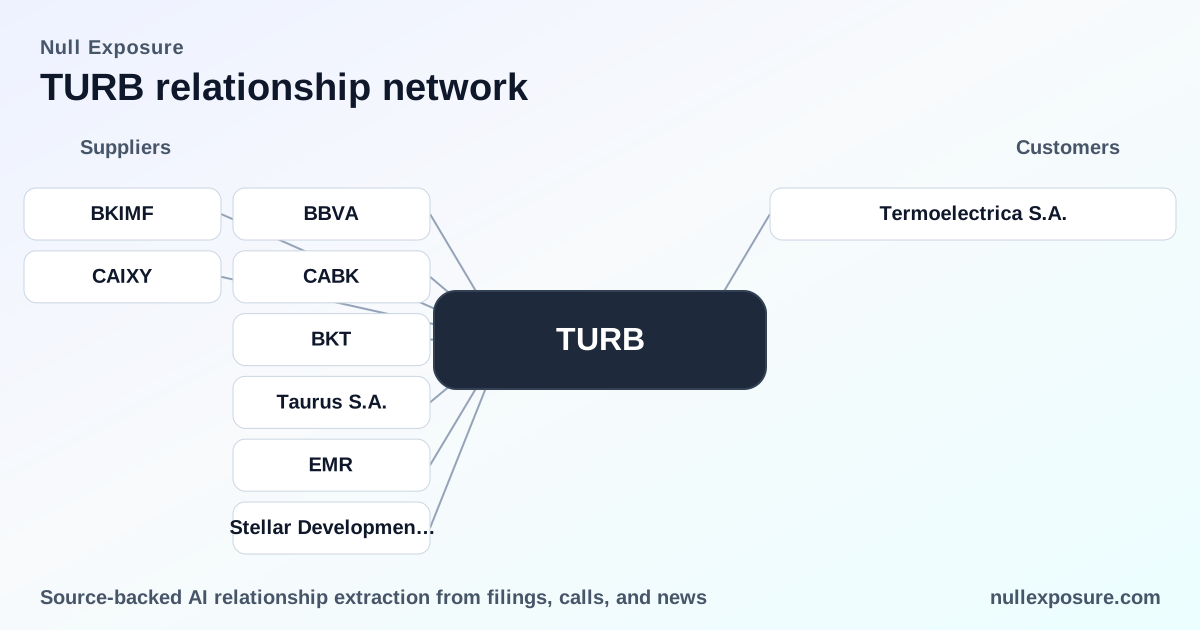
Turbo Energy designs, develops and distributes photovoltaic generation, management and storage equipment from its base in Valencia, Spain, and monetizes primarily through equipment sales and project financing arrangements that support deployment and recurring service revenue. The company has recently combined traditional bank refinancing with a novel tokenization initiative to access long-term capital for global expansion: a dual financing strategy that couples conventional lenders with blockchain-native capital markets. For investors and operators evaluating supplier relationships, the interplay between secured bank facilities and strategic technology partners defines both runway and execution risk.
Visit the research hub for supplier intelligence: Null Exposure.
What Turbo sells and why the financing matters
Turbo Energy’s core business is hardware and integrated solutions for solar generation and storage; 2025 trailing revenue is approximately €9.98 million (reported in USD as $9,976,500), but profitability metrics show negative EBITDA and EPS, underlining the company’s need for durable financing while scaling. Turbo’s management has converted short-term bank obligations into roughly €4.87 million of longer-dated facilities, a funding action that reduces near-term liquidity strain and supports rollout of pilot projects that are being packaged for tokenized finance. Financially, high insider ownership (about 75.8%) and extremely low institutional ownership (0.66%) signal concentrated control and limited institutional cap-market support, making supplier and lender relationships particularly material to corporate stability.
Capital partners and the bank refinancing — why that matters operationally
Turbo completed a refinancing that converts existing bank facilities into long-term structures totaling approximately €4.87 million. That refinancing is distributed across key Spanish banks—Bankinter, CaixaBank and BBVA—and represents a deliberate shift from short-term to longer-term credit as the company scales project deployment. According to a company announcement and subsequent press coverage in March 2026, these bank agreements are intended to add liquidity to support global expansion and align financing with long-term business plans (GlobeNewswire / EnergyDigital / QuiverQuant, Mar 2026).
- Why this is important: long-term bank financing reduces immediate rollover risk and signals that incumbent banks are willing to underwrite Turbo’s growth trajectory in exchange for structured repayment; for suppliers and operators, that translates into a lower probability of sudden funding-driven disruption to supply commitments.
Who Turbo Energy is working with (relationship-by-relationship)
BBVA
Turbo reached an agreement with BBVA to convert part of its bank facilities into long-term financing as part of a €4.87 million refinancing package, improving near-term liquidity for global expansion. A QuiverQuant summary and GlobeNewswire distribution documented the BBVA participation in March 2026.
CaixaBank
CaixaBank is a named lender in the same long-term financing conversion, joining Bankinter and BBVA to support Turbo’s balance-sheet restructuring and international rollout. StockstoTrade and EnergyDigital reported CaixaBank’s role in the March 2026 refinancing disclosures.
Bankinter
Bankinter is a co-lender on the €4.87 million conversion, and press coverage described the arrangement as a successful restructuring of bank financing to secure medium-term runway. StockstoTrade and QuiverQuant referenced Bankinter’s participation in March 2026.
Taurus S.A.
Turbo selected Taurus S.A. to oversee tokenization of renewable energy project financing using Taurus-CAPITAL, an institutional digital-asset infrastructure platform. The project selection and Taurus’s role were described in a GlobeNewswire press release and coverage in November 2025, with follow-up reporting in trading and crypto press in early 2026.
Stellar Development Foundation
Tokens for Turbo’s pilot hybrid renewable projects will be issued and managed on the Stellar blockchain with support from the Stellar Development Foundation, according to a Stellar press release and the November 2025 GlobeNewswire announcement. This positions Turbo to access a broader pool of investors via blockchain rails.
Emerson Process Management Romania SRL
TurboEnergy Power SRL offers a three-year warranty backed by Emerson Process Management Romania SRL, identifying Emerson as a regional manufacturing partner that supports product reliability claims; this warranty relationship was noted in reporting on procurement and warranty terms in March 2026.
(Each of the above relationships is documented in company press releases and industry coverage between Nov 2025 and Mar 2026, including GlobeNewswire, Stellar.org, QuiverQuant, StockstoTrade and EnergyDigital.)
Operational implications from these relationships
Turbo’s operating model now blends traditional bank underwriting with distributed capital issuance, which creates a layered capital structure that affects contracting, supplier confidence and project economics:
- Contracting posture: The shift to longer-term bank facilities signals a more stable contracting posture for suppliers—payment windows and procurement planning can be extended with lower short-term default risk. At the same time, tokenized financing introduces new counterparties and settlement mechanics that suppliers must understand when negotiating payment terms tied to project cashflows.
- Concentration and control: With insiders holding roughly 76% of equity, decision-making is concentrated; this expedites strategic pivots (such as tokenization) but limits oversight typical of diversified institutional ownership.
- Criticality of partners: Bank relationships with BBVA, CaixaBank and Bankinter are mission-critical for liquidity; Taurus and Stellar are strategically critical for Turbo’s alternative capital access strategy. Emerson’s warranty support directly underpins product acceptance in certain markets and affects post-sale liability.
- Maturity and execution risk: Financials show negative EBITDA and EPS, so Turbo is still in scaling mode rather than a stable cash-generative phase; execution of both bank refinancing and tokenization pilots will determine whether these relationships convert into durable growth.
Key takeaways for investors and operators
- Financing profile improved: The conversion of short-term debt into €4.87 million of long-term bank facilities materially reduces near-term liquidity pressure and supports planned expansion (press coverage, Mar 2026).
- Hybrid capital strategy: Turbo combines bank debt with tokenization via Taurus and Stellar to diversify funding sources and tap a broader investor base (GlobeNewswire, Stellar.org, Nov 2025).
- Concentrated governance risk: Very high insider ownership and low institutional holdings create concentrated control—fast decision cycles but limited external governance.
- Operational dependency on partners: Supplier warranties and bank covenants are meaningful operational levers; Emerson’s warranty and the Spanish banks’ financing are immediate touchpoints for supply chain resilience.
Consider these next steps for deeper due diligence: validate covenant terms in the bank facilities, obtain details on token issuance mechanics and investor protections through Taurus/Stellar, and request warranty pass-through terms tied to Emerson support.
For a broader comparative view of supplier risk across renewables and capital-structure plays, visit Null Exposure and review our supplier intelligence briefing.
Final recommendation
Turbo Energy is executing a deliberate capital strategy that pairs bank-backed runway with an innovative tokenization distribution channel. For investors, the combination reduces immediate liquidity risk while introducing frontier-market execution risk tied to digital issuance and concentrated governance. For operators and suppliers, the presence of major Spanish banks and an Emerson-backed warranty increases confidence in near-term performance, while the tokenization program requires contractual clarity on payment mechanics. Track actual drawdowns under the new bank facilities and the terms of the Taurus/Stellar issuances—these will determine whether financing innovations translate into durable commercial scale.
Stay informed on supplier relationships and financing developments at Null Exposure — our coverage focuses on how counterparty structures affect operational risk and investment outcomes.