Mammoth Energy Services (TUSK): supplier map, operational constraints, and what investors should price in
Mammoth Energy Services (TUSK) operates as an oilfield services and materials provider that monetizes through the sale and logistics of frac sand and related services, leveraging third‑party transport, transload facilities and leased railcars to deliver product to customers. Revenue conversion is driven by physical logistics as much as by commodity demand: with TTM revenue of $44.3M against a modest market capitalization (~$103.1M), supplier relationships that enable movement and customer access are direct drivers of cash flow and operating leverage.
Explore supplier relationships and risk signals in more depth at https://nullexposure.com/.
How Mammoth’s commercial model ties to suppliers
Mammoth’s operational footprint is a logistics‑heavy commodity service: the company sources frac sand, moves it through origin points, leases/uses railcars, and transloads product to customer sites. Its financials show a company that is small in absolute scale (market cap roughly $103M) with negative EBITDA and EPS pressure (EBITDA -$17.843M; diluted EPS -$1.76 TTM), which amplifies the importance of reliable, cost‑efficient third‑party providers. Regulatory language in company disclosures explicitly states that the suspension, termination or nonrenewal of third‑party providers could cause material operational delays and materially harm results, a clear signal that key logistics partners are operationally critical.
The operating model characteristics investors should incorporate into forecasts:
- Contracting posture: Mammoth uses short‑term commercial contracts with third‑party transport and transload providers and leases railcar fleets rather than owning a large rolling asset base. This implies flexibility but also exposure to counterparty availability and rate volatility.
- Concentration and criticality: Company disclosures identify supplier relationships as critical — a disruption to one or more logistics providers would materially affect operations and cash flows.
- Service orientation: Mammoth functions as a buyer of transport services and as a manager of third‑party providers for logistics execution rather than as an integrated rail operator.
- Maturity and scale: Given the firm’s modest revenue base and negative operating metrics, supplier relationships are structurally significant and can be a lever for near‑term margin stabilization or deterioration depending on contract pricing and service continuity.
The supplier list — who matters today
Below are the relationships disclosed in public reporting and coverage; each entry includes a concise operational read and the provenance for the reference.
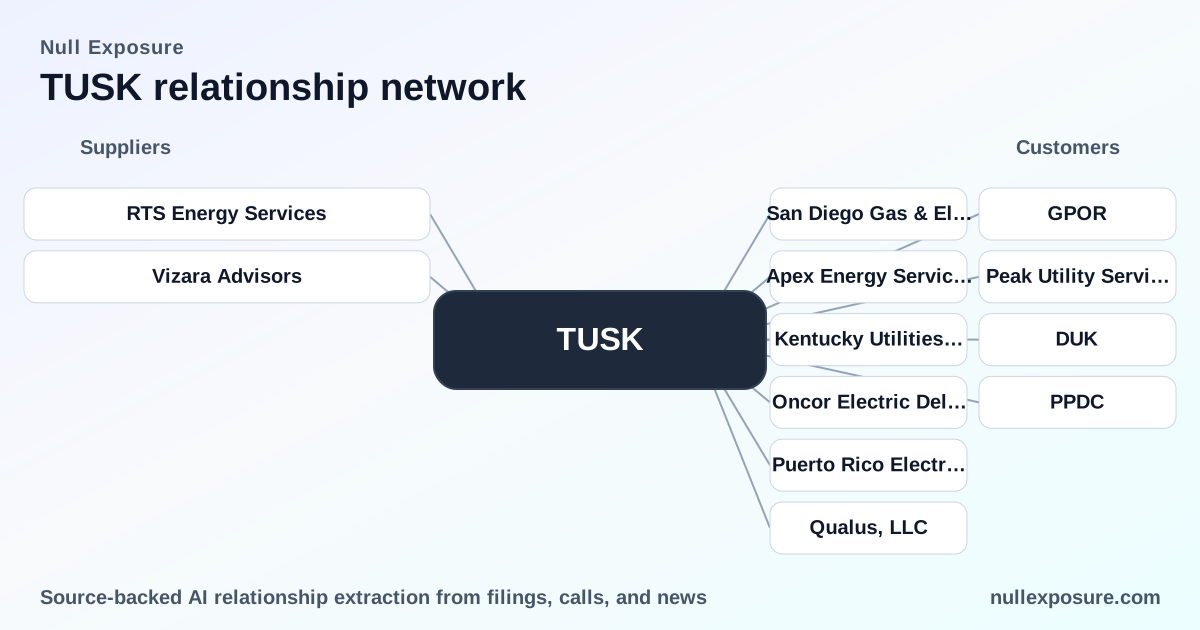
RTS Energy Services
RTS provides Mammoth with access to additional equipment and a channel of roughly 250 customers, helping to scale distribution and equipment availability without Mammoth owning all assets directly. According to a trade article about Mammoth expanding operations, RTS’s role is in equipment access and expanded customer reach (TTNews, March 2026): https://www.ttnews.com/articles/mammoth-energy-services-expands-operations.
Vizara Advisors
Vizara Advisors acts as a provider for investor relations support tied to Mammoth’s corporate communications and call logistics; it is referenced in a conference‑call announcement as the investor relations contact (MarketScreener, Q3 2025 conference call notice): https://www.marketscreener.com/news/mammoth-announces-third-quarter-2025-conference-call-ce7d5adcdc80fe20.
Both relationships are limited in number in public reporting, but they illustrate two different dependency vectors: one operational (RTS) and one corporate communications (Vizara). Investors should weigh operational dependencies more heavily for cash‑flow sensitivity.
What the constraints tell investors about operational risk
The company’s own disclosure language makes three constraints clear and actionable for investors and operators:
- Critical materiality: Mammoth warns that losing one or more third‑party logistics providers could cause material delays, higher operating costs, and an inability to service wells — language that elevates supplier risk to a strategic, not just tactical, level.
- Buyer posture: Mammoth contracts with third‑party providers to transport frac sand to railroad facilities; the company behaves as a buyer of logistics and transloading services rather than a large integrated carrier.
- Service provider reliance: The firm leases railcars from various third parties and leans on origin/destination transload facilities, indicating a model that privileges capital efficiency but increases exposure to vendor availability and railcar market dynamics.
These constraints collectively indicate high operational leverage to a small set of logistics providers. For a company with limited scale and negative operating metrics, this is a risk that can generate rapid downside to revenue and margins if service continuity or pricing worsens.
If you want a structured supplier risk profile and continuous monitoring for Mammoth, visit https://nullexposure.com/ for more detail.
How traders and portfolio managers should think about valuation and downside
Given the business model and supplier risk profile:
- Operational continuity is an earnings catalyst: securing stable, competitively priced transport and transload capacity will compress working capital and improve margins more quickly than commodity price moves alone.
- Counterparty events are asymmetric downside: a logistics outage could sharply curtail revenue given the company's stated sensitivity to third‑party relationships.
- Corporate communications providers matter for liquidity events: while Vizara Advisors is not operationally critical, effective investor communications can affect access to capital if capital raises become necessary.
From a risk‑management perspective, prioritize stress scenarios where a major transport provider becomes unavailable or railcar leasing costs spike; those scenarios should be modeled as plausible drivers of near‑term revenue interruption.
Key takeaways for operators and investors
- Supplier relationships are operationally critical. Company disclosures explicitly classify third‑party logistics providers as capable of causing material operational delays.
- Mammoth runs a capital‑light logistics model. Leasing railcars and contracting transload/transport services creates flexibility but elevates counterparty risk.
- Two public relationships illuminate the picture: RTS Energy Services supports equipment and customer access, and Vizara Advisors handles investor relations — one operationally material, the other materially relevant to capital markets messaging.
- Small scale increases vulnerability. With TTM revenue of $44.3M and negative EBITDA and EPS, any meaningful logistics disruption is likely to be felt in quarterly performance.
For a more granular supplier risk map and actionable surveillance, go to https://nullexposure.com/.
Investors and operations teams should treat supplier continuity and contract terms as first‑order variables in any financial model of Mammoth Energy Services. For portfolio due diligence or operator checklists, visit our homepage at https://nullexposure.com/ to request tailored supplier intelligence and monitoring.