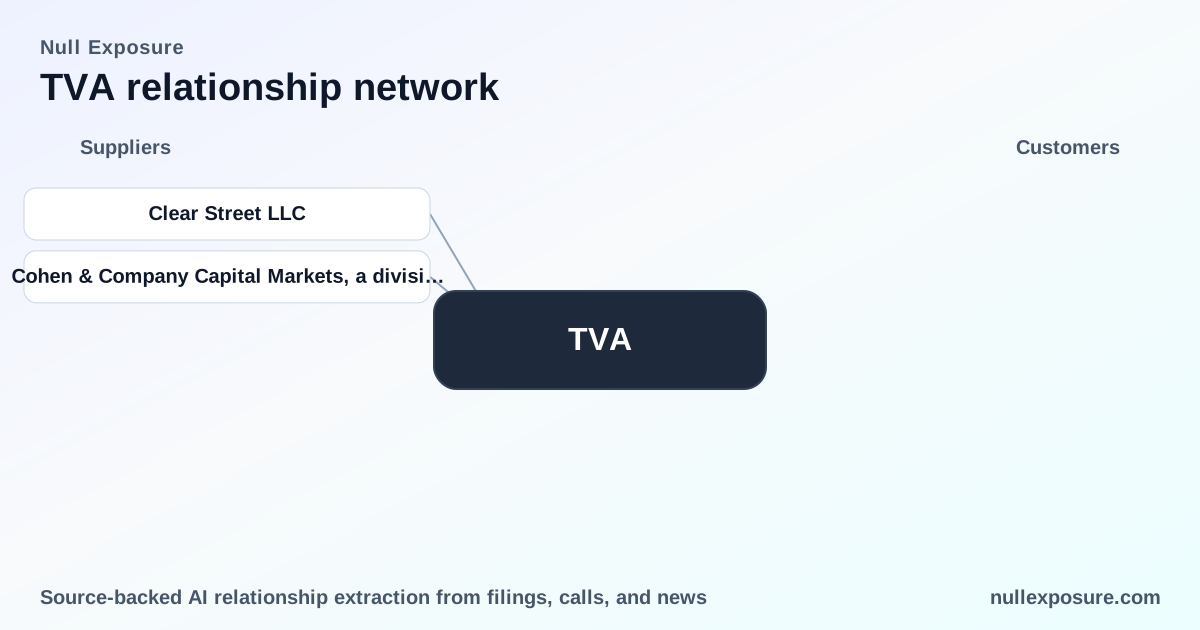
TVA Supplier Relationships: Underwriters, Capital Structure and What Investors Should Do
Texas Ventures Acquisition III Corp (TVA) is a NASDAQ-listed SPAC that raises capital through public offerings and monetizes by identifying, acquiring, and merging with a target operating company—capturing value through transaction execution, sponsor economics and post-merger operational uplift. The company’s P&L is currently immaterial because TVA operates as a shell vehicle; its economic value is driven by capital commitments, underwriting relationships and sponsor alignment around a successful business combination.
For more on supplier risk and counterparty diligence, visit https://nullexposure.com/.
One-paragraph operational snapshot investors need
TVA is a special purpose acquisition company structured to accumulate cash in trust via an IPO and then deploy that capital into a negotiated business combination. Key financial signals: market capitalization roughly $310 million, no operating revenue historically, negative book value (-$0.47) reported, and very high institutional ownership (~88.8%), all consistent with a capital-raising vehicle whose value is tied to deal execution rather than organic cash flows. Management monetizes through sponsor economics and transaction-driven value creation once a target is announced; until then, the company’s primary suppliers are capital markets intermediaries and legal/accounting advisors.
- Market cap: $310,200,000
- Shares outstanding: 22,500,000; shares float ~18,550,200
- Latest quarter on file: 2025-09-30
Why underwriting relationships matter for a SPAC
Underwriters and book-runners are not just transactional vendors for a SPAC; they shape IPO pricing, distribution, investor quality and timing for business combinations. A strong underwriting syndicate materially reduces execution risk, accelerates access to institutional demand, and improves the probability that trust capital persists until an attractive merger is completed. For operators evaluating TVA as a counterparty, the identity and role of underwriting partners is a direct signal on market confidence and transaction execution capability.
Visit https://nullexposure.com/ for a deeper supplier-risk briefing.
Clear Street LLC — joint book-runner role
Clear Street LLC acted as a joint book-runner on TVA’s $225 million initial public offering, supporting order handling and institutional placement alongside the lead manager. Clear Street’s participation signals modern execution capability and institutional distribution capacity for the offering. (Source: Reuters via TradingView, April 24, 2025: https://www.tradingview.com/news/reuters.com,2025-04-24:newsml_GNX1tPDky:0-texas-ventures-acquisition-iii-corp-completes-225-million-initial-public-offering/)
Cohen & Company Capital Markets (a division of J.V.B. Financial Group, LLC) — lead book-running manager
Cohen & Company Capital Markets, a division of J.V.B. Financial Group, LLC, served as the lead book-running manager for TVA’s IPO, directing pricing strategy and anchoring syndicate allocation decisions. A lead manager’s role concentrates responsibility for distribution and regulatory compliance, so Cohen & Company’s stewardship is a core operational dependency for TVA’s capital-raising track record. (Source: Reuters via TradingView, April 24, 2025: https://www.tradingview.com/news/reuters.com,2025-04-24:newsml_GNX1tPDky:0-texas-ventures-acquisition-iii-corp-completes-225-million-initial-public-offering/)
What these relationships reveal about TVA’s contracting posture and maturity
- Contracting posture: TVA operates with transactional, event-driven supplier relationships—engagements are discrete, tied to IPOs and the deal lifecycle rather than ongoing operational supply chains. Underwriting arrangements are fee-for-service and centered on capital allocation outcomes.
- Concentration and criticality: Underwriters are critical and concentrated suppliers: a limited set of book-runners determine execution quality and timing for capital raises, making counterparty selection high-impact for shareholder outcomes.
- Maturity and operational profile: TVA’s profile is that of an early-stage acquisition vehicle—no revenue, limited balance sheet operating activity, and dependence on capital markets intermediaries for core functions. That profile implies a short window of operational risk tied to deal sourcing and completion.
Practical implications for investors and operators
- Assess underwriting depth before committing capital. The identities and track records of book-runners provide a forward-looking signal on distribution strength and pricing discipline. TVA’s use of Clear Street and Cohen & Company demonstrates a syndicate with both modern execution tools and a traditional lead-manager structure.
- Evaluate sponsor alignment and timeline. With no operating revenues, TVA’s value realization is entirely contingent on finding a target and closing a business combination; underwriting relationships shorten risk by facilitating re-capitalization or follow-on financings but do not substitute for sponsor diligence.
- Monitor institutional ownership and market liquidity. High institutional ownership (around 88.8%) is supportive of aftermarket stability but concentrates vote and redemption dynamics that will determine capital available for a merger.
Company-level constraints and operating-model signals
There are no supplier-constraint excerpts explicitly disclosed in the available relationship data. Company-level signals relevant to operating and commercial risk include: no operating revenues, negative book value, high institutional ownership, and reliance on capital markets intermediaries for core execution functions. These characteristics indicate TVA’s operating model is transaction-focused, capital-market dependent, and immature from an operating-activity perspective—factors that investors must price when underwriting deal success probabilities.
How to act as an investor or operator
- Validate underwriting commitments and syndicate tier before taking a position; focus on execution history of lead managers and the distribution reach of joint book-runners.
- Maintain a short- to medium-term time horizon tied to transactional milestones (target announcement, vote, and close), since TVA generates value primarily through successful deal closure.
- For operational counterparties and target companies, insist on clear escrow, fee, and indemnity terms given the transient nature of SPAC engagements.
Explore supplier diligence templates and counterparty assessments at https://nullexposure.com/.
Bottom line
TVA is a capital-raising vehicle whose principal suppliers—lead and joint book-runners—directly determine execution quality and speed. Investors should treat underwriting relationships as core risk factors: they influence pricing, investor mix, and ultimately the probability of a successful business combination. The participation of Cohen & Company Capital Markets as lead manager and Clear Street LLC as joint book-runner is a concrete signal of the syndicate assembled for TVA’s $225 million IPO and is central to assessing the firm’s near-term prospects. For further supplier-level intelligence and model-driven due diligence, start at https://nullexposure.com/.