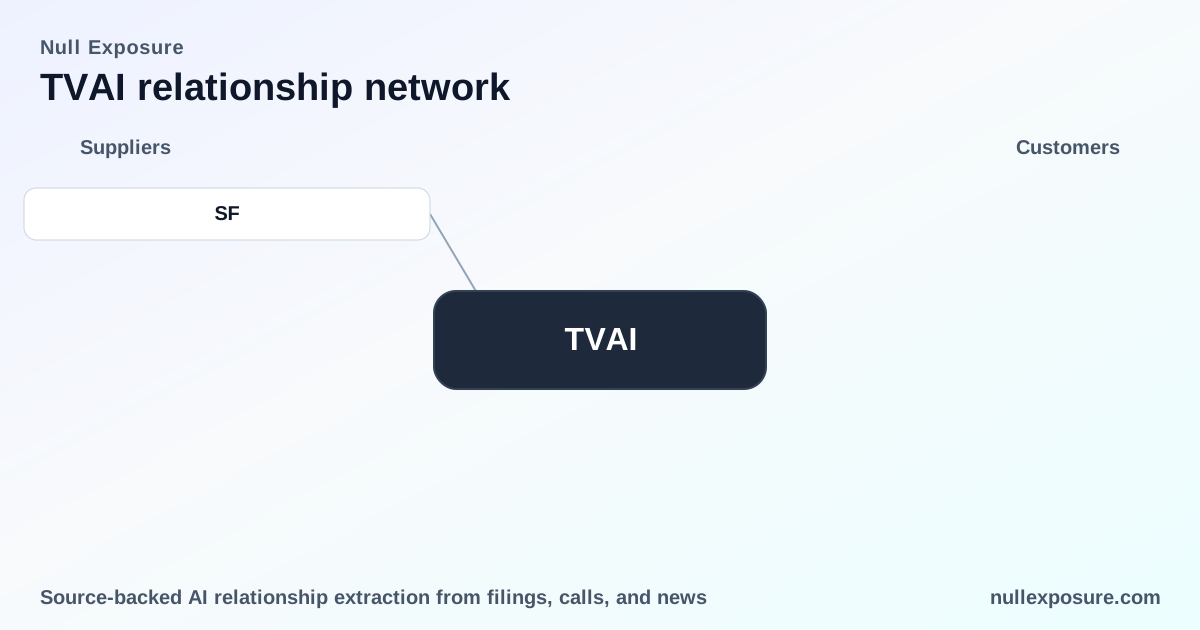
Thayer Ventures Acquisition Corporation II (TVAI): supplier relationships and what investors should price in
Thayer Ventures Acquisition Corporation II (TVAI) is a publicly traded special purpose acquisition company (SPAC) that raises capital in trust and seeks a merger target in the travel and transportation sectors; it monetizes through a combination of sponsor economics on a successful business combination and equity ownership in the post‑combination entity. For investors and operators evaluating supplier counterparty risk, the critical questions are: which intermediaries control liquidity or governance levers, and what contractual constraints restrict the company’s securities or capital actions? Explore more supplier coverage and signals at https://nullexposure.com/ to see how this relationship insight fits broader counterparty analysis.
Quick factual orientation: the corporate profile you should anchor to
TVAI is listed on NASDAQ as a SPAC focused on travel and transportation, with CIK 1872228 and a market capitalization reported around $277.1 million as of the latest data. The company has no operating revenue or operating margins reported—standard for pre‑transaction SPACs—and holds the structural profile of a shell vehicle that will realize value only through a qualifying merger or business combination. According to the company profile (CIK 1872228), TVAI’s strategy is to leverage its management team to identify transformative targets in its sector focus.
Supplier relationships that influence deal execution and liquidity
Below I cover every supplier relationship discovered in our review of TVAI supplier signals. For each relationship I give a plain‑English summary and the source.
Stifel — lock‑up on certain Class B ordinary shares
A MarketScreener item from March 10, 2026 reports that certain Class B ordinary shares are subject to a lock‑up requiring prior written consent from Stifel before sale or other disposition, limiting transferability without Stifel’s approval. This is a creditor/underwriter-style restriction that constrains liquidity of those securities and gives Stifel a contractual gatekeeper role over transfers (MarketScreener, March 10, 2026).
What that single supplier relationship practically changes for investors
The existence of a Stifel lock‑up is not merely procedural: it imposes a legal friction on share transfers and potentially on sponsor liquidity events. For investors in a SPAC vehicle, such restrictions alter secondary market dynamics for the affected share class and can influence how and when sponsor interests convert into tradable equity after a transaction. Because TVAI’s business model is timing‑sensitive—value crystallizes at business combination—any party that can block or condition disposals is a lever to watch. The MarketScreener report documents the excerpt of the lock‑up language and indicates this is an active contractual restriction as of early 2026.
How TVAI’s operating model shapes supplier exposure
TVAI’s supplier posture should be interpreted through the lens of how SPACs operate:
- Contracting posture: As a shell entity, TVAI executes a small number of high‑impact contracts (underwriting/placement agreements, escrow/trust arrangements, and advisory/sponsor commitments). These relationships are concentrated and legally heavy—each contract can materially constrain post‑transaction flexibility. The Stifel lock‑up is an example of a contracting term that directly limits shareholder actions.
- Concentration: The company’s supplier set is inherently narrow. A handful of financial counterparties, legal/advisory firms, and underwriters will carry outsized importance for execution risk. That concentration raises single‑counterparty impact: a dispute or restrictive term with one provider can affect the entire transaction timetable.
- Criticality: Suppliers to a SPAC are critical in a binary outcome model—closing a business combination or not. Providers like Stifel, trustees, escrow agents, and placement agents are gatekeepers for capital flows and governance transitions.
- Maturity and optionality: TVAI is in a pre‑revenue, trust‑held state; contractual maturities (lock‑ups, sponsor warrants, redemption windows) define optionality for shareholders. The company-level data show zero reported revenue and standard SPAC accounting lines; therefore, contractual terms—not operating cashflow—drive near‑term value realization.
No additional supplier constraints were recorded in our supplier constraint feed for TVAI; beyond the Stifel excerpt above, there are no other supplier lock‑ups or constraints surfaced in the examined records, which is itself a company‑level signal about the public record of supplier restrictions.
Explore broader counterparty analyses and supplier scoring at https://nullexposure.com/ so you can compare TVAI’s profile to peers across the travel and transportation SPAC cohort.
Investment implications and risk checklist
- Liquidity friction is real and actionable. The Stifel lock‑up reduces tradability of the affected share class until consent is given, which can compress price discovery and delay sponsor monetization events.
- Concentration amplifies single‑counterparty risk. TVAI’s reliance on a small set of financial intermediaries means any contractual dispute or restrictive clause carries outsized effect on the timeline and success of a merger.
- Governance leverage rests with contractual counterparties. Underwriting and placement agreements typically include transfer restrictions, consent rights, and representations that shape post‑deal ownership dynamics; investors must price these legal controls as part of valuation.
- Transparency matters for negotiation and exit. Publicly disclosed excerpts, like the MarketScreener item, are the primary windows into these constraints; lack of broader supplier constraints in the record is not the same as absence of risk—diligence must probe definitive agreements.
Final read: what to do next
For investors evaluating TVAI, treat supplier contracts as strategic instruments, not boilerplate footnotes—a single underwriter or trustee requirement can change deal timing and payoff. Revisit disclosed underwriting/placement documents and shareholder rights agreements before sizing positions. If you want a systematic comparative read on supplier counterparty risk across SPACs and travel‑sector acquirers, start here: https://nullexposure.com/.
In summary, TVAI’s single recorded supplier relationship (the Stifel lock‑up) is a material governance and liquidity constraint for the affected share class; given the concentrated and binary economics of SPACs, that relationship is sufficiently consequential to factor into transaction timing and valuation decisions (MarketScreener, March 10, 2026). For ongoing monitoring and deeper supplier analytics, visit https://nullexposure.com/ and register for alerts.