TVA Pref (TVC): Supplier relationships and what they mean for investors
Tennessee Valley Authority (TVA) operates as a vertically integrated power producer and wholesaler that monetizes electricity generation across fossil, nuclear, hydro, and expanding renewables portfolios by selling power to distributors and federal agencies. The preferred security TVC represents a claim on TVA’s capital structure while the utility’s core earnings derive from power sales and long-term purchase power agreements; TVA’s FY2025 results show $13.8 billion in revenue and $5.16 billion of EBITDA, underpinning operational cash flow available to service obligations. For investors evaluating supplier exposure and counterparty risk, focus on TVA’s insurance framework, nuclear technology partners, and the fast-growing PPA commitments for renewables and storage. Learn more about supplier risk analytics at https://nullexposure.com/.
How TVA runs procurement and why that matters to holders of TVC
TVA’s procurement posture is decisively long-term: during 2025, roughly 95% of purchased power was secured through long-term PPAs, with only about 3% from the spot market and ~2% from short-term PPAs. Those long-term contracts include 15–20 year PPAs for solar and battery projects expected to come online between 2026 and 2028. That contracting profile drives revenue predictability and capital commitment risk: it reduces near-term price exposure but concentrates counterparty and construction performance risk over multi-decade horizons. TVA’s FY2025 filing confirms these dynamics and quantifies material PPA cash commitments — for example, capacity payments for batteries over contract terms total $862 million. This concentrated, long-dated contracting posture is a structural feature of TVA’s business model that directly affects preferred recovery characteristics.
Supplier roster: insurance and nuclear partners (what the filings and press say)
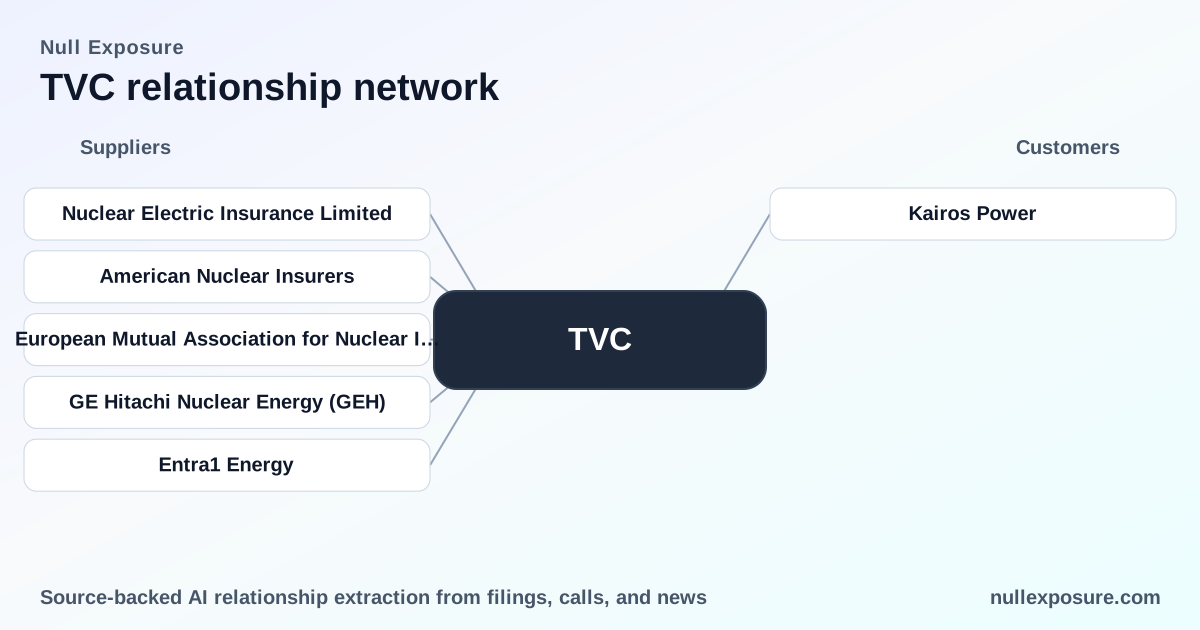
Nuclear Electric Insurance Limited (NEIL)
TVA carries property, decommissioning liability, and decontamination liability insurance through Nuclear Electric Insurance Limited, and purchases accidental outage (business interruption) insurance for its nuclear sites from NEIL, creating a layer of risk transfer for large nuclear loss exposures. This is described in TVA’s FY2025 Form 10‑K.
American Nuclear Insurers (ANI)
TVA’s nuclear liability protection includes a primary level provided by American Nuclear Insurers combined with secondary financial protection, which TVA states together provide up to $16.3 billion in coverage, a meaningful cap for catastrophic nuclear scenarios, as disclosed in the FY2025 10‑K.
European Mutual Association for Nuclear Insurance
In addition to NEIL, TVA lists the European Mutual Association for Nuclear Insurance among its carriers for property, decommissioning, and decontamination liabilities, per TVA’s FY2025 Form 10‑K, diversifying the insurer base for nuclear exposures.
GE Hitachi Nuclear Energy (GEH)
TVA entered an agreement with GE Hitachi in August 2022 to support planning and preliminary licensing for a potential deployment of the BWRX‑300 small modular reactor at the Clinch River site, reflecting a strategic technology partnership to expand TVA’s nuclear capacity pipeline (World Nuclear News, report on the Clinch River SMR program).
Entra1 Energy
TVA has an agreement to collaborate with Entra1 Energy to provide up to 6 GW of new nuclear generation through six Entra1 reactor units, positioning Entra1 as a prospective supplier of bulk firm capacity in TVA’s long-term generation mix (NucNet news report, December 2025).
What the constraints in filings tell investors about TVA’s operating model
TVA’s public filings and related reports produce several company-level signals that shape supplier risk and financing considerations:
- Contracting posture — long-term dominant. TVA sources the vast majority of purchased power through long-term PPAs (95% of purchased power in 2025), embedding multi-decade counterparty exposure and commissioning risk into its supply stack.
- Limited spot exposure. Spot market purchases represented roughly 3% of bought power in 2025, which constrains short-term procurement volatility but leaves TVA less nimble to short-term price dislocations.
- Contract maturity and project timeline. Renewable PPAs include 15–20 year terms with project start windows from 2026–2028, which front-loads capital commitments and counterpart performance risk into the next budget cycles.
- Counterparty mix includes government relationships. TVA supplies other federal agencies and purchases from the Southeastern Power Administration, indicating strategic governmental counterparties that affect regulatory and payment dynamics.
- Role duality — buyer and seller. TVA functions as both a buyer (fuel, purchased power) and seller (power to distributors and agencies), creating two-sided counterparty exposure across procurement and sales contracts.
- Opportunity pipeline and prospect stage activity. TVA issued an RFP in April 2025 for up to 2,250 MW of new-build resources and expects awards in 2027, indicating active, near-term capacity procurement that will translate into new long-term obligations.
- Scale of committed spend. The filings cite $862 million of total capacity payments related to battery PPAs over contract life, signaling material medium-term spend that impacts liquidity and contract risk.
These constraints collectively show a utility with predictable revenues and significant long-dated contractual commitments, but one that also concentrates execution risk in large projects and relies on structured insurance programs to cap tail liabilities.
Investment implications — what to watch and why it matters for TVC holders
- Insurance coverage is a core credit mitigant. The combination of NEIL, ANI and European Mutual Association protections — and the stated $16.3 billion of combined coverage — materially reduces balance-sheet exposure from a catastrophic nuclear event; investors should track renewals and capacity levels in future filings.
- Project delivery risk is concentrated and near-term. Multiple PPAs coming online between 2026–2028, plus the 2,250 MW RFP process with awards expected in 2027, make the 2026–2028 window critical for capital deployment and construction outcomes.
- Large battery PPA commitments are capital‑intensive. The $862 million capacity-payment figure is a meaningful commitment that affects near-term cash flow allocation and counterparty concentration.
- Nuclear suppliers influence long-term generation mix. Relationships with GEH for BWRX‑300 planning and Entra1 for up to 6 GW of capacity change TVA’s fuel and technology exposure over decades, with direct implications for operating cost structure and regulatory engagement.
For further due diligence on supplier exposure and contract-level analytics, visit https://nullexposure.com/ to see how supplier relationships map to credit and operational risk.
Final read: balancing predictability and execution risk
TVA’s model delivers high revenue visibility through long-term PPAs and regulated-like counterparties, which supports preferred-level claim stability; however, the same profile concentrates execution risk in large, multi-year projects and relies on structured insurance programs for nuclear tail risk. Monitor upcoming PPA awards in 2027, the 2026–2028 commissioning window, and future insurer capacity notices as primary triggers for credit and valuation shifts. For a deeper supplier-risk briefing tailored to investors and operators, go to https://nullexposure.com/.