Tevogen Bio Holdings (TVGN): Supplier Relationships That Power an AI‑driven T‑cell Therapeutics Platform
Tevogen develops off‑the‑shelf precision T‑cell therapeutics and monetizes through clinical development and, ultimately, product licensing and commercialization of cell therapies across virology, oncology and neurology. The company runs an AI‑enabled discovery and manufacturing roadmap that relies on third‑party cloud and data services as well as contract manufacturers and laboratories; those supplier linkages are operationally critical to platform scale and directly influence time‑to‑market and cost structure. For a consolidated supplier risk view and monitoring tools, visit https://nullexposure.com/.
What the supplier map looks like in plain terms
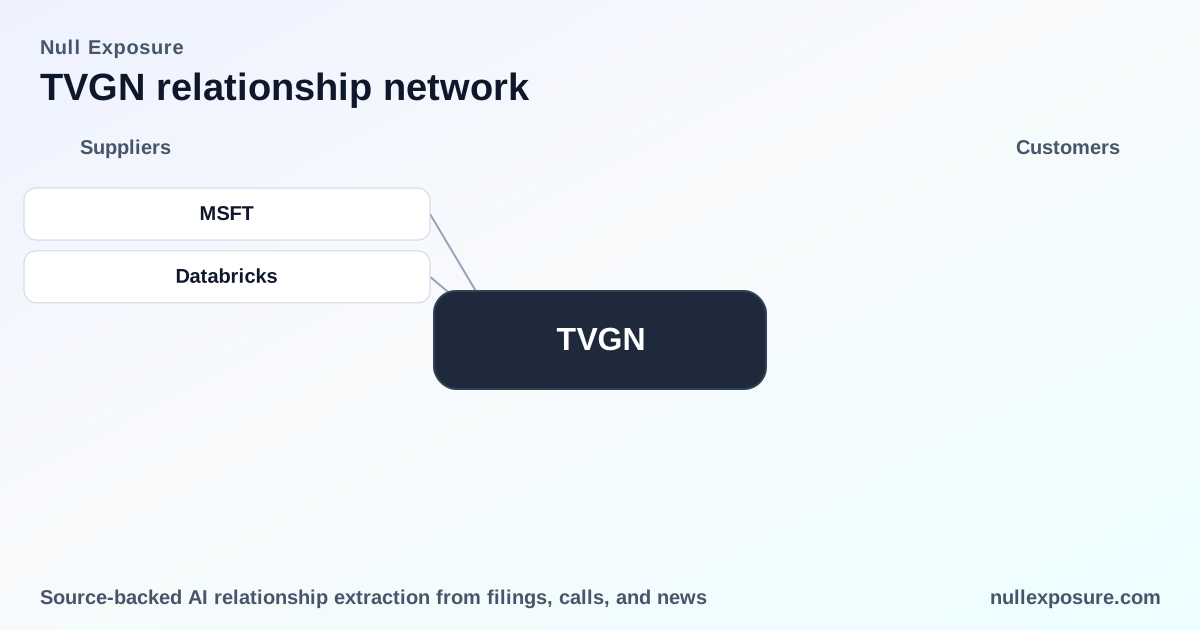
Tevogen’s public disclosures and press coverage identify two consistent technology partners in its platform stack: Microsoft and Databricks. Both are cited in multiple company statements describing the cloud and data backbone that supports Tevogen’s proteome prediction and therapeutic discovery ambitions.
Microsoft — cloud and data services supporting discovery workflows
Tevogen publicly states it uses Microsoft cloud and data services as a core component of its platform that aims to predict proteome interactions for protein–HLA combinations, accelerating therapeutic discovery and reducing per‑candidate costs. This linkage is highlighted in company press releases and investor communications across FY2025–FY2026. Source: GlobeNewswire press release (Dec 8, 2025) and subsequent FY2026 company announcements (e.g., SahmCapital and Yahoo Finance filings) — see https://www.globenewswire.com/news-release/2025/12/08/3201905/0/en/Tevogen-Recognized-on-2025-NJBIZ-Power-List-Amid-Growth-and-Multi-Billion-Dollar-Revenue-Outlook.html and related FY2026 notices.
Databricks — data engineering and analytics layer for proteomics
Tevogen names Databricks alongside Microsoft as a strategic data services provider that underpins the company’s aspiration to scale proteome prediction and analysis workflows, enabling rapid candidate selection across multiple indications. This relationship is documented in the same set of press communications covering late‑2025 and early‑2026 planning statements. Source: Company announcements and press releases including GlobeNewswire and SahmCapital (FY2025–FY2026) — see https://www.globenewswire.com/news-release/2025/12/08/3201905/0/en/Tevogen-Recognized-on-2025-NJBIZ-Power-List-Amid-Growth-and-Multi-Billion-Dollar-Revenue-Outlook.html and https://www.sahmcapital.com/news/content/tevogen-demonstrates-platform-scalability-and-multi-indication-t-cell-pipeline-expansion-in-2025-2026-01-12.
For a deeper supplier scorecard and periodic alerts on relationship changes, visit https://nullexposure.com/.
Why these relationships matter for investors and operators
Tevogen positions cloud and analytics vendors as foundational to its discovery economics. That dynamic creates three measurable operating implications:
- Concentration of critical capabilities. The company points to a small set of technology partners to run compute‑intensive proteome prediction workflows; that concentrates upstream operational risk in those providers and the supporting integrations.
- Outsourced manufacturing dependency. Public filings and disclosures show Tevogen relies on CMOs, academic manufacturing agreements, and third‑party laboratories for clinical‑grade material production — a classic biotech operating model where discovery is internal but GMP manufacturing is outsourced.
- Contract posture favors flexibility but increases transition risk. Tevogen discloses that many manufacturing and CRO contracts are cancelable and lack minimum purchase commitments, which reduces long‑term fixed costs but raises the risk of supply interruption and lead‑time exposure if a supplier relationship changes.
These are company‑level signals drawn from Tevogen’s regulatory filings and recent public statements.
Constraints and what they tell you about supplier economics and risk
Tevogen’s disclosures reveal an operating model that balances agility with exposure:
- Contracting posture: The company reports that agreements with CROs, CMOs and third parties are generally cancelable and without minimum purchase commitments, indicating a short‑term, on‑demand contracting approach that minimizes committed spend but increases supplier transition risk.
- Framework financing: Tevogen maintains a line of credit from the Patel Family that functions as a framework facility for term loans (initially $36 million capacity), which signals backstop liquidity to support supplier payments and manufacturing ramp.
- Individual‑expert relationships: The company contracted Dr. Manmohan Patel for advisory services related to manufacturing development, real estate and quality systems, reflecting reliance on individual expertise to operationalize manufacturing.
- Materiality and single‑source risk: Filings state that interruptions in limited or sole‑sourced raw materials could materially harm manufacturing, establishing supply inputs as a material operational constraint.
- Role mix: Disclosures treat counterparties as both manufacturers and service providers — Thomas Jefferson University and CMOs are cited for manufacturing of clinical materials, while MSSPs and other service providers support cloud security and operations.
- Spend scale: A disclosed $2.0 million sponsor advisory fee and related references place certain third‑party spend in the $1m–$10m band, consistent with a pre‑commercial company investing in platform scale rather than large fixed infrastructure outlays.
Collectively these constraints describe a company that is operationally mature enough to run multi‑partner programs but remains sensitive to supplier continuity and raw‑material sourcing.
Risks, mitigants and what operators should prioritize
- Risk — supplier concentration in cloud and analytics. Relying on a small set of technology providers centralizes risk around outages, price changes, or changes in commercial terms. Operators should model alternative compute and storage paths and negotiate defined SLAs and exit‑assistance clauses.
- Risk — manufacturing and single‑source inputs. The company flags potential material harm from supply interruptions. Investors should quantify time‑to‑qualification for alternative sources and assess inventory buffering strategies.
- Mitigant — flexible contracting and financing. Cancelable contracts reduce fixed overhead during development, and an available credit facility strengthens short‑term liquidity to bridge supplier payments and manufacturing scale‑up.
- Operational priority — governance and cyber controls. Given third‑party cloud usage, maintaining a managed security service provider and robust vendor governance is essential to protect PHI and research IP.
Key takeaway: supplier relationships with Microsoft and Databricks accelerate Tevogen’s discovery curve but amplify third‑party operational risk; the company’s contracting strategy minimizes committed spend while increasing sensitivity to supplier continuity.
Bottom line and next steps for investors
Tevogen is building a capital‑efficient discovery and early‑clinical engine that leans on enterprise cloud providers and contract manufacturing. For investors evaluating exposure, the critical questions are vendor concentration, supply‑chain redundancy for GMP inputs, and the company’s ability to convert platform scale into recurring commercial revenue.
For practical monitoring and supplier risk scoring tied to Tevogen’s public filings and news flow, explore our tools at https://nullexposure.com/. If you want an immediate supplier risk briefing or to set up periodic alerts for TVGN, visit https://nullexposure.com/ and request a tailored supplier risk note.