Tvardi Therapeutics (TVRD): what suppliers reveal about commercialization readiness and execution risk
Tvardi Therapeutics is a clinical-stage biopharma that develops small-molecule oncology therapies and advances them toward commercialization through partnerships and outsourced manufacturing. The company currently monetizes primarily through licensing, development milestones, and the pathway to future product sales contingent on regulatory approvals; near-term financials reflect clinical spending and negative EBITDA against a small market capitalization. For investors evaluating supplier risk, Tvardi’s public filings show a concentrated, deliberately contracted manufacturing footprint that is structured for long-term production but carries the usual CMO concentration and supply-chain criticality inherent to small-cap biotechs.
Explore supplier mapping and contract signal overlays at https://nullexposure.com/ to assess counterparties and renewal timing.
Why suppliers matter more than headlines for a clinical-stage drug developer
Manufacturing and supply agreements are the operational backbone for companies that rely on external chemistry and sterile-fill capabilities. Tvardi’s filings record commercial supply agreements and a master services framework rather than ad hoc one-off orders; that signals an intent to scale product manufacture without building owned capacity. For investors, those attributes translate to two practical checkpoints:
- Execution risk: CMOs are single points of failure for batch release, quality control, and regulatory compliance. A supply interruption can delay product launch and revenue timing.
- Negotiation and leverage: Long-term contracts with automatic renewals can lock the company into pricing and delivery terms, but they also secure capacity — a scarce asset for novel injectable drugs.
If you are modeling TVRD’s path to revenue, include contingency assumptions for CMO downtime and consider milestone timing tied to FDA approvals. For deeper counterparty profiles and renewal cycles visit https://nullexposure.com/ for supplier-level detail.
The relationship list — what the FY2024 10‑K records
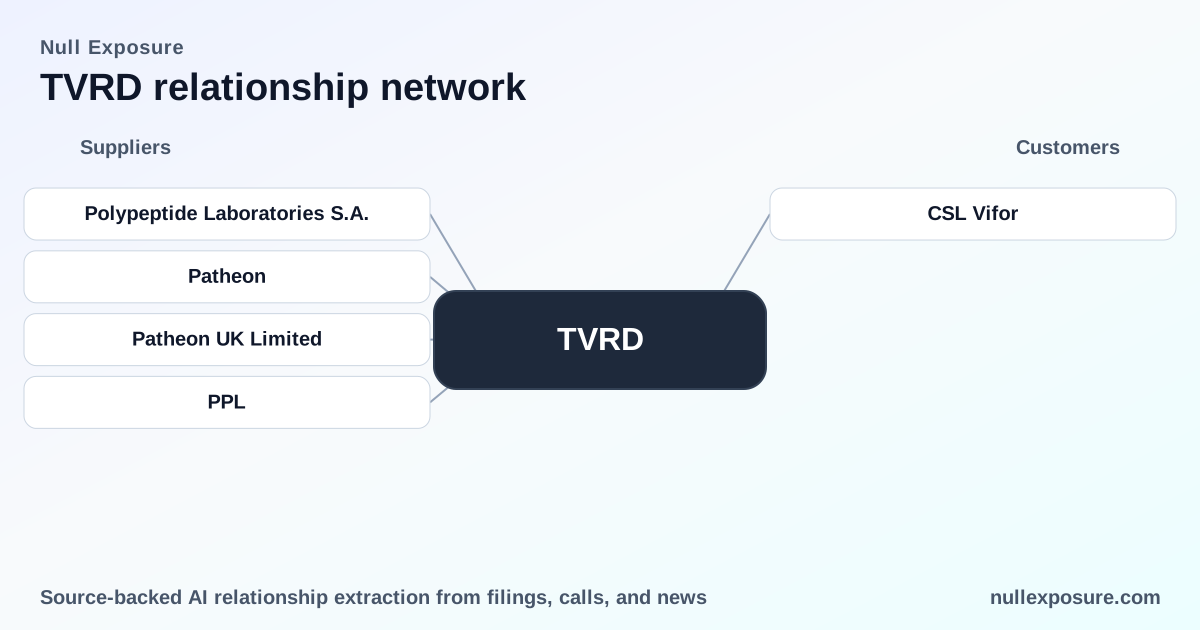
Below are every supplier relationship identified in the filing results delivered for TVRD’s supplier scope. Each item is a plain-English summary with the filing cited.
-
Polypeptide Laboratories S.A. (PPL) — The FY2024 10‑K states Tvardi (through its program disclosures) has an API Commercial Supply Agreement with Polypeptide Laboratories S.A. that defines responsibilities for the manufacture and supply of API for the difelikefalin injection product candidate. (Source: FY2024 10‑K, tvrd-2024-12-31.)
-
Patheon — The filing records a Master Services Agreement and related product agreements under which Patheon and its Greenville site provide commercial manufacture of difelikefalin injection, plus supportive services such as quality control testing for raw materials, packaging components, and finished product. (Source: FY2024 10‑K, tvrd-2024-12-31.)
-
Patheon UK Limited — In July 2019 Tvardi entered a Master Services Agreement with Patheon UK Limited; the MSA governs the non‑exclusive manufacturing services to be provided for specified drug products. (Source: FY2024 10‑K, tvrd-2024-12-31.)
-
PPL (listed again / inferred symbol PPL) — The filing repeats that a commercial supply agreement with PPL exists to produce API, indicating multiple mentions or separate contractual references to the same Polypeptide Laboratories counterparty in the document. (Source: FY2024 10‑K, tvrd-2024-12-31.)
These entries reproduce the filing language and frequency of mentions — multiple references to the same counterparty reflect both API supply and finished‑product manufacturing arrangements recorded in the company’s disclosure.
Contract posture, concentration and the operating constraints investors should read into
Tvardi’s supplier disclosures are accompanied by several contract-level signals that shape operational and financial risk.
-
Long-term contracting: The API Commercial Supply Agreement contains an initial term that runs until five years after FDA approval of the relevant NDA and automatically renews for successive five-year periods unless terminated, and the MSA includes automatic renewals after its initial term. That structure trades short-term flexibility for long-term capacity assurance. (Company-level signal taken from FY2024 10‑K language.)
-
Manufacturer role and concentration: The 10‑K explicitly describes Patheon and PPL as manufacturers of both API and finished product at specified sites (Monza, Italy and Greenville, North Carolina). This confirms material dependency on a narrow set of CMOs for commercialization-critical manufacturing functions. (Attribution: FY2024 10‑K excerpts naming Patheon and PPL.)
-
Active, non‑exclusive services: The agreements are described as non‑exclusive and active, indicating Tvardi maintains the contractual ability to engage multiple suppliers but currently relies on these named providers for commercial supply. Non-exclusivity reduces but does not eliminate supply risk. (Company-level signal from FY2024 10‑K.)
-
Service-provider breadth: The filing also makes a company-level statement that Tvardi uses external providers across hosting, CROs, and CMO functions, indicating a broadly outsourced operating model that centralizes capital-light development while externalizing execution risk.
Investment implications and near-term monitoring checklist
For operators and investors, the supplier footprint suggests a trade-off: Tvardi has secured long-dated manufacturing relationships that support commercialization timing, but the limited number of named CMOs concentrates execution and regulatory risk. Key items to track:
- Renewal and termination windows in the MSA and API agreement; automatic renewals create rollover risk if market terms have shifted.
- Quality and batch-release history at the Patheon Monza and Greenville sites; adverse manufacturing findings could materially delay launch.
- Inventory and dual-sourcing plans — the 10‑K notes non‑exclusivity, so evidence of active secondary suppliers would materially reduce single-supplier exposure.
- Contract price and capacity clauses that could affect gross margins post-launch; long-term price floors or volume commitments can be accretive or restrictive depending on demand.
If you want a supplier-level risk dashboard and renewal calendar built against Tvardi’s filings, see our supplier intelligence hub at https://nullexposure.com/.
Bottom line and recommendation for investors
Tvardi’s supplier disclosures in the FY2024 filing show purposeful long-term manufacturing arrangements with named CMOs (Patheon and PPL) plus an outsourced operating model that is standard for clinical-stage biotechs. This setup supports a credible path to commercial production but creates concentrated counterparty risk that requires active monitoring.
- If your thesis rests on near-term approval and commercialization, price in the operational risk of CMO disruptions and verify dual-sourcing or contingency inventory plans.
- If you are value-oriented and focused on licensing/milestone upside, the long-term contracts are a positive signal of commercialization intent but limit upside from renegotiating capacity at more favorable terms post-approval.
For a detailed supplier risk report and timeline tied to Tvardi’s disclosed agreements, visit https://nullexposure.com/ and request the TVRD supplier dossier.
Conservative modeling of TVRD should include scenario bands for CMO-related launch delays and cost-of-goods adjustments; the handoff from regulatory success to reliable commercial supply is the operational gauntlet that determines revenue realization.