Travere Therapeutics (TVTX): Supplier footprint, contract exposure, and what it means for investors
Travere Therapeutics is a commercial-stage biopharma that develops and sells therapies for rare diseases and monetizes primarily through product sales, led by FILSPARI and Thiola. The company outsources virtually all manufacturing and distribution activity to third parties, creating a business model where product revenue and margin depend on external contract manufacturers and distributors rather than in‑house production. Travere reported roughly $491 million in trailing twelve‑month revenue and a market capitalization near $2.6 billion, underscoring how supplier performance directly drives cash flow and valuation. For a deeper supplier-risk view, visit https://nullexposure.com/.
How Travere runs its supply chain and why investors should care
Travere operates with no meaningful internal manufacturing or distribution capacity; it relies on contract manufacturing organizations (CMOs) and third‑party distributors for commercial supply. That operating stance produces a set of predictable commercial characteristics: long‑term contractual exposure, concentration risk around key manufacturing partners, and direct operational criticality for marketed revenues. The company explicitly links long‑term reliance on external partners to the commercial supply of FILSPARI and its development‑stage programs, making supplier continuity a core investment risk.
Key supplier relationships that matter today
Catalent Pharma Solutions
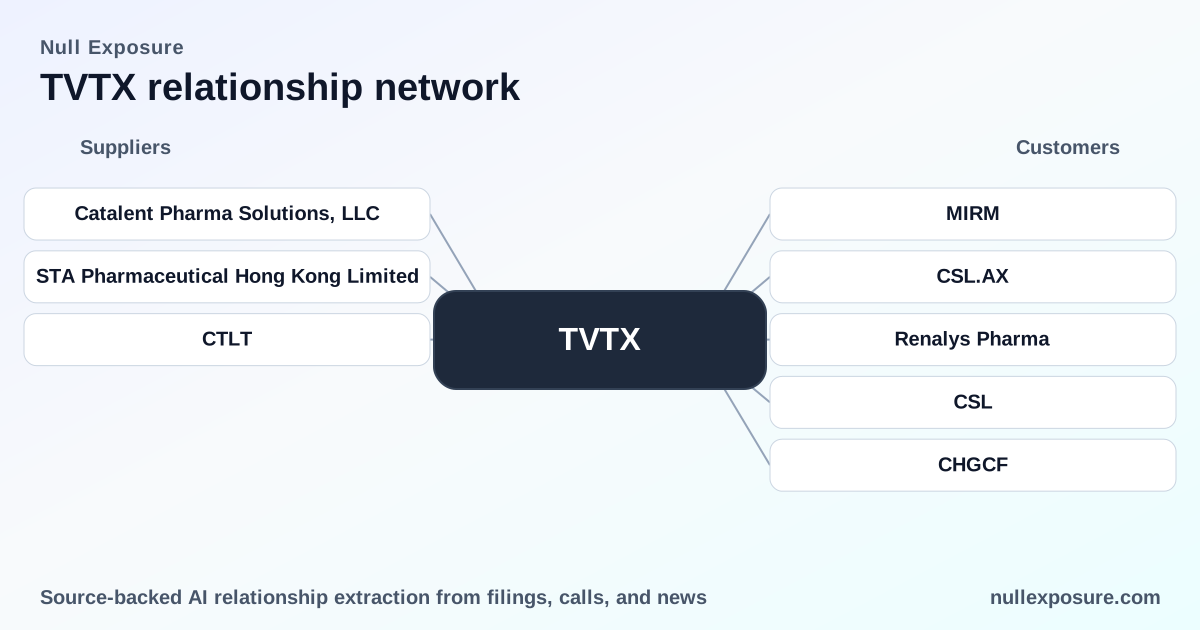
Travere has a Commercial Supply Agreement with Catalent Pharma Solutions dated December 21, 2021, which governs commercial manufacturing services. According to the company’s FY2024 Form 10‑K, this contract underpins part of Travere’s outsourced production footprint, and a TradingView news post (March 2026) reiterated Catalent’s role in producing FILSPARI. Catalent is a material manufacturing partner for Travere’s lead product.
Source: Travere Therapeutics FY2024 Form 10‑K; TradingView coverage referencing the company 10‑K (March 2026).
STA Pharmaceutical Hong Kong Limited (WuXi AppTec subsidiary)
Travere maintains a Master Manufacturing Supply Agreement dated September 30, 2020, with STA Pharmaceutical Hong Kong Limited, a subsidiary of WuXi AppTec. The FY2024 Form 10‑K documents that agreement as part of Travere’s CMO network, and recent reporting (TradingView, March 2026) again lists STA among the third‑party manufacturers producing FILSPARI. STA/WuXi functions as a core external manufacturer in Travere’s supply chain.
Source: Travere Therapeutics FY2024 Form 10‑K; TradingView coverage referencing the company 10‑K (March 2026).
What the company disclosures say about contracting posture and constraints
Travere’s filings and related reporting collectively describe a supplier posture with these company‑level signals:
- Long‑term contractual commitments. The company discloses long‑term commitments and operating lease obligations and explicitly states intent to rely on third‑party manufacturers for the long‑term commercial supply of FILSPARI and other candidates. This indicates multi‑year contractual relationships and planning horizons that extend through late‑2020s.
- Global sourcing and geopolitical exposure. Travere sources materials and finished product from multiple countries and cites risk from changing trade policies, tariffs, and cross‑border limitations as a company‑level exposure.
- Material contractual obligations. The company reports that some CMO agreements require binding forecasts or minimum purchase commitments, which are material to financial statements and can create downside if demand falls or supply shifts.
- Outsourced distribution and operational criticality. Travere has no in‑house distribution network for FILSPARI or Thiola and depends on third‑party distributors; distribution failure would directly affect revenue and provider/patient access.
- Sole‑source manufacturing and concentration. Travere states reliance on third parties that are sole‑source suppliers, elevating concentration and operational risk.
- Active vendor program and service‑provider reliance. The company runs an active vendor management program and uses third‑party service providers across manufacturing, clinical, and IT functions.
- Spend scale consistent with mid‑range commitments. Public excerpts show spend and lease commitments in the $10m–$100m band, aligning supplier spending with material budget lines rather than incidental purchases.
These constraints form a coherent operating model: an asset‑light commercial biotech that converts clinical assets into revenue via outsourced manufacturing and distribution, with concentrated supplier exposure and contractual minimums that are financially meaningful.
For more supplier intelligence and relationship mapping, visit https://nullexposure.com/.
How supplier exposure translates into investment risk and opportunity
From a valuation and risk framework, Travere’s supplier posture produces a few direct implications:
- Revenue continuity is supplier‑dependent. With FILSPARI manufacturing split across third‑party CMOs, any manufacturing disruption, regulatory action at a CMO site, or failure to meet minimum purchase forecasts would reduce near‑term revenue and could force costly remediation.
- Negotiation leverage is asymmetric. Long‑term minimums and sole‑source arrangements create limited tactical flexibility and potential margin pressure if manufacturers increase pricing or require renegotiation to cover capacity costs.
- Geopolitical and supply concentration risk is priced into multiples. Global sourcing comments and reliance on overseas manufacturing increase exposure to tariffs and trade actions; investors should apply a premium for operational risk until diversification or redundancies are evident.
- Operational mitigants exist but are partial. Travere maintains a vendor management program and highlights active relationships, but those programs are preventive rather than substitutes for multi‑site replication of critical production capacity.
These are not theoretical concerns: the FY2024 Form 10‑K and subsequent reporting explicitly link manufacturing partners such as Catalent and STA to the supply of FILSPARI, tying product economics directly to external counterparties.
Practical next steps for investors and operators
For investors: focus due diligence on contract scope (minimum purchase obligations, termination rights, and transition timelines), CMO site regulatory history, and diversification plans for manufacturing and distribution. For operators: prioritize redundancy planning, clear service level agreements for critical product batches, and staged inventory buffers to protect commercial supply.
If you need a supplier‑level intelligence briefing or counterparty risk scoring for Travere’s partners, start here: https://nullexposure.com/.
Bottom line
Travere’s business model converts rare‑disease assets into revenue via outsourced manufacturing and distribution, making supplier relationships a central determinant of near‑term cash flow and valuation. Catalent and STA are documented commercial partners in public filings, and company disclosures flag long‑term commitments, concentration, and geopolitical sourcing as primary operational constraints. Investors should treat supplier contracts and minimum purchase obligations as first‑order risk factors when underwriting TVTX. For a tailored supplier risk profile and contract analysis, visit https://nullexposure.com/.