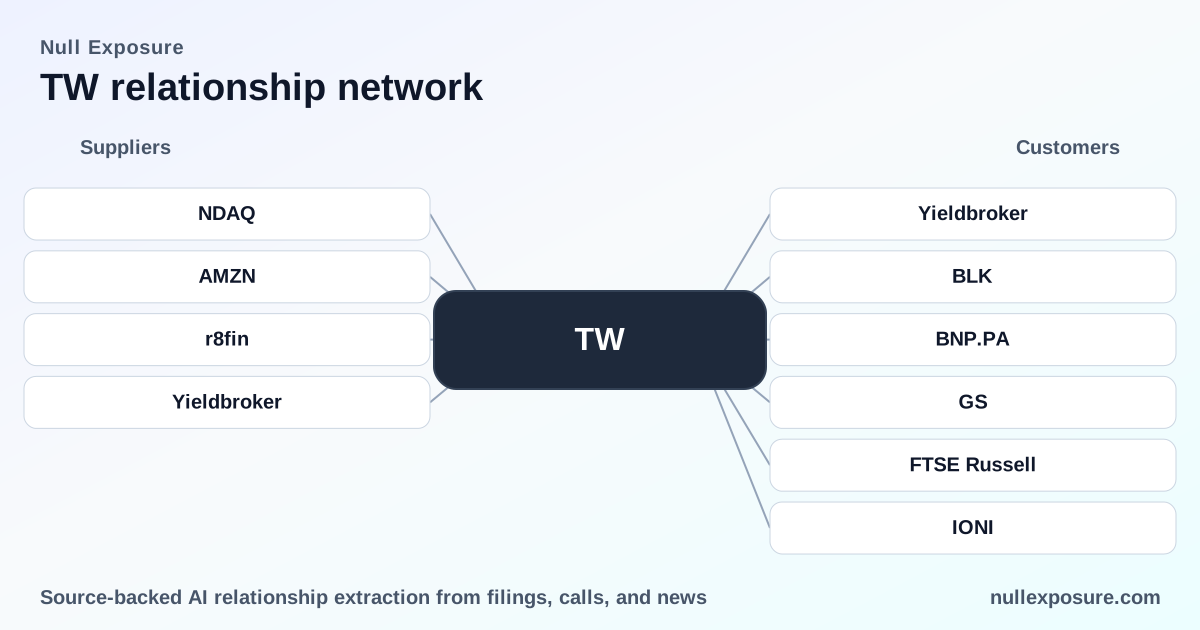
Tradeweb Markets (TW): Supplier relationships that shape margins and market access
Tradeweb operates electronic marketplaces for fixed income, derivatives and ETFs and monetizes through transaction fees, market data and analytics subscriptions, and post-trade services. The company combines fee-for-trade economics with high-margin data and reporting products, producing recurring revenue alongside episodic transaction volume. For investors and counterparties evaluating Tradeweb as a supplier or partner, the firm's external relationships—acquisitions, partnerships and third‑party dependencies—directly influence execution capacity, product distribution and data economics. Learn how Tradeweb’s partner set translates into operational leverage and exposure at https://nullexposure.com/.
A concise business snapshot investors should internalize
Tradeweb is a mature capital‑markets technology operator with $2.05B revenue TTM, ~40% profit margin, and a market capitalization near $27.1B (company latest quarter ended 2025-12-31). The company trades at a premium (trailing P/E ~32.8) reflecting durable margins, predictable data revenue, and scale benefits in electronic trading. Tradeweb’s revenue model is dual: trade execution fees drive volume sensitivity while data & reporting products deliver high-margin, recurring revenue.
Why supplier relationships matter to the model
Tradeweb’s marketplace economics rely on two dimensions that make supplier relationships strategically important: (1) market access and execution technology—partners expand instruments, geographies and execution methods; and (2) data and analytics supply chains—third parties contribute to pre- and post-trade data, analytics and reporting. Company disclosures identify dependence on third parties to perform key functions and to supply pre- and post-trade data and analytics, signaling that supplier disruption would directly hit both top-line execution capacity and high-margin data services.
At the company level, this produces clear operating characteristics: a contracting posture oriented to vendor integration and acquisitions, high criticality of a limited set of external providers for data/analytics, and a business maturity that enables M&A to internalize capabilities rather than outsource them. These are company‑level signals grounded in Tradeweb’s own statements that it depends on third parties for core data and reporting solutions.
Explore supplier exposure scenarios and how they affect valuation modeling at https://nullexposure.com/.
Who Tradeweb is working with — four relationships to include in your model
Nasdaq — acquisition of Nasdaq Fixed Income (NFI)
Tradeweb completed the purchase of Nasdaq’s US fixed income business, Nasdaq Fixed Income (NFI), expanding its footprint in U.S. fixed income marketplaces and consolidating market share in electronic liquidity for rates and credit. This transaction strengthens Tradeweb’s product set and reduces reliance on third-party access for certain fixed-income flows (Finance Magnates, March 10, 2026: https://www.financemagnates.com/institutional-forex/nasdaq-announces-it-completed-the-sale-of-its-nfi-to-tradeweb-markets/).
Amazon Web Services (AWS) — data and cloud partnership
Tradeweb formed a partnership with Amazon Web Services to enhance data access and cloud capabilities, signaling continued investment in scalable data delivery and analytics infrastructure that supports subscription products and client-facing tools (Finance Magnates, reported April/first seen March 10, 2026: https://www.financemagnates.com/institutional-forex/nasdaq-announces-it-completed-the-sale-of-its-nfi-to-tradeweb-markets/).
r8fin — acquisition of algorithmic execution technology
Tradeweb announced a definitive agreement to acquire r8fin, a Chicago-based provider of algorithmic execution tools for U.S. Treasuries and interest rate futures, bringing in proprietary execution algorithms and low-latency execution capabilities that bolster Tradeweb’s rates execution offering (Finance Magnates, March 10, 2026: https://www.financemagnates.com/institutional-forex/tradeweb-enters-definitive-agreement-to-acquire-algorithmic-tech-provider-r8fin/).
Yieldbroker — completed acquisition of Australian trading platform
Tradeweb acquired Yieldbroker, an Australian platform specialized in government bonds and interest-rate derivatives, in an all-cash transaction (A$125 million), expanding Tradeweb’s APAC distribution and product coverage in sovereign and rate markets (Finance Magnates, March 10, 2026: https://www.financemagnates.com/institutional-forex/tradeweb-enters-definitive-agreement-to-acquire-algorithmic-tech-provider-r8fin/).
What these relationships imply for risk, concentration and strategy
Collectively, these relationships show a deliberate strategy: acquire adjacent market infrastructure and execution technology while partnering for scalable cloud and data distribution. Acquisitions like NFI, r8fin and Yieldbroker reduce dependence on outside execution providers by internalizing capabilities and geography-specific flow; the AWS partnership addresses the scalability and distribution of high-margin data products.
Operationally, key constraints for modeling include:
- Contracting posture: trade execution and data contracts will be a mixture of owned platforms and long-term agreements with cloud/data vendors, implying ongoing capex and integration costs but lower recurring pay-for-access fees as acquisitions complete integration.
- Concentration: criticality is elevated around a small number of platform-level relationships for data delivery and cloud infrastructure, which creates single‑vendor operational risk even as M&A reduces reliance on external execution platforms.
- Maturity: Tradeweb is in a consolidation phase—mature revenue and margins allow acquisitions to be accretive to data and execution products rather than speculative extensions.
Key risk factors to incorporate in valuation and operational diligence
- Execution volume sensitivity: trading fees are cyclical; modeling should stress scenarios where macro volatility compresses volumes while data revenue holds.
- Integration risk: recent and announced acquisitions require execution; failure to integrate r8fin, NFI or Yieldbroker would delay projected synergies and inflate costs.
- Third‑party criticality: reliance on third parties for pre/post-trade data and cloud services is a structural exposure; contract terms and service-level guarantees will materially affect resilience.
- Regulatory and clearing dependencies: Tradeweb depends on counterparties and clearinghouses; operational interruptions in these layers propagate into platform revenue.
Bottom line and action steps for investors and operators
Tradeweb’s supplier moves are strategic and accretive: acquisitions expand execution capabilities and geography, while cloud and data partnerships scale distribution. For investors, the combination of high margins, recurring data revenue and targeted M&A supports a premium multiple, but modelers must account for integration risk and concentrated third-party dependencies. For operators evaluating Tradeweb as a supplier, focus diligence on service-level terms for data delivery and the roadmap for integrating newly acquired execution tools.
For deeper supplier-level risk modeling and benchmarking against peer marketplaces, start with a focused exposure review at https://nullexposure.com/. If you are building counterparty diligence or vendor scorecards, tradeoffs between owned execution and third-party dependence are the primary drivers — evaluate those contracts and SLAs now at https://nullexposure.com/.
Tradeweb’s current trajectory is clear: grow execution share through acquisition while monetizing data at scale via cloud partnerships. That combination sustains margins and justifies a premium valuation, conditional on successful integration and stable clearing/counterparty dynamics. For a tailored supplier risk briefing, visit https://nullexposure.com/ and request a model-ready exposure report.