TWFG as a Supplier Partner: What investors need to know
TWFG is an insurance distribution platform that monetizes through agency sales and fee-based contracts: premiums and commissions from property & casualty insurance distribution, complemented by operational licensing and third‑party services that keep the network running. TWFG’s public filings show a business model that mixes recurring commission-driven revenue with infrastructure cost lines (software licensing and multi‑year physical commitments) that affect margins and capital planning. Learn how their supplier posture influences operating leverage and execution by exploring their disclosed vendor relationships and corporate constraints — or start a supplier risk review at https://nullexposure.com/.
How TWFG runs the business and where the money comes from
TWFG operates a hybrid insurance distribution and agency network that earns primary revenue through underwriting commissions and fees, while outsourcing specialist functions to third parties and licensing software to operate its agency platforms. According to the company’s most recent filings (latest quarter 2025-12-31), TWFG reported TTM revenue of $248.5 million with an operating margin of 21.1%, indicating the core distribution business is relatively profitable before non‑operating items. The company’s valuation metrics (market cap roughly $300.7M and a trailing P/E ~37.8) reflect investor expectations for growth and margin expansion; analysts’ consensus target price is $28 with a mix of buy and hold recommendations.
TWFG’s cost base includes predictable vendor fees (software licenses) and multi‑year lease commitments for physical offices, which makes supplier contracting posture a direct lever on cash flow and scalability. Review TWFG supplier exposures at https://nullexposure.com/ if you are modeling operating leverage or counterparty risk.
Supplier relationships investors should be watching
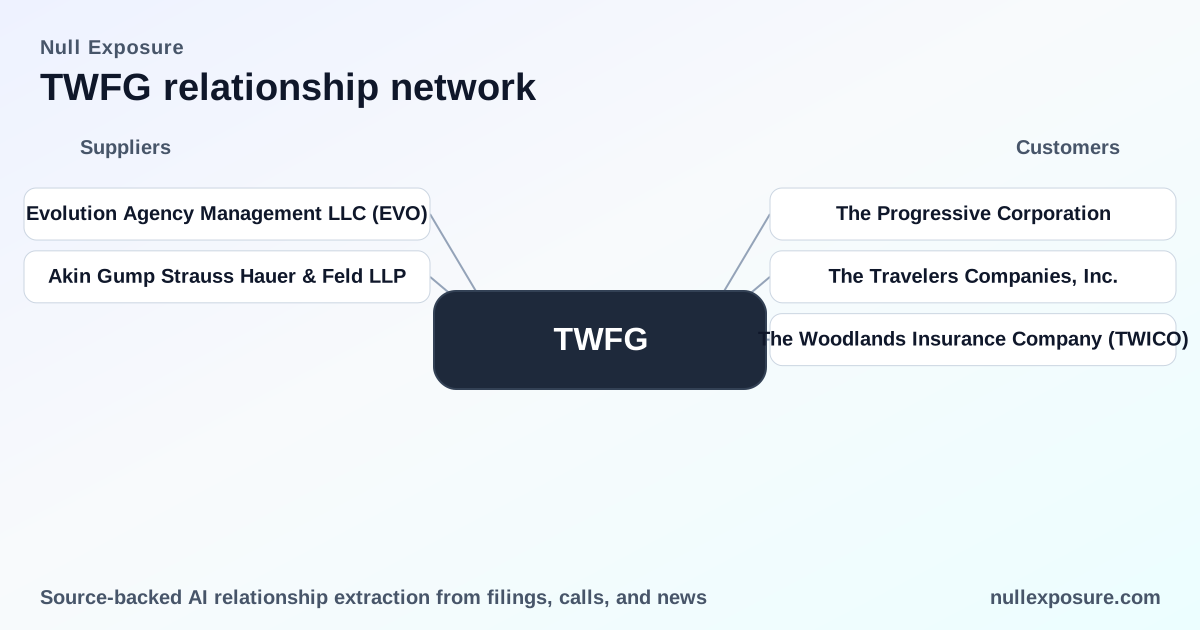
Evolution Agency Management LLC (EVO)
TWFG licenses EVO’s proprietary agency management system for its TWFG-IS and TWFG-GA operations under a fixed annual fee arrangement. This is a classic licensee relationship where the vendor provides mission‑critical agency management software and TWFG pays a recurring fee — a structurally predictable operating expense tied to day‑to‑day distribution effectiveness. According to TWFG’s 2024 Form 10‑K, the company explicitly discloses this software licensing agreement (FY2024, 10‑K).
Akin Gump Strauss Hauer & Feld LLP
Akin Gump acted as legal counsel to TWFG in connection with TWFG’s initial public offering of common stock, a professional services engagement tied to capital markets activity rather than ongoing operational delivery. The engagement was documented in a press release by Akin Gump in FY2025 announcing their advisory role on the IPO.
What the disclosed constraints reveal about the operating model
The company’s constraint signals — extracted from its supplier and risk disclosures — outline how TWFG contracts, where dependencies exist, and how management frames materiality.
-
Licensing posture and vendor lock‑in (relationship‑level). The 10‑K explicitly states TWFG has a software licensing agreement with EVO that provides access to a proprietary agency management system for a fixed annual fee. That licensing model creates predictable OPEX but also operational dependency on a single vendor for critical agency systems (EVO is named in the filing).
-
Multi‑year commitments for physical expansion (company‑level). TWFG discloses that opening offices and expanding distribution requires substantial commitments, and the company is “often required to commit to multi‑year, non‑cancellable lease agreements.” This points to capital rigidity: expansion scales revenue but increases fixed costs and lease duration risk.
-
Third‑party service reliance (company‑level). Management states the company “relies substantially upon third‑party service providers for various aspects of our business processes,” flagging operational concentration across outsourced vendors and the need for vendor continuity planning.
-
Security event deemed immaterial (company‑level). A disclosed security event was characterized as not having a material impact on the business or financial condition at the time, which signals incident detection and response capability, but also leaves ongoing cyber risk on the balance sheet as a monitoring item.
Together these constraints indicate a company with predictable recurring vendor costs, structured vendor relationships, and fixed commitments that amplify operating leverage in both directions: faster growth improves margins; operational disruption or unfavorable vendor renewals compress them.
Investment implications: upside, risks, and what to model
TWFG’s strengths for investors are clear: high operating margin (21.1% TTM), recent top‑line growth (quarterly revenue growth YOY ~35.8%), and meaningful institutional ownership (about 89% institutional). These support a thesis of continued margin conversion as distribution scales.
Key risks for investors evaluating supplier relationships:
- Vendor concentration on critical software (EVO) creates single‑point operational and negotiation risk; model scenarios where license terms escalate or transition costs arise.
- Lease and expansion commitments make cash flow less flexible — stress scenarios should include higher occupancy costs or slower office productivity.
- Third‑party service reliance and cyber risk require sensitivity to service interruptions and remediation costs despite the company’s current assessment of immateriality.
Operational levers to watch in quarterly filings:
- Renewals or renegotiations of the EVO license (pricing, term length, termination rights);
- Disclosures on multi‑year lease obligations and new office openings;
- Any material change in third‑party service provider arrangements or security incident outcomes.
If you are building a supplier risk overlay to a financial model, prioritise license cost escalation, transition risk, and lease fixed‑cost stress tests. For a deeper supplier mapping and continuous monitoring, explore https://nullexposure.com/ for tailored reports.
Bottom line for investors
TWFG is a distribution‑first insurer with recurring revenue and high operating profitability, but supplier and real‑estate commitments are non‑trivial levers on free cash flow. The EVO software license is a concrete, named exposure that delivers predictable functionality at a fixed annual cost; other constraints—long‑term leases, broad third‑party reliance, and a disclosed but non‑material security event—are company‑level signals that increase the importance of vendor diligence in any investment thesis.
For institutional diligence that combines financial metrics with supplier contract intelligence, start your supplier review at https://nullexposure.com/. Conduct vendor‑level sensitivity testing on license renewals and lease obligations as part of any valuation or risk assessment before adding TWFG exposure.