TWG (Top Wealth Group): Capital Intermediation, Premium Caviar Supply, and what investors should price in
Top Wealth Group Holding Limited (NASDAQ: TWG) is a Hong Kong–based supplier of premium sturgeon caviar and related gourmet products that monetizes primarily through product sales and international distribution, while periodically tapping capital markets to fund growth and inventory. The company’s operational spine is food distribution and branded gourmet retail; its financial posture depends on small-scale revenue relative to market valuation and episodic equity raises executed through placement agents. For investors evaluating supplier relationships, the key commercial link to track is TWG’s use of securities intermediaries to access funding, which directly affects working capital for inventory-intensive luxury goods. Explore more supplier risk intelligence.
How TWG runs its business and where money actually comes from
TWG sells premium caviar and associated winery products into Hong Kong and international markets under branded channels and wholesale distribution. Revenue is derived from product sales, with gross profit and operating margins that suggest the company captures meaningful pricing power in its niche, but absolute scale remains small—TTM revenue is roughly $4.5 million and gross profit about $2.03 million.
Capital structure and market metrics tell the rest of the story: market capitalization is approximately $98 million with a small public float and low institutional ownership, which increases reliance on capital markets and private placements to finance inventory cycles and growth. Earnings are currently negative on a per-share basis, while valuation multiples (Price/Sales and EV/EBITDA) are elevated, so successful access to funding is an operational necessity rather than an occasional convenience.
Recent capital intermediation: Univest Securities, LLC handled a $5.04 million placement
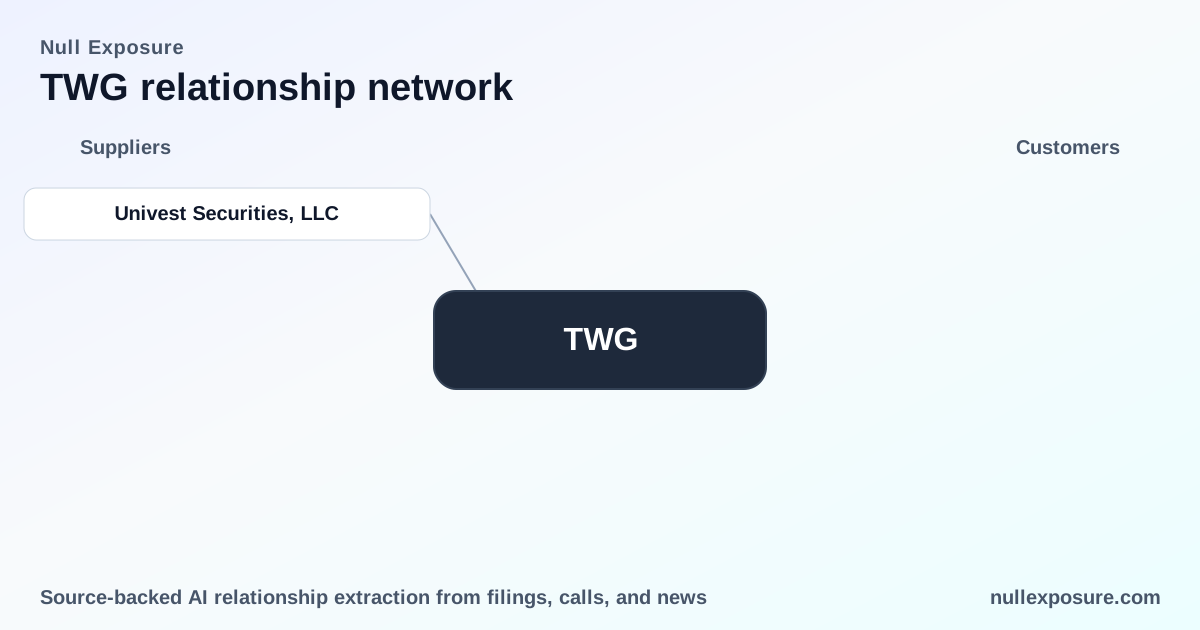
Univest Securities, LLC — recent placement agent for TWG — executed a best-efforts public offering to raise approximately $5.04 million for the company.
- A GlobeNewswire release dated December 10, 2025 reported that Univest acted as the exclusive placement agent in the closing of a $5.04 million best-efforts public offering for Top Wealth Group (https://www.globenewswire.com/news-release/2025/12/10/3203537/0/en/Univest-Securities-LLC-Announces-Closing-of-5-04-Million-Public-Offering-for-Its-Client-Top-Wealth-Group-Holding-Limited-NASDAQ-TWG.html).
- A FinancialContent markets note on December 9, 2025 likewise confirmed that Univest was acting as the exclusive placement agent in the offering, documenting the pricing and agent role (https://markets.financialcontent.com/wral/article/gnwcq-2025-12-9-twg-announces-pricing-of-504-million-public-offering).
Both notices establish a clear, recent financing relationship between TWG and Univest; the placement agent role is the primary supplier relationship documented in the public record for FY2025.
What that relationship implies for operations and liquidity
The use of a best-efforts placement agent signals a contracting posture that is transactional and non-committal on the agent’s part—Univest’s role is to source investors rather than to underwrite the raise on a firm-commitment basis. For a small luxury-goods distributor, that is consistent with a need to preserve balance-sheet flexibility without transferring significant underwriting risk to an investment bank.
Company-level signals that shape operational constraints include:
- Scale and concentration: With TTM revenue of ~$4.5 million and market cap under $100 million, the business is small relative to public-company comparables, increasing sensitivity to single financing events.
- Capital intensity and timing: Premium food distribution requires inventory financing and working capital; periodic equity raises are a practical tool to bridge seasonal or procurement-driven cash needs.
- Liquidity and governance: A small public float (approximately 541,610 shares) and modest institutional ownership (about 9.5%) create thin trading and heighten the influence of insiders (≈14.7% insider ownership) on strategic choices.
- Valuation vs. fundamentals: High Price/Sales and EV/EBITDA multiples indicate the market is pricing growth or scarcity value; operating and profit margins suggest profitable unit economics but the company’s negative diluted EPS demonstrates a reliance on capital infusions to support near-term strategy.
These are company-level constraints and signals, not attributes of any single supplier relationship.
Practical risk and opportunity checklist for investors and operators
- Funding cadence is a strategic risk. TWG’s dependence on periodic equity raises (as evidenced by the Univest placement) makes timing and market receptivity to small-cap deals a critical variable for inventory continuity.
- Supply integrity and brand premium are strengths. Gross margins indicate pricing power in a niche luxury category; protecting product quality and distribution channels is core to sustaining margins.
- Liquidity and control risks exist. Narrow float and meaningful insider ownership can produce volatility and sudden shifts in capital strategy; investors should watch any future placement agent announcements for dilutive events.
- Counterparty monitoring is essential. The selection of placement agents and the terms (best-efforts vs firm-commitment) directly affect the probability of successful capital raises and the company’s negotiating leverage.
For a deeper, operationally focused supplier risk profile, consider examining capital-raise timelines and agent track records to anticipate liquidity windows. Get supplier intelligence at NullExposure.
How to monitor TWG’s supplier- and capital-related signals going forward
Track three categories of public signals on a rolling basis: (1) placement agent engagements and offering docs (dates, sizes, agent type); (2) cash and working capital disclosures in quarterly filings around the fiscal year end (June); and (3) sales cadence and margin trends to validate that premium pricing sustains gross-profit levels despite scale constraints. Each financing notice is a near-term operational indicator because it translates directly into inventory purchasing power for a caviar-centric business.
Bottom line and recommended actions
TWG is a niche premium food distributor with concentrated capital needs and a recent reliance on placement agents to shore up liquidity. The Univest relationship is the most relevant supplier linkage for investors today: it directly supplies capital rather than product, and therefore determines short-term operational continuity. Monitor future placement announcements, the structure of any offerings, and quarterly cash disclosures before updating valuation assumptions.
If you are evaluating partnership or investment decisions, prioritize due diligence on capital-raising cadence and placement terms, and revisit TWG’s operating metrics at each post-offer quarter. For continuous supplier-risk monitoring and deeper relationship intelligence, visit NullExposure and set up alerts: https://nullexposure.com/.
For specific documents cited in this analysis, see the Univest placement reports via GlobeNewswire (Dec 10, 2025) and FinancialContent/Markets (Dec 9, 2025). Stay informed at NullExposure.