Twin Disc (TWIN): Supplier Relationships, Strategic Shape, and Investor Takeaways
Twin Disc is a designer and manufacturer of power-transmission equipment for off‑highway and marine markets that monetizes through equipment sales, aftermarket parts and service, and targeted acquisitions that expand product scope and geographic reach. The company's core economics come from a mix of hardware margins and recurring aftermarket revenue, amplified by periodic M&A to buy technology and channel access. For investors assessing supplier risk and partner strategy, the recent acquisition cadence and a globally distributed procurement footprint are the primary operational levers to watch. Explore more supplier risk profiles at https://nullexposure.com/.
Recent M&A and integration are reshaping Twin Disc’s supplier posture Twin Disc completed multiple acquisitions that broaden its marine and industrial stack and add European and Canadian manufacturing capabilities. Management has publicly emphasized integration execution as a top strategic priority, which positions the company to capture cross-sell and aftermarket opportunities but also raises near‑term integration execution risk.
How Twin Disc runs its sourcing and supplier governance Twin Disc operates with a global supplier footprint and active buyer behavior. The company proactively monitors supplier quality and sources many raw materials internationally, creating exposure to trade policy and tariff shifts. This is a business that contracts as an industrial buyer with manufacturing capabilities in‑house, relying on both external suppliers and proprietary machining and assembly operations.
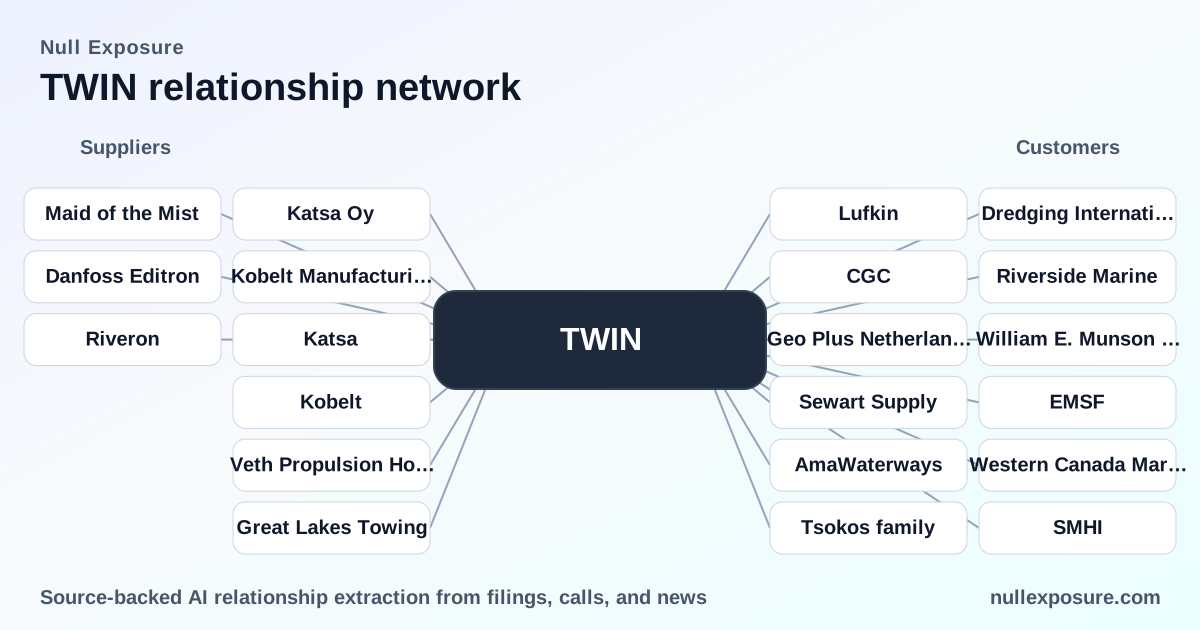
Relationship slate: every partner and mention in the record Below are the supplier- and partner-related relationships referenced in Twin Disc’s recent filings, calls, and press — each described in plain English with a concise source note.
-
Katsa Oy — Twin Disc completed the acquisition of 100% of Katsa, a Finland-based manufacturer of custom power transmission components and gearboxes, on May 31, 2024. According to Twin Disc’s FY2025 Form 10‑K, this purchase extends Twin Disc’s European manufacturing and product design capabilities (FY2025 10‑K filing).
-
Kobelt Manufacturing Co. Ltd. — Twin Disc completed the acquisition of 100% of Kobelt on February 14, 2025; Kobelt is a Surrey, British Columbia manufacturer of controls and propulsion systems serving marine, oil & gas, and industrial end markets. The FY2025 Form 10‑K records this transaction as an inorganic expansion into control systems and marine steering/braking products (FY2025 10‑K filing).
-
Katsa (integration update) — Management noted progress on integration as part of strategic priorities, signaling that post‑acquisition assimilation of Katsa is an active execution item for product and channel consolidation. This update came directly on the 2025 Q4 earnings call (2025 Q4 earnings call transcript).
-
Kobelt (integration update) — The company explicitly cited meaningful progress on Kobelt integration during the same earnings call, indicating a unified integration program for the two recent acquisitions (2025 Q4 earnings call transcript).
-
Veth Propulsion Holding, B.V. — Twin Disc announced a definitive agreement to acquire Netherlands‑based Veth Propulsion, a maker of marine propulsion products, as reported in industry press; this earlier deal signals a multiyear strategy of embedding European propulsion expertise into the Twin Disc portfolio (MarineLink news report, FY2018 coverage).
-
Great Lakes Towing — Management referenced working on tug projects for customers like Great Lakes Towing to illustrate the limits of single‑vendor supply for complex marine builds, a comment that underscores Twin Disc’s role as a specialized equipment supplier within multi‑vendor systems (MarineLink interview with CEO John Batten, FY2020).
-
Maid of the Mist — Twin Disc supplied thrusters for the electric tour boats for Maid of the Mist, with ABB providing motors and inverters; this example highlights Twin Disc’s positioning as a specialized propulsion/ thruster supplier within broader electric marine systems (MarineLink interview with CEO John Batten, FY2020).
-
Danfoss Editron — Veth (and by extension Twin Disc’s marine propulsion efforts) has partnered with Danfoss Editron on an integrated electric motor solution known as a “pancake” PM e‑motor, demonstrating collaborative supplier engineering to produce turnkey electric propulsion solutions (Baird Maritime coverage, FY2021).
-
Riveron — Riveron is referenced in investor communications with a Twin Disc investor relations contact included in a January 29, 2026 press release announcing a quarterly cash dividend; the mention indicates use of external advisory or IR services in corporate communications (GlobeNewswire press release, January 29, 2026).
What these relationships collectively signal about Twin Disc’s operating model
-
Acquisition‑driven capability build: The Katsa, Kobelt, and earlier Veth transactions are clearly deliberate moves to buy engineering, manufacturing footprint, and channel access rather than relying solely on organic R&D. This produces faster revenue ramp potential for new product lines and aftermarket synergies.
-
Integration risk is a primary execution node: Management’s repeated, explicit comments on integration of Katsa and Kobelt position near‑term operational execution as the main catalyst for realizing acquisition value. Successful integration converts acquired installed bases into recurring aftermarket revenue.
-
Specialist supplier posture: Customer examples like Maid of the Mist and Great Lakes Towing show Twin Disc functioning as a specialty equipment supplier within multi‑vendor systems, which supports higher per‑unit pricing but requires close technical partnerships (e.g., with Danfoss Editron) for electric propulsion solutions.
Operational constraints that matter to investors (company‑level signals)
-
Global procurement exposure: Twin Disc sources many raw materials internationally, which establishes sensitivity to tariffs, freight costs, and trade policy; this is a company‑level driver of input cost volatility and supply continuity risk. Consequence: contracting posture favors proactive supplier quality programs and diversified sourcing to preserve manufacturing continuity.
-
Buyer role and supplier governance: Twin Disc actively monitors and evaluates supplier quality, signifying a contracting posture that exerts buyer discipline over the supply base. Consequence: this reduces single‑source dependency but requires investment in supplier management and inspection capacity.
-
In‑house manufacturing scale and multiple raw material sources: Most products are machined from common metals available from multiple suppliers, indicating a manufacturer posture that can flex sourcing when needed. Consequence: commodity availability is less likely to be a single point of failure, but specialized subcomponents and electromechanical partnerships remain critical.
Mid‑report action item For investors focused on supplier risk and integration execution, track Twin Disc’s integration KPIs and aftermarket conversion rates over the next four quarters and review supply‑chain disclosures around tariffs and freight. For a concise, regularly updated view of supplier and partner exposure, visit https://nullexposure.com/.
Investment implications and closing takeaways Twin Disc’s strategy is clear: buy capability, integrate to unlock aftermarket revenue, and position as a technical partner in marine electrification. That strategy improves growth optionality while concentrating near‑term risk on integration execution and global sourcing dynamics. Valuation metrics (forward P/E below 8 and EV/EBITDA around 12.5) reflect a company with cyclical industrial exposure and operational leverage.
If your investment or operational thesis centers on execution, prioritize monitoring integration milestones, supplier quality metrics, and any public disclosures around tariff or freight exposures. To compare Twin Disc’s supplier profile against peers and identify potential single‑source exposures, review our supplier risk resource at https://nullexposure.com/.
Bold, acquisition‑led product expansion improves long‑term upside; near‑term execution and global procurement are the principal risks to manage.