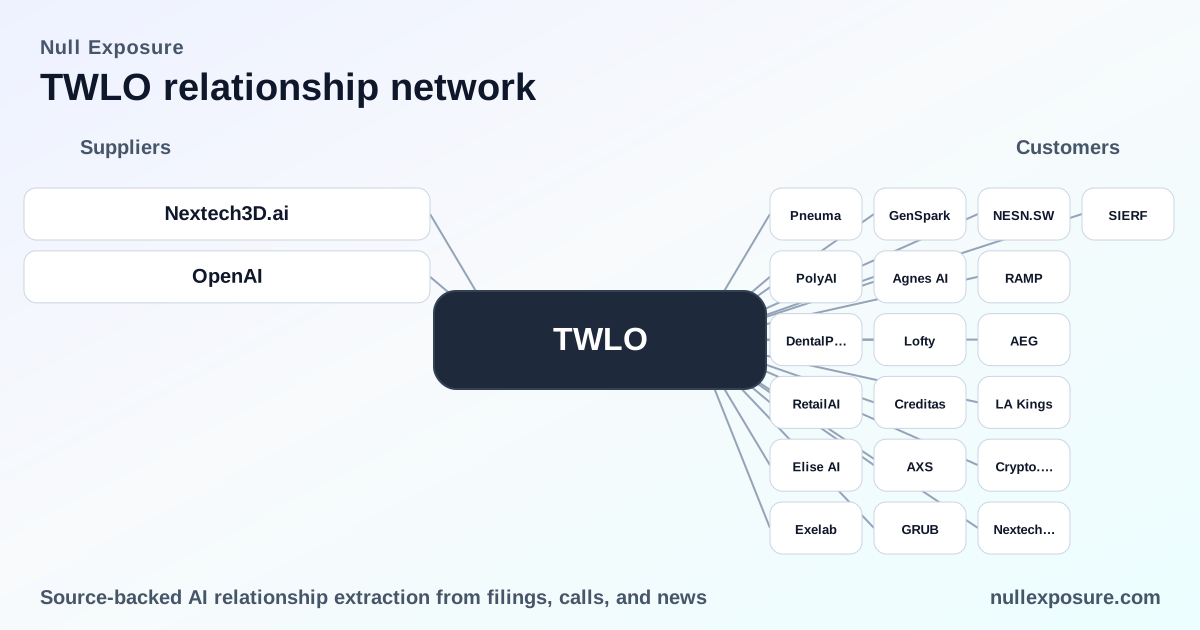
Twilio (TWLO): supplier relationships that determine margins and service continuity
Twilio operates a cloud communications platform that monetizes by charging developers and enterprises for message, voice and number usage while layering higher-value software services on top. The company's revenue mix is driven by usage-based fees (per-call, per-message, per-number) and subscription/seat-based products for engagement and contact center software; network and cloud suppliers supply the underlying channels and compute that make monetization possible. For investors, the critical lens is how supplier contracts and cost pass-throughs shape gross margins, margin volatility, and operational continuity. If you want structured supplier risk intelligence, start here: https://nullexposure.com/.
Why suppliers matter to Twilio’s economics
Twilio’s model is fundamentally volume-driven. The company purchases telephony carriage, numbering, and cloud compute from third parties and resells those capabilities to customers as integrated platform services. That structure makes supplier costs a direct variable against revenue growth: higher message/voice volumes increase both top line and cost of goods sold. Twilio’s reported financials show cost of revenue is dominated by fees paid to network and infrastructure providers, which translates to both high revenue leverage and corresponding margin sensitivity to supplier pricing and capacity.
Key business-model implications:
- Contracting posture: Twilio operates predominantly on usage-based supplier contracts, creating direct correlation between customer activity and supplier spend.
- Cost materiality: Supplier fees are a material component of cost of revenue and therefore central to margin management and pricing strategy.
- Operational criticality: Network and cloud suppliers are critical-path; outages or capacity limits upstream transmit immediately to Twilio customers.
- Maturity and diversification: Twilio has built broad supplier relationships across carriers and cloud providers, but the underlying model still exposes it to supplier pricing pressure and regulatory or capacity shocks.
If you want a deeper supplier risk overview and mapping to counterparty filings, see the research hub: https://nullexposure.com/.
What the public record shows about recent supplier relationships
Below I cover every supplier relationship surfaced in the available results and what each implies for operations and strategy.
Nextech3D.ai — A customer implementation that leverages Twilio for voice concierge functionality. According to a MarketScreener news item (first seen Mar 10, 2026), Nextech3D.ai launched an Eventdex AI Voice Concierge "Powered by OpenClaw, Twilio, AWS EC2 & Pinecone CI" on Feb. 27, signaling Twilio’s role as the telephony and programmable-voice layer in hybrid vendor stacks. This illustrates how Twilio is embedded as the communications plumbing in third-party AI/voice solutions and highlights ongoing demand from event and conversational AI use cases. (MarketScreener, Mar 10, 2026)
OpenAI — Platform-level integration and strategic positioning around real‑time AI. A Sahm Capital note (Feb 12, 2026) highlighted Twilio’s emphasis on AI and machine learning integrations, citing the use of services such as OpenAI’s real-time API as a platform enabler and competitive differentiator. This underscores Twilio’s strategy to combine communications primitives with AI partners to create higher-value, integrated offerings for customers. (Sahm Capital, Feb 12, 2026)
How these relationships move the needle
Both items above reinforce a consistent theme: Twilio is the communications substrate in broader AI and applications stacks, not just a commodity carrier. Nextech3D.ai demonstrates Twilio’s role in event-focused voice products; OpenAI references position Twilio as the interface for integrating generative and real-time AI into customer engagement. For investors, those dynamics support revenue expansion into higher-margin software layers, but supplier cost structures still govern gross-profit conversion.
Operational constraints that shape supplier dynamics
The company-level evidence identifies several constraints that drive Twilio’s supplier posture and financial sensitivity:
- Usage-based contracting: Twilio’s agreements with network service providers and cloud infrastructure vendors are predominantly volume-based — fees scale with calls, messages, and compute consumption. This creates matched revenue and cost flows but also means margins compress if supplier unit costs increase faster than Twilio’s resale pricing.
- Material cost of revenue: Public disclosures describe cost of revenue as consisting primarily of fees paid to network service providers, making supplier pricing a material determinant of gross margin.
- Service-provider role: Twilio’s classification of those counterparties is as service providers rather than strategic equity partners — the relationship is operational and transactional.
- Infrastructure segment exposure: Twilio’s dependency on cloud infrastructure providers for server capacity is explicit; these relationships influence service latency, scalability, and availability.
These constraints imply a contracting posture that is operationally agile but economically exposed: Twilio can scale quickly with customer demand, yet it must actively manage supplier mix, negotiate favorable volume tiers, and pass product value upstream to sustain margins.
Key risks and strategic mitigants
Twilio’s supplier structure creates concentrated operational and cost risks, but management has multiple levers:
-
Risks:
- Price volatility: Volume-based supplier fees create margin sensitivity to carrier and cloud pricing moves.
- Service continuity: Carrier outages or cloud capacity constraints directly impact customer SLAs and churn risk.
- Regulatory and numbering costs: Changes in telecom regulation or numbering availability can raise acquisition costs for phone numbers.
-
Mitigants:
- Diversified supplier base across carriers and cloud providers reduces single‑point failures.
- Productization and bundling (adding AI and software features) increase gross-margin capture beyond raw usage resale.
- Negotiated volume discounts and regional sourcing lower unit costs as scale grows.
Investor takeaways and action items
- Supplier costs are a core driver of Twilio’s gross margin volatility because the company operates a usage-based resale model for network and compute services.
- Partnerships with AI platforms like OpenAI and implementations with customers such as Nextech3D.ai strengthen Twilio’s move up the value chain, enabling higher-margin software monetization over time.
- Monitor carrier pricing, cloud compute contracts, and regulatory changes as the primary external variables that will impact Twilio’s margin trajectory.
For portfolio managers and procurement leads who need a consolidated supplier map and counterparty risk scoring, explore tailored supplier intelligence at https://nullexposure.com/.
Conclusion — where to focus next
Twilio’s economics are straightforward: growth expands top line and supplier spend in tandem, while productization and integrations determine how much of that growth drops to the bottom line. Investors should evaluate Twilio by tracking supplier pricing trends, capacity reliability, and the company’s success in converting communications primitives into software value. For a comprehensive supplier-risk dossier and ongoing monitoring, visit the research portal: https://nullexposure.com/.