TWLV: What operators and investors need to know about its supplier footprint
Twelve Seas Investment Company II (TWLV) is a special-purpose acquisition company (SPAC) whose business model is to complete a business combination and deliver public equity exposure to the target and to its sponsors and shareholders. TWLV currently generates no operating revenue and derives economic value from executing a successful merger or acquisition and the subsequent equity upside of the combined entity. Public filings show zero revenue trailing twelve months, a market capitalization around $111.7 million, and a concentrated insider ownership profile that shapes how the company contracts and sources capital providers. If you are evaluating TWLV as a counterparty, partner, or investor, the key commercial relationships you should monitor are transaction and capital markets service providers rather than recurring operational vendors. Read on for the supplier-level detail and commercial implications.
Learn more about supplier exposure and counterparty profiles at https://nullexposure.com/.
How to read a SPAC’s supplier footprint: practical rules for investors
SPACs are not operating companies in the traditional sense: they are event-driven vehicles that depend on episodic supplier relationships to execute an offering and a de-SPAC. That structure shapes contracting posture, concentration, criticality, and maturity of supplier relationships:
- Contracting posture is transactional and short-term. Engagements are centered on underwriters, legal counsel, auditors, and placement agents for a defined capital or acquisition event rather than ongoing procurement.
- Concentration is high and execution-sensitive. A single underwriter or book-running manager can determine distribution reach, pricing, and the speed of capital formation; that concentration translates into execution risk ahead of a merger.
- Criticality is binary: event-critical suppliers control outcome. If the chosen placement bank or book-runner underperforms, the SPAC’s ability to complete a deal or raise follow-on capital is materially impaired.
- Maturity of supplier relationships is typically low. Many SPACs have limited historical vendor relationships; the counterparty footprint evolves rapidly around each financing or merger process.
These are company-level signals for TWLV: public data shows no operating revenue (TTM $0) and a high insider ownership (≈79.8%) with low public float, which reinforces an event-driven sourcing model and concentrated counterparty exposure (latest quarter reported 2023-09-30; market data reflected in public filings).
What the record shows about TWLV’s counterparties
Below I list every supplier relationship captured in the accessible record and give a concise, plain-English take on its role in TWLV’s business rhythm.
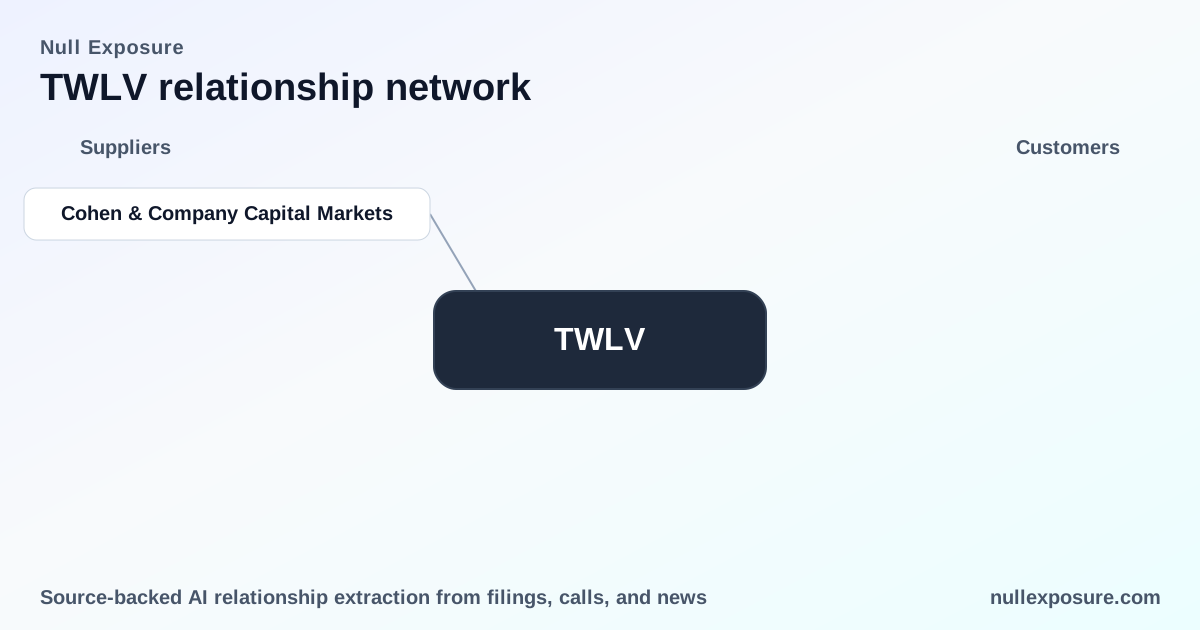
Cohen & Company Capital Markets — sole book-running manager for an offering
Cohen & Company Capital Markets acted as the sole book-running manager for TWLV’s offering, which indicates Cohen was responsible for underwriting and distributing that capital raise and likely handled placement logistics and investor allocation for the transaction. According to a news entry on Intellectia (first seen March 10, 2026), Cohen & Company served in that central underwriting role: https://intellectia.ai/en/stock/TWLV/news.
What a sole book-runner relationship means for risk and execution
With Cohen & Company as the sole book-runner on the record, derive these operational conclusions for counterparty risk and commercial diligence:
- Execution is concentrated. A single book-runner increases the likelihood that distribution, pricing, and settlement depend on one provider’s capabilities and relationships—this is normal for a SPAC but worth tracking as the company pursues additional financings or a target.
- Short-term criticality, limited long-term dependency. Underwriting is essential to getting deals done, but it is an episodic service: once the merger process moves forward or completes, the operational dependency on that underwriter typically falls away.
- Counterparty diligence priorities shift toward balance-sheet and distribution capability. Investors and potential service providers should evaluate the underwriter’s track record, syndicate reach, and the terms agreed—fee structure and allocation mechanics will directly affect sponsor economics and public investor dilution.
There are no recorded supplier-specific constraints in the available supplier constraints feed for TWLV. That absence is itself a signal: the public record for supplier constraints contains no contractual encumbrances or long-term supply commitments captured against the company. Treat this as a company-level observation rather than a relationship-level finding.
Tactical implications for investors and operators
For institutional investors, placement banks, and service providers assessing TWLV, the commercial playbook is straightforward:
- Prioritize transparency on the underwriting engagement: fees, allocation policy, and syndicate composition determine both short-term financing success and sponsor economics.
- Monitor insider concentration and float dynamics: TWLV reports high insider ownership (~79.8%) and a small free float, which affects secondary liquidity and the bargaining power of external counterparties.
- Assess contingency options: because contracting posture is transactional, confirm whether alternative underwriters or PIPE partners are available if primary execution falters.
Key takeaways:
- TWLV is event-driven, with concentrated supplier risk centered on placement banks and underwriters.
- Cohen & Company acted as sole book-runner in the documented offering, making them a materially important execution partner for that transaction (source: Intellectia news, March 10, 2026).
- No supplier-specific constraints are recorded publicly, which suggests a clean vendor ledger in the available feed but requires continued monitoring as TWLV pursues a business combination.
Midway diligence and ongoing monitoring tools are available at https://nullexposure.com/ for teams that need to track counterparty changes and new placement announcements in real time.
A short checklist before you transact
- Confirm the underwriter’s fee schedule and distribution reach for the specific offering.
- Verify any follow-on commitment or PIPE arrangements that could dilute existing holders.
- Watch for new supplier records or constraints as the SPAC moves into a de-SPAC phase; that’s when vendor profiles and contractual obligations expand.
For primary research, counterparty alerts, and portfolio risk overlays tailored to SPAC exposures, visit https://nullexposure.com/.
Conclusion: TWLV’s supplier footprint is typical for a SPAC—transactional, concentrated, and event-centric—with Cohen & Company Capital Markets playing a central underwriting role in the documented offering. Investors and operators should prioritize underwriting diligence, monitor insider and float dynamics, and maintain contingency plans for distribution risk.