Two Harbors (TWOD): Supplier relationships, financing posture, and what investors should price
Two Harbors is a mortgage-focused investment company that sources, finances and manages residential mortgage assets and related servicing rights, monetizing through net interest spread on financed holdings, servicing income and capital gains on trading and sales. The firm funds origination and warehouse inventory largely with short-duration repurchase agreements and targeted long-term borrowings, and outsources core servicing operations — a structure that concentrates operational criticality in a small set of counterparties while keeping financing cadence sensitive to market liquidity. For a concise supplier-risk view and monitoring framework, visit https://nullexposure.com/.
Houlihan Lokey: fairness opinion, $2.5 million in fees, and a shareholder challenge
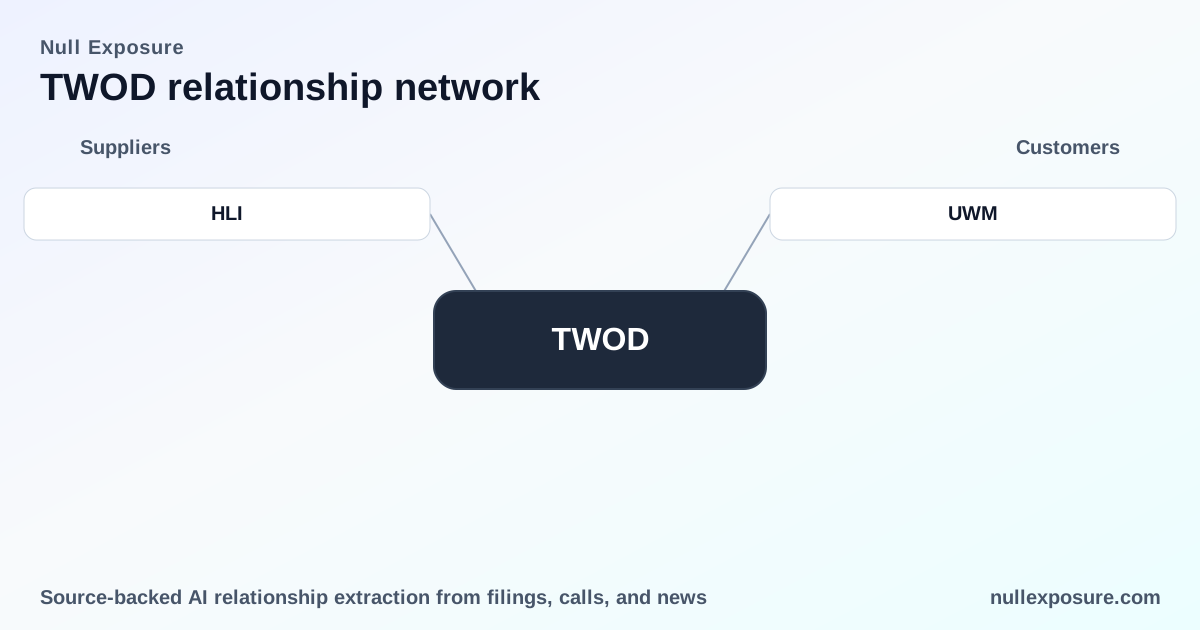
Two Harbors engaged Houlihan Lokey to provide a fairness opinion related to its proposed UWM transaction, with Houlihan receiving approximately $2.5 million in aggregate fees for services over the prior two years. A shareholder lawsuit filed in early March 2026 alleges the registration statement did not fully disclose the nature of services Houlihan provided and omitted projections and implied valuation assumptions tied to that fairness analysis. According to a HousingWire report (March 10, 2026), the complaint specifically flags undisclosed service specifics and questioning of the fairness analysis; a contemporaneous Scotsman Guide article (March 10, 2026) likewise notes the $2.5 million compensation figure for Houlihan Lokey and the disclosure allegations.
How Two Harbors contracts and finances the business — constraints that matter
Two Harbors’ public disclosures and recent filings reveal concrete operating constraints that shape supplier relationships and counterparty risk:
- Short-term financing dominates the capital structure. Repurchase agreements are the primary vehicle for Agency RMBS financing, with weighted-average remaining maturities reported at 94 days (Dec 31, 2024) and 55 days (Dec 31, 2023), and weighted-average borrowing rates of roughly 5.15% and 5.74%, respectively. Filings state warehouse facilities for originations are collateralized and typically run up to 90 days or until loans are sold. This is a company-level signal that financing is cadence-sensitive and dependent on healthy repo and secondary markets.
- Long-term borrowings exist but are secondary. Management discloses both short- and long-term repo structures, meaning the capital mix includes duration diversity but remains skewed toward short maturities.
- Geographic footprint is administrative, not asset-heavy. Two Harbors leases office space in Minnesota, New York, South Carolina and Texas, and explicitly states it does not own material physical properties; this reduces fixed-asset concentration risk but keeps counterparty and servicer relationships operationally critical.
- Service spend is material at scale. Prior to a September 30, 2023 acquisition, servicing expenses tied to RoundPoint’s subservicing were reported at $23.9 million for the year ended December 31, 2023 (and $2.0 million in 2022), suggesting mid-double-digit millions of recurring external servicing expense pre-acquisition and a non-trivial vendor cost line.
(These observations arise from Two Harbors’ public filings and financial disclosures, including notes referencing repurchase agreements, warehouse facility terms and servicing expense line items as of year-end 2023–2024.)
RoundPoint and TH MSR Holdings: the practical servicing dependency
Two Harbors’ structure places mortgage servicing functions largely in the hands of RoundPoint through its TH MSR Holdings vehicle. Filings state TH MSR Holdings acquires MSR through flow and bulk purchases and that RoundPoint — a wholly owned subsidiary — handles substantially all servicing functions for loans underlying the company’s MSR. That arrangement creates an operational dependency on RoundPoint for day‑to‑day borrower interaction, loss mitigation and cash remittance timing, and concentrates counterparty risk in the servicing chain.
What the Houlihan Lokey dispute signals for investors
The Houlihan Lokey fairness-opinion dispute is small in direct dollar terms ($2.5 million) relative to Two Harbors’ balance sheet, but it has outsized governance and disclosure implications:
- Legal and disclosure risk is non-trivial. Shareholder litigation challenging disclosures and fairness analyses can delay transactions, increase transaction costs and create reputational noise that affects counterparties and financing markets.
- Operational knock-on effects are indirect but material. If a strategic transaction against which financing or counterparty commitments were sized stalls, Two Harbors’ repo-funded origination and warehouse cadence could be disrupted in a stressed market.
- Fee quantum vs. materiality. The fee amount is modest versus book size, but governance challenges elevate the importance of clarity around advisor scope and valuation assumptions.
Sources: HousingWire and Scotsman Guide reporting on the March 2026 shareholder complaint and the disclosure of Houlihan Lokey fees.
Practical implications for valuation and monitoring
Two Harbors’ supplier and counterparty signals translate directly into credit, liquidity and operational risk factors that investors must price:
- Concentration and criticality: Outsourced servicing through RoundPoint makes that relationship operationally critical; monitor servicer performance metrics and any third-party dependence. Filings explicitly name RoundPoint as the servicer for TH MSR Holdings.
- Contracting posture and maturity mismatch: Heavy reliance on short-term repurchase agreements means financing availability and roll‑over spreads are primary drivers of earnings volatility and refinancing risk; track repo market spreads and average repo maturities reported each quarter.
- Governance and legal exposure: Advisory fees tied to M&A and fairness opinions are small but litigable; follow disclosure updates and any amendments to registration statements when transactions are announced.
- Cost trajectory: The servicing expense line (reported $23.9M in 2023 pre-acquisition) is a visible spend band that can erode net income if not offset by servicing income or efficiency gains.
Mid-analysis resource: for ongoing surveillance and supplier-profile updates, see https://nullexposure.com/.
A short checklist for active investors
- Watch quarterly repo maturities and weighted-average borrowing rates for signs of tightening funding conditions.
- Track servicer performance and counterparty concentration metrics for RoundPoint and TH MSR Holdings.
- Monitor legal filings and registration-statement amendments tied to advisor disclosures (Houlihan Lokey) that could affect transaction timing.
- Review servicing expense trends post-acquisition to determine whether subservicing costs normalize or compress.
Bottom line: financing cadence and a few concentrated relationships drive the risk premium
Two Harbors operates a highly levered, repo-centric funding model with a concentrated servicing relationship and occasional advisory engagements that carry governance risk. The principal investment risk is liquidity and execution — the ability to roll short-term financing and manage a small set of critical counterparty relationships — not asset-level ownership of material real estate. Investors should price a liquidity premium into equity and credit valuations and monitor the legal and servicer-readout cadence closely. For a practical supplier-risk scorecard and alerts tailored to mortgage REIT counterparties, visit https://nullexposure.com/.