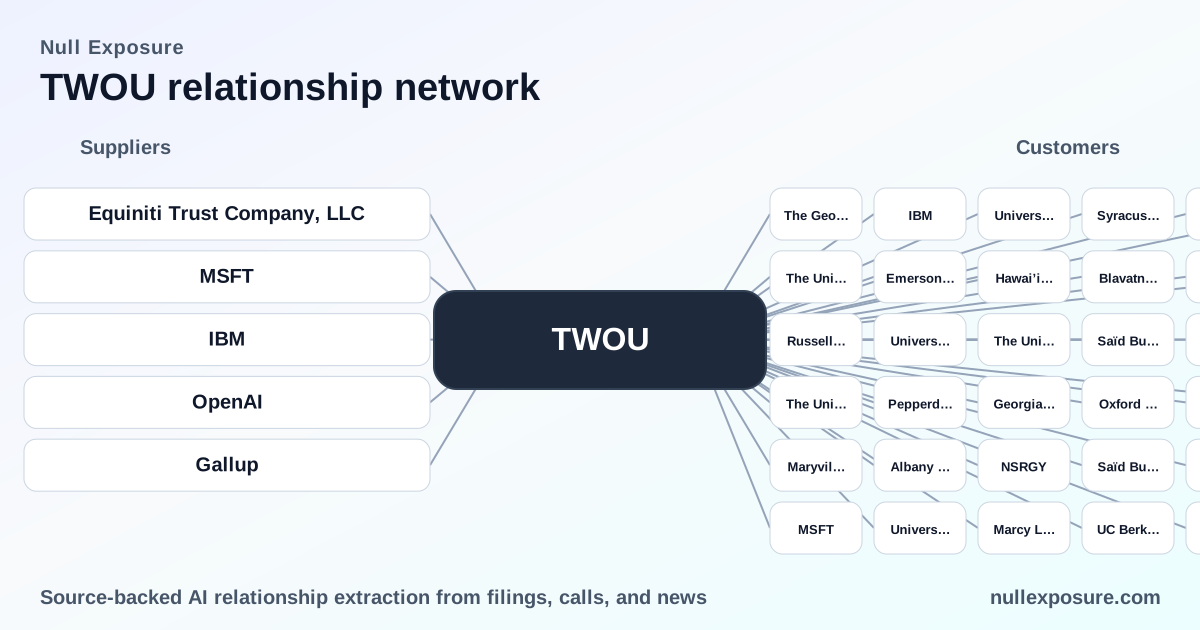
2U (TWOU): Partnership-driven growth with platform leverage and concentrated execution risk
2U operates as an education-technology provider that builds, markets, and operates online degree and non-degree programs for universities and enterprise partners; it monetizes through revenue-share and fee-based contracts that convert institutional content into scalable online programs and microcredentials, while also selling platform services and marketing enrollment. The business model is partnership-led: content and credibility come from anchor partners, while operational revenue accrues from 2U’s technology, student services, and credentialing delivery. For investors evaluating supplier relationships, the key lens is how third-party partners contribute to product depth, go-to-market reach, and operational criticality.
If you want a structured supplier-risk view and benchmarked relationship intelligence, start here: https://nullexposure.com/
How 2U sells value and where supplier relationships matter
2U’s economics combine upfront investment in course development with long tail revenue sharing on tuition and fees. Revenue concentration is governed by the quality and exclusivity of institutional relationships—the stronger and more exclusive the university tie, the higher the lifetime revenue per program. Partner integrations (technology providers, content creators, and transfer/administration agents) are operationally critical because they directly affect time-to-market, regulatory compliance, and student experience.
Company-level operating signals relevant to supplier risk:
- Contracting posture: Partnership and revenue-share agreements dominate, implying multi-year commitments with mutual performance incentives.
- Concentration: Revenue depends on a finite set of marquee academic partners and enterprise clients; single-partner disruptions translate to measurable program-level revenue risk.
- Criticality: Third-party platform and content suppliers are functionally critical—technology integrations and transfer agents affect issuance, compliance, and student lifecycle management.
- Maturity: 2U is a mature edtech player with established revenue streams and negative EPS dynamics driven by scaling and investment cycles; suppliers are therefore both strategic partners and levers for margin improvement.
The supplier and partner map investors need to know
Below I cover every relationship in the public results set and explain the practical significance for operators and investors.
Equiniti Trust Company, LLC — transfer and exchange agent for stock action
Equiniti is acting as the exchange agent and transfer agent for 2U’s 1-for-30 reverse stock split, a corporate action that consolidates outstanding shares and simplifies capitalization structure. According to a PR Newswire release on March 10, 2026, Equiniti (formerly American Stock Transfer & Trust) is the designated agent for that transaction, which has direct implications for share count and administrative processing costs. (PR Newswire, March 10, 2026)
Microsoft — enterprise partner for executive AI education
2U announced a collaboration with Microsoft to launch “CxO Edge: Run your business on AI,” an executive education program launching on edX in early 2026, signaling 2U’s push into enterprise executive learning tied to a major cloud and AI provider. The initiative positions 2U to monetize premium executive learning anchored by Microsoft’s brand and technology platform, broadening enterprise revenue channels. (PR Newswire, program announced 2026)
IBM — curriculum and credential partner for AI microcredentials
2U launched IBM-developed microcredential programs that use IBM’s curriculum, subject matter experts, and hands-on capstone projects, which shifts content development risk to an anchor technology partner while allowing 2U to capture credentialing and platform revenues. 2U’s newsroom described these programs as IBM-led in curriculum and delivery structure; that combination accelerates time-to-market for industry-aligned credentials. (2U Newsroom, 2026)
OpenAI — AI tooling provider for learner assistants on edX
edX introduced two AI-powered learning assistants built on OpenAI’s technology to deliver real-time academic support and course discovery, integrating OpenAI’s models to improve learner outcomes and discovery funnels. This relationship is operationally significant because it embeds third-party AI tooling into the student experience, creating both upside in engagement and dependency on external model performance and licensing. (2U Newsroom, edX announcement 2023)
Gallup — outcomes research and program validation partner
2U has partnered with Gallup on longitudinal research into bootcamp outcomes and career impact, producing studies that validate program ROI and support marketing claims to prospective students and university partners. 2U’s historical collaboration with Gallup, reported in 2021 and referenced in later communications, strengthens evidence-based positioning for career-oriented offerings and aids enterprise and academic sales efforts. (2U Newsroom, Gallup study, 2021)
What these relationships tell investors about operational risk and upside
These supplier relationships collectively reveal a strategy that transfers content and credibility to partners while retaining platform, student services, and monetization rights. Microsoft and IBM supply content credibility and direct enterprise pathways; OpenAI provides learner-facing tooling that can raise engagement if integrated correctly; Gallup supplies independent validation that supports pricing and enrollment conversion; and Equiniti is a governance and administrative vendor relevant to corporate actions. That mix reduces single-source content risk but increases dependency on third-party tech stability and partner alignment on go-to-market priorities.
Key risk and opportunity signals:
- Upside: Partner-branded offerings accelerate enterprise sales and justify premium pricing, supporting higher revenue per learner and improved gross margins if enrollment scales.
- Risk: Reliance on third-party AI and platform providers introduces operational dependency and potential cost volatility from licensing or governance changes.
- Execution sensitivity: Successful monetization requires tight integration between academic partners and 2U’s student services; misalignment produces program underperformance and revenue drag.
- Corporate governance note: The reverse split and the use of a transfer agent reflect capital structure management, which investors should monitor for follow-on equity actions.
If you want a concise supplier risk scorecard and playbook tailored to institutional exposure, analyze these relationships with comparative benchmarks at https://nullexposure.com/
What investors and operators should do next
- Prioritize diligence on contractual terms with Microsoft and IBM offerings—specifically revenue share, exclusivity, and content renewal cadence—because these determine long-term revenue rights.
- Review vendor dependency on OpenAI-style models for learner experience and plan for redundancy or cost pass-through clauses to avoid single-vendor shocks.
- Map revenue concentration by partner program to quantify downside from any single partner program underperformance.
For a deeper partner-by-partner exposure analysis and a recommended monitoring framework, start here: https://nullexposure.com/
Bottom line
2U’s model is partner-centric and platform-driven, with suppliers providing crucial content credibility, AI-enabled learning, and validation research that together shape monetization and margin potential. Investors should value the upside of branded enterprise programs while rigorously modeling dependency risk and contractual terms that determine how much revenue and margin 2U truly captures. For structured intelligence on supplier risks and proactive monitoring, visit https://nullexposure.com/ and translate these partner signals into actionable portfolio decisions.