Twist Bioscience (TWST): supplier relationships that shape growth and risk
Twist Bioscience manufactures synthetic DNA and monetizes through direct product sales (oligos, libraries, enzymes), recurring contract services (custom DNA and discovery services), and strategic licensing/collaborations that bundle IP and platform access. With trailing revenue near $392M and persistent operating losses, the company's path to durable profitability depends on scaling product margins, expanding higher‑value antibody discovery services, and managing supplier concentration and long‑term property commitments.
If you evaluate counterparties or need a concise commercial map for diligence, start here—and consider a deeper supplier-risk review at https://nullexposure.com/.
Quick takeaways for investors
- Revenue mix is product + services + licensing: commercial sales of synthetic DNA and discovery services plus selective platform licenses (antibody and enzymatic reagents) generate top-line and strategic optionality.
- Concentration and contractual duration are meaningful risks: Twist discloses a single‑source critical component and large long‑term lease commitments that create operational leverage.
- Recent strategic licensing expands biologics addressable market: the Invenra and Aptamer arrangements signal an active push into antibody discovery and assay/enzyme functionality.
Explore supplier risk profiles and supplier relationships in more depth at https://nullexposure.com/.
How the relationships on file fit into Twist’s operating playbook
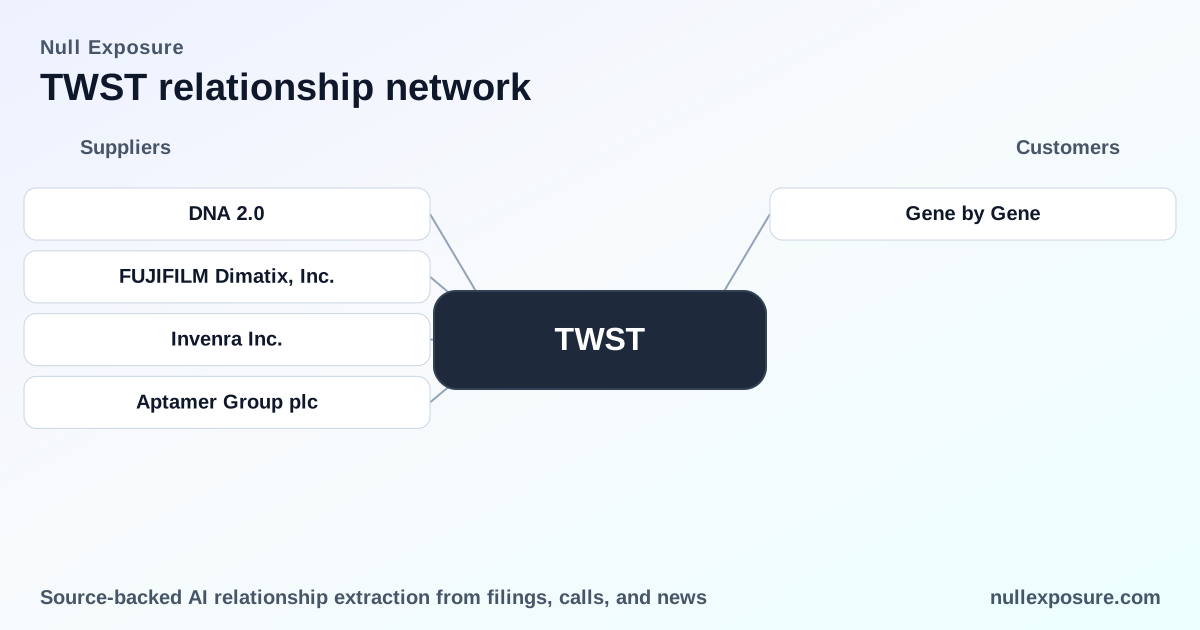
Twist combines in‑house manufacturing, outsourced sub‑assemblies and third‑party IP licenses to operate both as a reagent vendor and as a services-driven discovery partner. Below I summarize every supplier / partner relationship surfaced in public filings and press coverage, with a plain‑English note on the commercial role and an explicit source reference.
DNA 2.0 — IP license visible in the 10‑K
Twist documents that Genome Compiler held a non‑exclusive license to U.S. Patent No. 7,805,252 owned by DNA 2.0, reflecting Twist’s attention to legacy patent positions and third‑party IP that can affect product claims and freedom‑to‑operate. According to Twist’s FY2025 Form 10‑K filing, the patent license is explicitly referenced in the company’s IP discussion.
FUJIFILM Dimatix, Inc. — supply agreement underpinning production
Twist cites an End User Supply Agreement with FUJIFILM Dimatix, Inc., originally dated November 5, 2015, indicating a durable supplier relationship that supports manufacturing or instrument components used in DNA synthesis. The FY2025 10‑K references this supply agreement as part of Twist’s contractual landscape.
Invenra Inc. — co‑exclusive bispecific antibody platform license (Feb 2026)
Twist entered a co‑exclusive licensing agreement for Invenra’s B‑Body bispecific antibody platform, expanding the company’s antibody discovery services and platform offerings; the consideration included $5 million in cash, $15 million in common stock, and a stock‑funded preferred stake valued at about $13.8 million (roughly 6% ownership). Public reporting on the February 2026 deal includes coverage from Sahm Capital and financial outlets such as Yahoo Finance and SimplyWallSt describing the transaction economics and strategic intent.
Aptamer Group plc — enzyme‑modulating binders and TrueAmp collaboration
Under a non‑exclusive arrangement, Aptamer supplies an enzyme‑modulating Optimer binder for Twist’s hot‑start PCR and NGS products, and Twist credits Aptamer collaboration for the TrueAmp polymerase hot‑start functionality in its product announcements. Press coverage from December 2025 and early 2026 (TS2.Tech and Yahoo Finance) documents the licensing and product collaboration.
What these relationships reveal about Twist’s supplier posture
Twist’s partner map highlights a hybrid commercial model: product manufacturing anchored by supplier contracts and IP licenses, combined with strategic investments into biologics platforms through licensing and equity. From the public excerpts and filings, several operational characteristics stand out:
- Contracting posture is a mix of long‑term leases and ongoing licenses. Twist discloses long‑term lease amendments and explicitly notes long‑term supply contracts in supplier continuity planning, implying multi‑year commitments that create fixed cost leverage.
- Concentration is material and actionable. The company states reliance on a single‑source supplier for a critical DNA synthesis component, a structural risk that elevates procurement and quality control priorities across operations.
- Criticality of relationships varies across the stack. Some partners supply IP or reagents (Aptamer, DNA 2.0), others supply instruments or components (FUJIFILM Dimatix), and some extend platform capability through licensing and equity (Invenra) — together they determine product capability and market expansion speed.
- Maturity and stage: active, but evolving toward platform partnerships. The mix of historic supply agreements and recent platform licenses shows a pivot from pure reagent manufacturing toward integrated service/platform revenue streams (antibody discovery, hot‑start enzyme products).
These are company‑level signals drawn from public excerpts and filings; the specific constraints cited in Twist’s reports point to long‑term contracting, licensing exposure, a North‑America real‑estate consolidation, a single‑source critical supplier, outsourced sub‑assemblies, an active lease amendment with significant tenant improvement allowance, and a material lease rent obligation estimated at over $100 million across the expansion period.
Investment implications and risk checklist
For operators and investors evaluating supplier exposure, the takeaways are concrete:
- Supply security is a top risk-control priority. Single‑source dependency for a critical component requires rapid mitigation planning or qualified second sources to protect production continuity.
- Licensing expands addressable market but creates royalty/termination exposure. Twist’s increased use of co‑exclusive platform licenses (Invenra) and non‑exclusive reagent licenses (Aptamer, DNA 2.0) fuels growth in discovery services while embedding license compliance and royalty expense dynamics into margins.
- Fixed‑cost real estate commitments amplify operating leverage. The company’s lease amendments and significant tenant improvement allowances raise near‑term capital and cash flow demands even as they consolidate operations into South San Francisco.
If you are performing commercial diligence or vendor risk scoring, incorporate these items into supplier questionnaires and scenario modeling. For systematic supplier risk benchmarking and to map counterparties against contractual duration, concentration and spend bands, visit https://nullexposure.com/.
Conclusion: tactical next steps for investors and operators
Twist’s supplier relationships are a mixture of operational plumbing (FUJIFILM Dimatix, single‑source components), IP fencing (DNA 2.0), and strategic platform extension (Invenra, Aptamer). The company is deliberately moving up‑stack into biologics discovery while retaining exposure to single‑source and long‑term property obligations that will determine margin recovery and capital intensity.
For a granular supplier risk profile or to commission a tailored supplier concentration report, see https://nullexposure.com/. Conduct targeted diligence on the single‑source critical component, assess license termination clauses and royalty mechanics, and stress‑test the cash impact of the company’s lease expansion when modeling valuation scenarios.