Ternium (TX): Supplier relationships and the Usiminas transaction investors need to price in
Ternium is an integrated steel manufacturer that monetizes through sales of long and flat steel products, tolling and processing services, and strategic equity investments in related steel assets across Latin America and the U.S.; its scale—approximately $15.6 billion revenue and $1.42 billion EBITDA on a $7.49 billion market cap—gives it both production reach and negotiating leverage with regional suppliers and partners. For investors and operators assessing TX as a supplier or counterparty, the company’s activity in equity acquisitions and one-off charges is a direct signal that Ternium executes strategic, balance-sheet-backed transactions in addition to routine procurement and processing contracts. Learn more about supplier intelligence and counterparty monitoring at https://nullexposure.com/.
How Ternium runs its commercial playbook and why that matters to counterparties
Ternium operates as a vertically integrated steel player with geographic diversification across Mexico, Argentina, Brazil and North America, which converts commodity exposure into recurring commercial flows with mills, distributors and industrial customers. The firm’s metrics—operating margin ~4.7%, profit margin ~2.7%, and trailing EV/EBITDA ~4.2—signal a capital-intensive, low-margin industry profile where cash generation is cyclical and strategic investments in assets (like equity stakes in regional mills) are used to secure supply, downstream access, or market share.
These characteristics create an operational posture worth noting for suppliers and operators:
- Contracting posture: Ternium combines commercial purchase agreements with occasional equity transactions and asset-level investments, so counterparties should expect both transactional procurement and strategic, longer-duration negotiations.
- Concentration and counterparty leverage: Institutional ownership is modest (~16% of shares), insiders report effectively zero, and public valuation multiples indicate the market prices in cycle sensitivity—this drives conservative commercial terms and selective capital allocation.
- Criticality and maturity: Ternium’s scale makes it a critical buyer/seller in Latin American steel markets; counterparties that secure stable commercial terms with Ternium gain durable volume, while those that rely on spot transactions face exposure to cycle-driven margin compression.
The Usiminas counterparties Ternium named in its FY2026 release
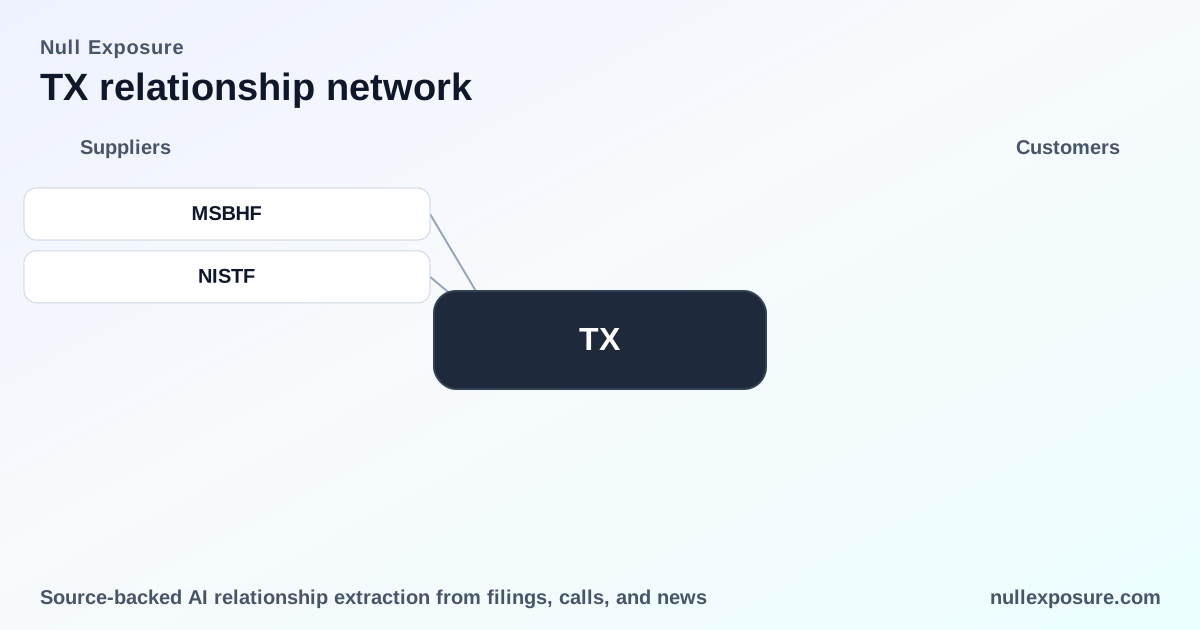
Ternium disclosed a transaction-related charge tied to purchases of additional interest in Usiminas; the press release identifies two counterparties involved in the transaction.
-
Mitsubishi Corporation — Ternium recorded a $21 million charge in Q4 2025 associated with the accelerated recognition of the purchase of an additional participation in Usiminas from Mitsubishi Corporation. This indicates a settled or restructured equity transfer with a near-term earnings impact. According to Ternium’s fourth-quarter and full-year 2025 results press release on EQS News (March 10, 2026), the charge is directly tied to the acquisition accounting for that stake.
-
Nippon Steel Corporation — The same $21 million Q4 2025 charge also reflects the accelerated recognition of the purchase of additional participation in Usiminas from Nippon Steel Corporation, implying both Japanese trading/steel groups were sellers or counterparties to Ternium’s stake increase. The company’s FY2025 results filing on EQS News (published March 10, 2026) lists Nippon Steel as the other named counterparty connected to the accounting charge.
Both entries are drawn from Ternium’s public results commentary for FY2025 and the fourth quarter of 2025; the disclosure is explicit about the counterparty names and the charge amount in the same release.
What the $21 million charge actually means for investors and operators
A $21 million one-time charge is immaterial relative to Ternium’s FY trailing EBITDA of approximately $1.42 billion, and it is a non-recurring, transaction-related accounting adjustment rather than an indicator of operating weakness. The market will treat this as a cleanup item tied to the consolidation or recognition timing of an equity stake in Usiminas, not as core earnings deterioration. The structural signals are more important: Ternium is using balance-sheet capacity to accrete strategic footholds in regional mills, which changes the counterparty landscape from pure buyer/seller to partial owner/collaborator in certain jurisdictions.
Operational constraints and company-level risk signals investors should price
With no discrete constraint documents attached to the relationship records, company-level signals emerge from Ternium’s financials and corporate behavior:
- Capital allocation discipline: Valuation multiples (trailing P/E ~17.3, forward P/E ~9.2, price-to-book ~0.63) and a high dividend yield (~7.1%) show a blend of return-of-capital to shareholders and opportunistic reinvestment in assets—counterparties should expect transactional sophistication and occasional strategic M&A.
- Cyclicality and margin pressure: Negative recent quarterly earnings growth (-56.5% YoY) and slight quarterly revenue decline (-2.6% YoY) indicate exposure to commodity cycles; counterparties should price tighter payment terms and operational flexibility into contracts to protect margins through cycles.
- Operational maturity: Large revenue base and solid gross profit (~$2.34 billion TTM) confirm industrial scale; suppliers that can offer integrated logistics, credit terms and just-in-time supply will capture premium status.
- Disclosure behavior: The company’s explicit naming of counterparties in transaction-related press release content demonstrates a transparent disclosure posture, which reduces counterparty ambiguity but raises the importance of legal and accounting diligence when negotiating stake or asset transfers.
If you need continuous tracking of how these relationships evolve or the financial impact on your portfolio, sign up or learn more at https://nullexposure.com/.
What operators and partners should do next
For suppliers, distributors and regional operators that transact with TX or with Usiminas post-transaction:
- Insist on clear contractual milestones and credit protections when Ternium is a counterparty, because strategic equity positions can shift negotiation dynamics.
- Treat Ternium as a strategic buyer whose balance-sheet transactions can change supply dependencies—plan for multi-year arrangements and include exit mechanics.
- Monitor Ternium’s public filings and earnings commentary for transaction-related disclosures, since those statements have immediate P&L and working capital implications.
For investors, the takeaway is simple: this was a small, one-off accounting charge tied to an equity acquisition, but it reinforces Ternium’s active role in consolidating regional steel assets. That behavior affects supplier relationships, competitive positioning and long-term cash flow profiles.
Explore supplier risk and counterparty intelligence tools at https://nullexposure.com/ to keep your exposure to cyclical counterparties under control.
Final takeaway: Ternium’s operational scale and willingness to use capital for asset positions make it more than a transactional buyer; counterparties and investors should price contracts and portfolios accordingly, focusing on contractual protections, working-capital resilience and monitoring of future transaction disclosures.