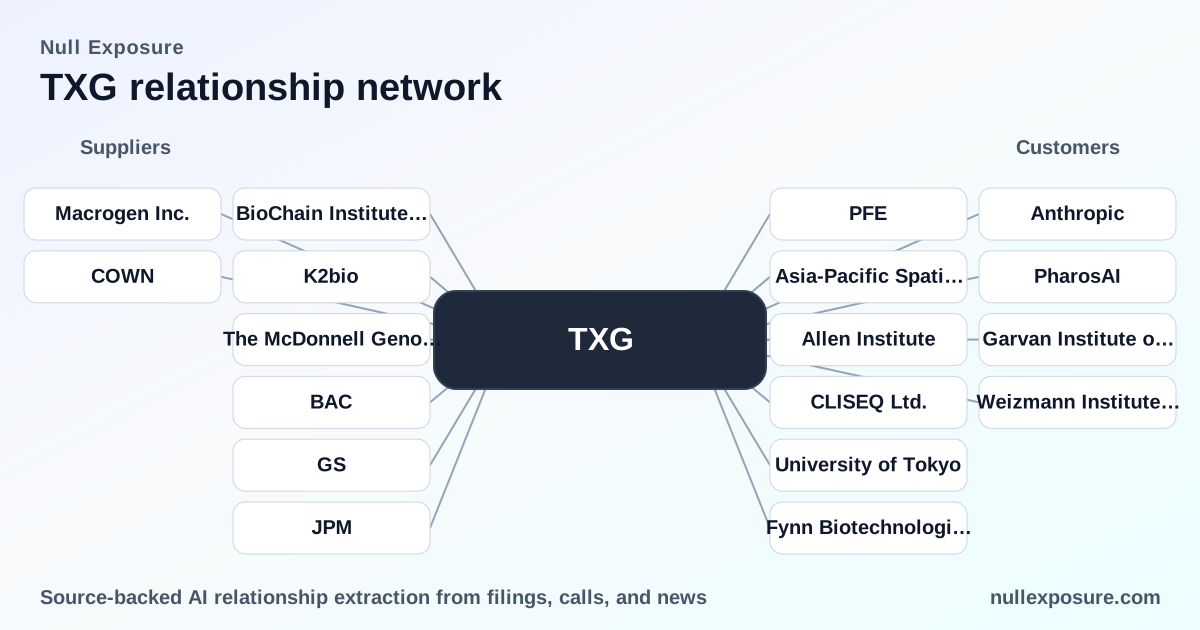
10X Genomics (TXG) — supplier relationships that shape platform economics
10X Genomics builds and sells laboratory instruments, recurring consumables, and complementary software, monetizing through a blend of one-time instrument sales and high-margin repeat consumables plus software subscriptions and licensed IP. The company extends market reach through an external services network—the Xenium Catalyst Network—whose members deliver spatial genomics services that accelerate platform adoption and drive consumable throughput. For investors and operators, the commercial model is a classic hardware-plus-consumables play with increasing dependency on software and outsourced execution to scale service delivery.
Explore supplier and partner signals in depth at https://nullexposure.com/ for a structured view of counterparty exposures and contract posture.
What these relationships reveal about how TXG operates in practice
10X Genomics converts installed instrumentation into predictable revenue by pairing devices with proprietary consumables and software licensing. The company’s public communications and filings reveal several company-level signals that investors should treat as part of the operating blueprint:
- Recurring revenue and contract commitments. 10X reports non‑cancelable software subscription commitments totaling $18.6 million over four years (as of 12/31/2025) and purchase commitments of $12.2 million over two years, reflecting meaningful near‑term contractual spend.
- Mixed contract types. The business relies on subscriptions, in‑licensed technologies and licensing arrangements for third‑party IP that is incorporated into consumables.
- Outsourced manufacturing posture. Instruments are assembled by contract manufacturers (Asia and U.S.) under purchase commitments and ISO 13485 expectations — a deliberate outsourcing model that trades fixed-capacity risk for supply-chain vendor risk.
- Infrastructure and software dependencies. Operations depend on third‑party data centers and open‑source software components, indicating technology-stack concentration beyond lab hardware.
These characteristics create a supplier footprint that is mid‑mature (established third‑party manufacturing and licensing), concentrated in execution risk (critical contract manufacturers and data hosting), and commercially sticky (consumables and subscriptions drive repeat spend). Track these linkages at https://nullexposure.com/ to quantify counterparty concentration and contractual tenors.
The network partners and banks — plain-English summaries
Below are every relationship identified in the collected results, each with a concise, sourced description.
BioChain Institute Inc.
BioChain joined the Xenium Catalyst Network to offer single‑cell spatial services using 10X’s Xenium platform, expanding the platform’s service footprint in commercial lab settings. According to BioSpace coverage of the Xenium Catalyst launch (March 10, 2026), BioChain positioned the relationship as an expansion of its service offerings.
K2bio
K2bio, a full‑service preclinical CRO, publicly welcomed participation in the Xenium Catalyst Network to integrate in‑situ single‑cell analysis into its service stack, reinforcing 10X’s route-to-market through CROs. This was reported by BioSpace on March 10, 2026.
The McDonnell Genome Institute at Washington University School of Medicine
The McDonnell Genome Institute joined the Catalyst Network to offer state‑of‑the‑art spatial genomics services, signaling academic-to-commercial pathway adoption for Xenium. Michael Heinz’s remarks were reported by BioSpace on March 10, 2026.
Macrogen Inc.
Macrogen announced Catalyst Network membership to expand pharmaceutical services and clinical diagnostic pipelines leveraging 10X’s single‑cell capabilities, emphasizing commercial lab scale and international service ambitions. BioSpace covered Macrogen’s statement on March 10, 2026.
BofA Merrill Lynch (Banking relationship — IPO)
BofA Merrill Lynch served as a lead joint book‑running manager on 10X’s IPO, establishing a capital markets relationship that supported the company’s public listing. The role was described in the GlobeNewswire IPO pricing release on September 12, 2019.
Goldman Sachs & Co. LLC (Banking relationship — IPO)
Goldman Sachs acted as a lead joint book‑running manager for the IPO, providing underwriting and market access during the company’s initial public offering on September 12, 2019, per GlobeNewswire.
J.P. Morgan Securities LLC (Banking relationship — IPO)
J.P. Morgan Securities served as one of the lead joint book‑running managers on the IPO, anchoring 10X’s capital raise in the public markets, as detailed in the GlobeNewswire announcement on September 12, 2019.
Cowen (Banking relationship — IPO)
Cowen participated as a lead manager on the IPO, contributing to the underwriting syndicate and distribution of shares at listing, per the GlobeNewswire release dated September 12, 2019.
How supplier and partner signals translate into investor risk and opportunity
The relationship map and company disclosures highlight two principal investment theses:
- Platform-driven recurring revenue is the upside. Catalyst Network partners and installed instruments feed consumable volume and services revenue, reinforcing a durable, high-margin consumables stream that supports multiple revenue levers (instruments, consumables, software subscriptions, and services).
- Operational concentration is the key risk. Outsourced instrument assembly, reliance on third‑party hosting and in‑licensed IP create vendor concentration that can disrupt production or increase costs if a supplier fails performance or enforces commercial changes.
Key risk items for diligence:
- Supplier concentration risk from contract manufacturers and the contractual purchase commitments that lock exposure into specific vendors.
- Transition and integration risk for the Xenium Catalyst Network as 10X relies on third‑party labs and CROs to execute spatial services at commercial scale.
- Contractual spend profile is material: non‑cancelable software and purchase commitments totaling tens of millions indicate mid‑term fixed obligations.
Operationally, these signals imply a contracting posture that balances growth (outsourced scale, network partnerships) with counterparty risk (concentrated manufacturing and hosting). For operator teams, ensure supplier scorecards cover ISO 13485 compliance, delivery SLAs, and fallback capacity.
Investigate counterparty exposure and term structure in detail at https://nullexposure.com/ — assess how supplier concentration affects EBITDA leverage and margin durability.
Final takeaways and recommended next steps
10X Genomics runs a purposeful hardware-plus-consumables business that is being extended through a services network and software contracts. Revenue stickiness is strong, but operational risk is concentrated in a handful of manufacturing and infrastructure suppliers. Investors should treat supplier contracts and network adoption as primary drivers of margin expansion and downside risk respectively.
For investors and procurement teams, the immediate next steps are:
- Validate manufacturing redundancy and contractual exit terms.
- Monitor Xenium Catalyst Network throughput for consumable lift.
- Model non‑cancelable commitments and subscription revenue into multi‑year cash flow scenarios.
For a structured supplier risk assessment and traceable contract evidence, visit https://nullexposure.com/ and request a tailored counterparty exposure report.