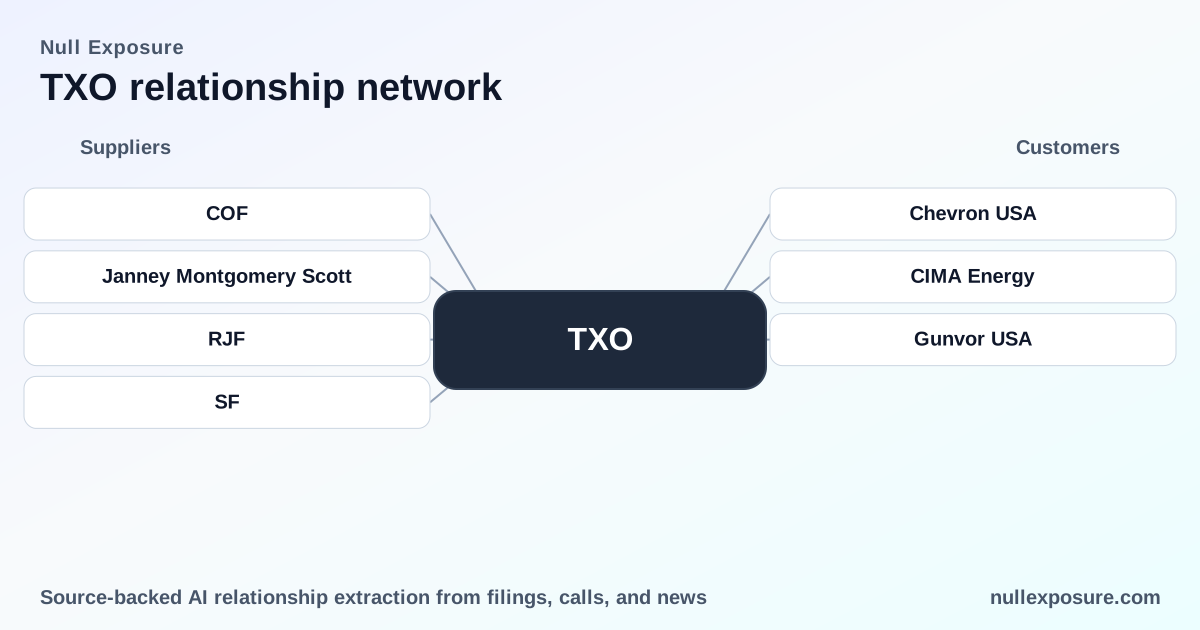
TXO Energy Partners (TXO): Supplier-side briefing for investors and operators
TXO Energy Partners operates by acquiring, developing and optimizing conventional oil, natural gas and NGL reserves in North America and monetizes through hydrocarbon production sales and disciplined capital markets activity that supports drilling programs and balance-sheet liquidity. Its public metrics show a mid‑cap exploration & production profile (Market Cap ~$692M; Revenue TTM $401M) with a high cash return focus reflected in a meaningful dividend yield alongside negative trailing EPS driven by capex and commodity cycles. For counterparties and operators, the company’s financing and underwriting relationships determine near‑term liquidity and the firm’s ability to fund development and optimization programs.
For complementary supplier risk intelligence, visit https://nullexposure.com/.
How TXO contracts and funds its operations — what matters to suppliers
TXO’s operating model is a typical E&P blend of production economics and capital-market dependence. It generates cash flow from oil and gas sales, then cycles that cash into drilling, optimization and acquisition work. Balance‑sheet mechanics matter: the company reports an EV/EBITDA of ~10.6 and continues to distribute cash (Dividend per share $1.71; Dividend yield ~13.8%), signaling a capital allocation mix that prioritizes shareholder distributions while relying on external funding for growth.
Key business-model constraints for counterparty diligence:
- Contracting posture — evidence of multi‑year finance arrangements. An amendment extended the company’s credit facility maturity to August 30, 2028, indicating medium‑term funding stability that suppliers can rely on when negotiating service terms.
- Maturity and criticality — production cash supports near‑term obligations but capital intensity remains. TXO’s operating margin and negative EPS show that operations are cash‑sensitive; counterparty claims should price for timing and payment assurances.
- Concentration and governance signals. Insiders hold ~26.6% and institutions ~30.0% of shares, which creates concentrated control dynamics that influence strategic decisions, including capital raises and farm‑out priorities.
These constraints are company‑level signals drawn from public filings and credit disclosures rather than any single third‑party relationship.
The commercial drivers and risk stack suppliers need to model
Suppliers and contractors should underwrite engagements with TXO against three drivers:
- Commodity price and production volumes — revenue volatility translates to payment risk for large capital projects.
- Access to capital markets and credit — underwriting syndicates and lenders determine the company’s ability to execute on growth plans.
- Operational maturity and cost control — TXO’s operating margin and EBITDA trend will dictate scope‑timing negotiations for service contracts.
Operational counterparty playbook:
- Price for shorter payment terms on high‑exposure projects.
- Prefer milestone payments tied to production uplift.
- Negotiate liquidity protections where possible (letters of credit or step‑in rights).
For a broader view of supplier risk frameworks, check https://nullexposure.com/.
The banking and underwriting relationships you should know
TXO’s recent capital markets activity shows a compact, transactional underwriting group that supports its equity and financing initiatives. Renaissance Capital reported on March 10, 2026 that the firm used a group of joint bookrunners for a deal; the following are the named participants.
Raymond James (RJF)
Raymond James served as a joint bookrunner on TXO’s documented capital deal, providing distribution and underwriting capability that supports secondary equity placement or other offerings. Renaissance Capital reported this syndicate placement on March 10, 2026.
Stifel (SF)
Stifel is listed as a joint bookrunner alongside other firms, offering institutional placement and investor relations reach that helps TXO access mid‑market investors. Renaissance Capital documented the role in its March 10, 2026 coverage.
Janney Montgomery Scott
Janney Montgomery Scott joined the syndicate as a co‑bookrunner, contributing regional placement strength useful for marketing TXO paper to wealth‑management channels. Renaissance Capital reported the syndicate composition on March 10, 2026.
Capital One Securities (COF)
Capital One Securities is named as a joint bookrunner on the same deal, providing additional distribution capacity and balance‑sheet support for the transaction. Renaissance Capital’s March 10, 2026 news item lists Capital One Securities among the joint bookrunners.
Each of these entries is drawn from the same Renaissance Capital news report covering the transaction; the presence of multiple joint bookrunners indicates TXO uses a diversified underwriting approach rather than relying on a single lead bank (Renaissance Capital, March 10, 2026).
What the syndicate composition means for suppliers and operators
The presence of multiple joint bookrunners (Raymond James, Stifel, Janney, Capital One Securities) signals that TXO taps a syndicate approach to place capital efficiently across investor channels. For suppliers, that implies:
- Improved near‑term liquidity access when TXO needs to raise equity or issue instruments to fund drilling or acquisitions.
- A transactional, market‑driven capital posture rather than long‑term strategic bank partnerships, which affects predictability of funding for multi‑year service contracts.
- Diverse investor reach, which frequently lowers cost of capital compared with a narrow distribution strategy.
Capital structure signal: takeaways from the credit amendment
A disclosed amendment extended the maturity date of TXO’s credit facility to August 30, 2028. This is a company‑level signal that should shape supplier negotiations:
- Contract maturity is aligned to medium‑term operational plans, reducing refinancing pressure through 2028 and improving counterparty visibility.
- Criticality for suppliers: extended maturity reduces immediate liquidity risk, enabling more competitive pricing for services timed before 2028; however, suppliers should still require payment protections for multi‑year scope given commodity volatility.
Conclusion — positioning for sensible exposure
For investors and operators evaluating TXO as a counterparty, the combination of production‑based cash flow, a dividend‑oriented payout profile, and accessible capital via a multi‑bank syndicate creates both opportunity and conditional risk. Suppliers should trade off improved near‑term liquidity visibility against commodity and operating‑margin risk by structuring contracts with milestone payments and liquidity protections. For deeper supplier relationship intelligence and tailored counterparty scoring, visit https://nullexposure.com/.
For a timely read on upstream counterparties and financing patterns, see additional supplier profiles and analysis at https://nullexposure.com/.