Tri-Continental Corporation PFD $2.50 (TY‑P): The manager-driven preferred you own for yield, not growth
Tri‑Continental Corporation PFD $2.50 (TY‑P) is a listed preferred equity that monetizes for investors principally through regular distributions tied to the company’s investment income, while portfolio construction and distribution policy are delegated to an external investment manager. The security functions as a yield instrument rather than an operating business: returns are delivered via dividends managed by an appointed adviser, and the investment manager is the operational fulcrum that determines cash flow generation and timing. For a strategic assessment of the supplier relationships that govern TY‑P’s economics, see the supplier profile at NullExposure.
The single supplier dynamic that defines TY‑P’s operating model
Tri‑Continental’s preferred shares are not an operating entity in the conventional sense; they are a capital claim on a pooled investment vehicle whose portfolio decisions and distribution cadence are executed by a named investment manager. That delegation creates a concentrated supplier posture: one external manager handles the core functions that generate the yield investors receive. This concentration is an investment-grade operational signal — it reduces internal complexity but increases reliance on a single counterparty for performance and governance.
For deeper supplier mapping, consult the Tri‑Continental supplier entry on NullExposure.
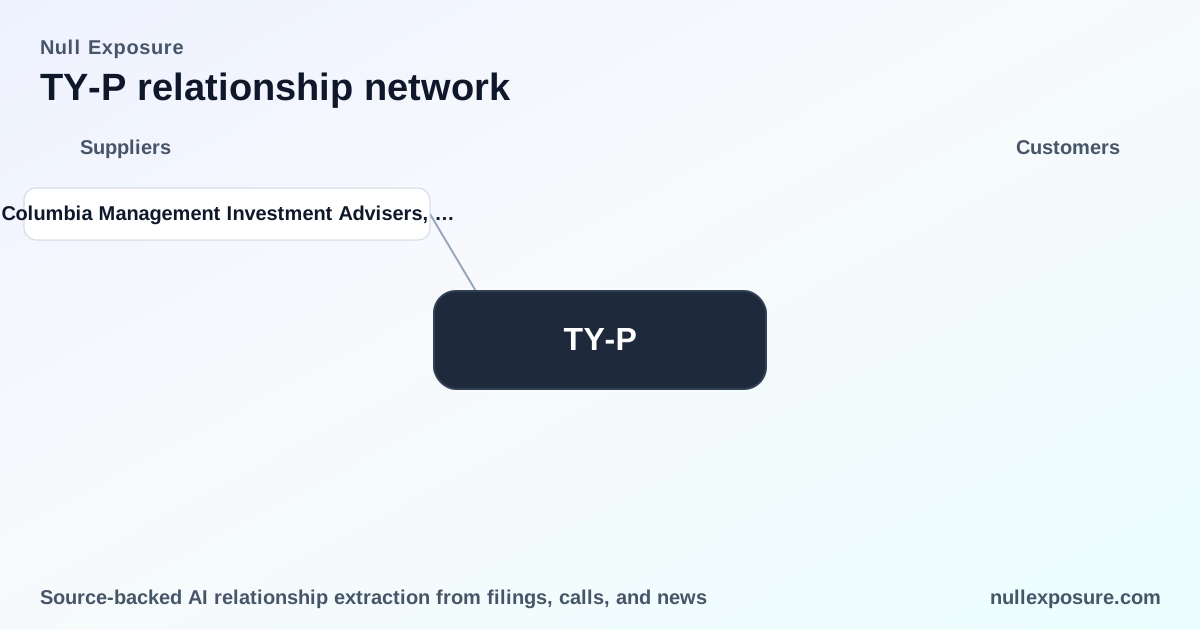
Columbia Management Investment Advisers, LLC — the manager and the decision point
According to a Globe and Mail press release dated March 10, 2026, Tri‑Continental’s investment manager is Columbia Management Investment Advisers, LLC, a wholly‑owned subsidiary of Ameriprise Financial, Inc., which performs portfolio management and supports distribution declarations for the corporation. (Globe and Mail, press release, March 10, 2026.)
A MarketScreener note published the same date reiterates that the fund’s manager is Columbia Management Investment Advisers, LLC, underscoring that the investment advisory function is the contractor executing portfolio strategy and distribution mechanics. (MarketScreener, March 10, 2026.)
How the supplier relationships translate into investor exposure
Columbia Management’s role is not ancillary: it is the operational engine behind cash flow to preferred holders. That creates four practical characteristics investors must treat as part of the security’s risk/return profile:
- Contracting posture: Outsourced, manager‑led — Tri‑Continental relies on a formal management agreement with Columbia Management, delegating asset allocation, trading, and income realization.
- Concentration: High — the supplier set is dominated by a single adviser, which centralizes operational dependencies and governance leverage.
- Criticality: Acute — dividend timing and portfolio risk are controllable through the manager’s decisions; any disruption to that relationship would materially affect distributions.
- Maturity and stability: Established manager backing — Columbia Management is a subsidiary of Ameriprise Financial, delivering institutional scale and process maturity that supports steady operations and standard reporting.
Key company metrics that color these supplier dynamics: market capitalization stands at approximately $2.48 billion and the current dividend yield is 3.41%, with the next dividend payable on April 1, 2026. These numbers position TY‑P as a cash‑flow instrument whose ongoing return profile is effectively the output of the manager’s mandate and execution.
For a complete supplier view and additional context, visit NullExposure.
Relationship-level facts investors need on the record
-
Columbia Management Investment Advisers, LLC is named as Tri‑Continental’s investment manager in a company press release that declared the fourth‑quarter distribution; the release identifies Columbia Management as a wholly‑owned subsidiary of Ameriprise Financial, Inc., anchoring the operational chain of command. (Globe and Mail press release, March 10, 2026.)
-
MarketScreener’s report for the first quarter of FY2026 confirms that Columbia Management serves as the fund’s manager, reinforcing the single‑manager supplier relationship across consecutive filings and communications. (MarketScreener, March 10, 2026.)
Operational constraints and company‑level signals
There are no supplier constraints explicitly listed in the available relationship data. That absence is itself an operational signal: no disclosed contractual caveats or supplier limitations appear in the supplier results, which should be interpreted as a neutral company‑level indicator rather than proof of unlimited flexibility. Additional company‑level signals evident from the public profile:
- Reporting posture: The preferred instrument reports limited operating metrics (no revenue or EBITDA figures typical for a preferred share), which emphasizes that credit and yield analysis rely on distribution history and manager performance rather than underlying operating cash‑flows.
- Data irregularities as governance signals: Several balance and share metrics are shown as zero in the data feed (for example, SharesOutstanding and SharesFloat), which reflects class‑level reporting practices for preferreds rather than an operative change; investors and operators should confirm share registry and liquidity details in official filings before executing large trades.
- Dependency on manager stability: Because the manager is a fully owned Ameriprise affiliate, counterparty risk is moderated by parent‑company scale; nevertheless, operational continuity is tied to the manager agreement and its renewal terms, which are material for forward distribution certainty.
What investors and operators should do next
- For yield investors: treat Columbia Management as the primary operational counterparty; your credit and liquidity assessment should weight the manager’s performance track record and the parent company’s financial strength as much as Tri‑Continental’s headline yield.
- For portfolio risk managers: stress test dividend continuity under scenarios where the manager’s mandate is curtailed or restructured; supplier concentration implies a low probability but high impact event.
- For operators and governance teams: review the management agreement and succession provisions to ensure continuity of portfolio execution and clarity on fee and distribution mechanics.
To benchmark this supplier relationship against peers, use the supplier intelligence hub at NullExposure.
Bottom line — what this means for capital allocation
TY‑P is a manager‑dependent preferred designed for investors seeking yield. The single most important supplier relationship is with Columbia Management Investment Advisers, LLC; that relationship determines the timing and reliability of distributions. Investors should allocate to TY‑P when they have conviction in the manager’s approach and in Ameriprise’s stewardship of Columbia Management, and should discount the position for the concentrated operational counterparty risk.
If you want a targeted supplier report and a side‑by‑side comparison with other manager‑run preferreds, start your assessment at NullExposure.