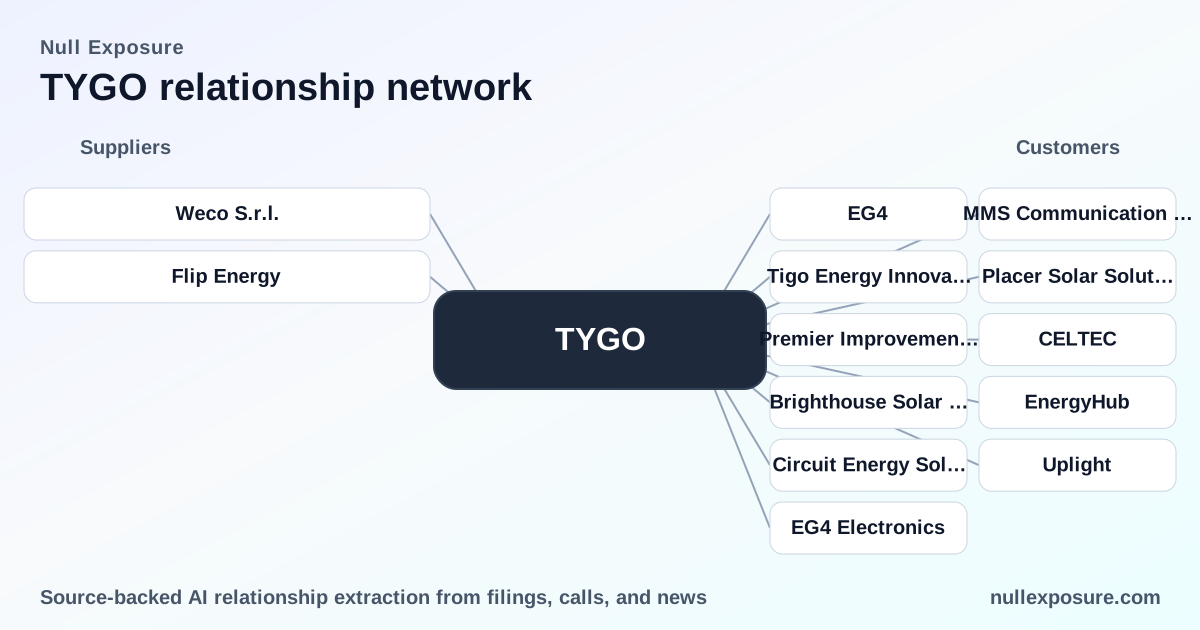
Tigo Energy (TYGO): supplier relationships and operational constraints investors should price in
Tigo Energy sells hardware and cloud-enabled software that increase yield and observability on solar arrays, monetizing through product sales (MLPE hardware and battery systems) and recurring software/services tied to its EI Platform. Revenue is driven by growing installation penetration and platform integrations that convert one-time hardware buyers into recurring software users. For investors evaluating supplier risk and operational durability, the relevant facts are concentrated manufacturing, APAC production footprint, and active integration partnerships that expand product stickiness.
Learn more about supplier risk tools and supplier dashboards at https://nullexposure.com/ for deeper diligence.
How Tigo operates and where value is created
Tigo’s operating model is a hybrid hardware-plus-software play. The company outsources all production to contract manufacturers, then layers firmware, monitoring, and integration services that add recurring value through platform capabilities (e.g., VPP participation) and installer-friendly integrations. Financially, Tigo reports revenue growth (Revenue TTM: $103.5M) and solid gross margins (Gross Profit TTM: $44.4M), while operating and bottom-line metrics reflect ongoing investment and negative EPS (-$0.03). The economic thesis: scale hardware distribution to seed the EI Platform ecosystem, then monetize upgrades, analytics, and grid services.
Key commercial characteristics that shape supplier risk:
- Contract-based manufacturing posture with master supply agreements that renew automatically, reducing procurement friction but increasing lock-in exposure to specific vendors.
- Geographic concentration in APAC manufacturing, which lowers tariff exposure for US imports when production is routed appropriately, but increases geopolitical and logistics sensitivity.
- High supplier criticality because contract manufacturers produce the bulk of all MLPE products, making single-supplier disruptions potentially material to revenue delivery.
Two recent partner relationships that extend product scope
Both relationships below expand Tigo’s platform value proposition: one establishes hardware compatibility with inverters, the other enables energy storage participation in VPPs via an integration.
Weco S.r.l. — compatibility certificate for hybrid inverters
Tigo signed a certificate documenting compatibility between its Flex MLPE products and hybrid inverters from Weco, formalizing interoperability that simplifies PV system design and installer workflows. This is a classic product-extension move: broaden compatible inverter list to reduce friction for channel partners and accelerate hardware adoption. (Source: Tigo announcement reported on AIJourn, March 2026).
Flip Energy — API integration to enable VPP-capable storage
Flip Energy integrated at the API level with the Tigo EI Platform so that the GO Battery can participate in U.S. VPP programs without additional hardware or complex configuration, effectively turning Tigo’s platform into a VPP on-ramp for installers. This integration increases recurring value and differentiates the EI Platform as a utility-interactive orchestration layer. (Source: Solar Power World coverage, January 2026).
What the disclosed constraints say about supplier posture and operational risk
Tigo’s constraint signals are coherent and actionable for investors assessing counterparty and delivery risk.
-
Contracting posture — framework agreements: Tigo relies on master supply agreements with automatic renewals (example clauses cited for Kinpo and Asteelflash), which indicates a preference for long-running supplier relationships that simplify procurement but create dependency over time. Automatic renewals reduce near-term sourcing volatility but raise switching costs if quality or cost becomes an issue.
-
Geographic footprint — APAC manufacturing: Tigo imports MLPE products manufactured in Kinpo’s Thailand facility, a deliberate strategy to manage tariff exposure for the U.S. market. Manufacturing in APAC is a control lever for tariff and supply-chain planning, but concentrates risk in that region.
-
Concentration and criticality — a small set of principal manufacturers: The company discloses Kinpo Electronics and Asteelflash Suzhou as its principal contract manufacturers that account for the substantial majority of products sold. This concentration is material: manufacturing disruptions at either partner would directly impair product availability and revenue generation. (Company disclosures, FY2024–FY2026).
-
Operational model — fully outsourced manufacturing: Tigo does not own or lease manufacturing facilities; it outsources production to contract manufacturers. That accelerates capex-light scaling but creates vendor management as a core operational competency and a primary point of operational risk.
-
Cyber and services posture — reliance on third-party security providers: Tigo engages professional services, consulting firms, and threat intelligence vendors to identify and manage cybersecurity risks, signaling that platform security is treated as a sourced capability rather than fully in-house.
Taken together, these company-level signals show an asset-light hardware supplier that is operationally dependent on a concentrated set of APAC contract manufacturers and increasingly dependent on platform integrations to drive recurring revenue.
Risk profile: what to watch next
- Supply concentration: Monitor order fill rates and any public statements from Kinpo or Asteelflash. Given that these two contract manufacturers produce the bulk of Tigo’s MLPE, a facility outage, quality lapse, or tariff change routing could compress revenue.
- Integration execution: Partnerships like Flip Energy expand addressable market through software hooks; execution risk lies in installer adoption and interoperability performance.
- Margin and scaling: Tigo’s gross margins are healthy relative to revenue, but EBITDA is negative and EPS slightly negative, indicating that profitable scaling and software monetization are the next valuation levers.
- Geopolitical exposure: APAC manufacturing reduces immediate U.S. tariff exposure in instances where production is routed through Thailand, but concentration in that region still exposes the company to logistics disruption and regional policy shifts.
If you want a structured view of supplier exposure and contract characteristics for Tigo, visit https://nullexposure.com/ to see a supplier-first analysis framework.
Investor takeaways and recommended next steps
- Short-term: track fill rates and public notices from Kinpo and Asteelflash for signs of disruption; these two factories are functionally mission-critical.
- Medium-term: evaluate how many installations convert to paid platform subscriptions after integrations like Flip Energy and Weco expand installer options; platform monetization will be the primary driver of margin expansion.
- Portfolio action: Given current scale and product-roadmap partnerships, Tigo is best viewed as a growth equity with supplier concentration risk—position size should reflect exposure tolerance to APAC manufacturing dynamics.
For a deeper supplier-oriented diligence package and benchmarking against peer manufacturing footprints, explore tools and reports at https://nullexposure.com/.
In closing, Tigo’s commercial model leverages outsourced APAC manufacturing to scale hardware distribution while building recurring platform value via integrations and software services; the company’s upside will be driven by successful platform monetization, and its principal downside is concentrated supplier risk tied to a small number of contract manufacturers.