Tyler Technologies (TYL): Supplier Relationships and Strategic Constraints
Tyler Technologies is the largest provider of software to the U.S. public sector and monetizes through subscription software, transaction fees for digital government services, and implementation/maintenance contracting. The company converted the bulk of its on-premise offerings to cloud-delivered SaaS since 2019, driving higher recurring revenue and predictable cash flows while incurring short-term accounting and growth transition effects. Investors should evaluate Tyler’s supplier posture through two prisms: cloud hosting and third‑party software costs as a vector of operating leverage, and multi‑year purchase commitments that lock in cost and capacity through 2031. For a focused supplier-risk evaluation and benchmarking, visit https://nullexposure.com/.
What every investor needs to know up front
- SaaS-first revenue model: Tyler shifted thousands of products to subscription delivery, converting one‑time license economics into recurring revenue and transaction streams.
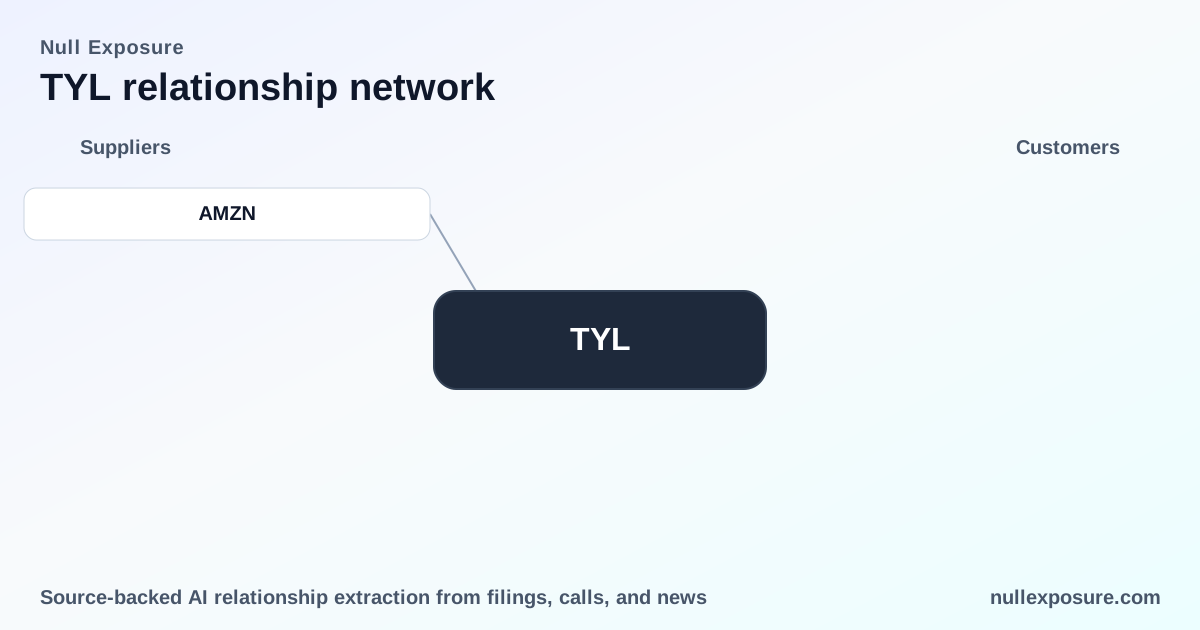
- Cloud dependency: Amazon Web Services is the primary hosting partner identified across multiple market writeups, which makes cloud availability and commercial terms a core operational risk.
- Commitments and cost visibility: The company disclosed an aggregate minimum purchase commitment of roughly $646 million through 2031, implying material multi‑year spend and contractual lock‑ins that influence margins and vendor negotiation leverage.
Supplier relationship record — every item in the results
AWS mentioned in Finviz coverage (Mar 2026)
A Finviz analyst note highlights Tyler’s strategic shift to SaaS since 2019, powered by AWS, and credits that migration with converting over 2,000 on‑premise products into subscription offerings that increase long‑term recurring revenue while creating temporary headline growth distortion due to accounting shifts. Source: https://finviz.com/news/326241/tyler-technologies-inc-tyl-a-bull-case-theory
Amazon Web Services in Directorstalk Interviews (Mar 2026)
A Directorstalk Interviews piece describes a strategic collaboration with Amazon Web Services for cloud hosting services, calling out AWS as a foundational element of Tyler’s service delivery and capacity to scale its public‑sector SaaS offerings. Source: https://www.directorstalkinterviews.com/tyler-technologies-tyl-stock-analysis-exploring-a-38-67-upside-potential-amidst-strong-buy-ratings/4121240661
AWS referenced again in InsiderMonkey commentary (Mar 2026)
InsiderMonkey reiterated that Tyler’s SaaS conversion is “powered by AWS”, restating the conversion of thousands of products and the resulting shift toward subscription revenue and transaction-based services. Source: https://www.insidermonkey.com/blog/tyler-technologies-inc-tyl-a-bull-case-theory-4-1701926/
How the disclosed constraints shape the operating model
Tyler’s constraints are a map to contracting posture, concentration, criticality, and maturity rather than isolated metrics.
- Contracting posture — long‑term commitments: Company filings indicate an aggregate minimum purchase commitment of about $646 million through 2031, signaling a deliberate long-term procurement pattern that reduces short-term vendor churn but also locks in spend and exposure across the planning horizon. This is a firm-level signal of commitment-driven procurement (company filing as of December 31, 2024).
- Vendor role mix — licensor and service provider: Tyler incurs costs for software licenses and royalties (a licensor relationship signal) and relies on third‑party vendors for transaction processing and hosting (a service provider relationship). The filing describes both license costs and vendor‑assisted transaction services, establishing a hybrid vendor dependency profile.
- Spend concentration — >$100M band: The $646 million commitment places Tyler in a high spend band with long-dated obligations, implying that a meaningful portion of operating cost structure is contractually fixed or predictable through 2031.
- Critical supplier naming — AWS as hosting provider: The filing explicitly names Amazon Web Services among third‑party providers used for hosting and other technology services needed to deliver cloud solutions, making AWS a critical operational supplier for Tyler’s SaaS stack.
These constraints collectively indicate a mature SaaS operator with embedded third‑party hosting dependency and material long‑tail contractual commitments that shape margins, negotiation leverage, and vendor risk.
Commercial implications: what investors and operators should price in
Tyler’s supplier profile generates a clear set of commercial tradeoffs investors must price.
- Upside from recurring revenue: The SaaS conversion increases revenue visibility and valuation multiple support from predictable ARR and transaction fees. Tyler’s Price/Revenue and EV/Revenue profiles already reflect premium expectations for recurring software growth.
- Concentration and availability risk: AWS is the named hosting provider in the company’s own disclosures and multiple market writeups, so cloud service disruption or adverse contract repricing would have immediate operational consequences for service delivery and customer satisfaction.
- Margin compression and fixed spend: The $646 million minimum commitment through 2031 creates both predictability and rigidity—Tyler retains predictable capacity but has reduced flexibility to renegotiate economics quickly if competitive pressures increase.
- Accounting and growth transition: The SaaS shift temporarily affects headline growth metrics due to revenue recognition changes; investors should focus on underlying ARR and transaction trends rather than short‑term GAAP growth fluctuations.
For a structured supplier‑risk scorecard and peer benchmarking to quantify these implications, check the tools at https://nullexposure.com/.
Risk checklist for partnership diligence
- Confirm contractual scope: ascertain whether long‑term commitments relate primarily to hosting, software licenses, or capacity purchases.
- Validate failover and multi‑cloud plans: if AWS is the primary host, evaluate secondary hosting or disaster recovery arrangements.
- Assess margin stress scenarios: model the impact of vendor cost inflation under the existing purchase commitment structure.
- Monitor ARR conversion cadence: track which converted on‑premise modules are successfully driving subscription renewals and transaction volume.
Bottom line and recommended next steps
Tyler Technologies has transformed into a SaaS and transaction‑driven operator with material long‑term vendor commitments and a clearly named reliance on Amazon Web Services for hosting. That structure delivers predictable cash flows and valuation upside but also concentrates operational risk in cloud hosting and locks in multi‑year spend. For investors, the path is straightforward: value the durability of recurring revenue while stress‑testing supplier concentration and contract economics.
If you require a tailored supplier-risk assessment or a benchmarking package to compare Tyler with peers, visit https://nullexposure.com/ to start a focused review. For immediate, actionable intelligence on supplier exposure across your portfolio, see our homepage at https://nullexposure.com/.