Unity Software (U): Supplier Relationships That Shape Revenue and Risk
Unity operates a real-time 3D development platform and monetizes through engine licensing, developer tools, advertising and monetization services, cloud-hosted runtime and content services, and payments/commerce integrations. Unity’s revenue base is anchored in software sales and services ($1.85B TTM revenue, $1.37B gross profit), while its margins and capital allocation are driven by the economics of advertising and cloud-hosted offerings. Investors evaluating supplier exposure should focus on ad-tech integrations, physics middleware changes, cloud hosting partners, and payments relationships that directly influence uptime, developer retention, and take-rates. For a concise supplier intelligence feed, visit https://nullexposure.com/.
How suppliers move the needle: a quick operating thesis
Unity’s platform is both a product and a distribution channel: developer tools lock in creators while in-editor monetization and ad partners convert that scale into recurring revenue. Supplier relationships that embed into the editor (ad SDKs, physics engines, cloud backends, payment rails) change user economics immediately — they materially affect developer friction, ad yield, and platform fees. Unity’s market capitalization and analyst coverage reflect this platform dynamic and the market’s expectation that ad and cloud economics will drive forward profitability.
Company-level supplier posture and constraints
Unity runs a hybrid hosting model and outsources several operational functions. The company’s disclosures show it uses co-located data centers and third-party cloud providers (Google Cloud, AWS, Azure, Tencent) to deliver platform services, and it engages third-party vendors for security reviews and incident management. This structure produces several company-level signals:
- Contracting posture: Multi-cloud and co-location access give Unity negotiating leverage with providers while increasing integration complexity; contracts likely combine long-term commitments with variable usage fees.
- Concentration risk: Reliance on the largest cloud vendors spreads risk but keeps Unity exposed to major providers’ pricing actions and regional outages.
- Criticality and maturity: Hosting and vendor security processes are core operational dependencies; they are mature enough to be standardized but remain critical single points for uptime and compliance. These are company-level constraints derived from Unity’s vendor disclosures and should inform counterparty diligence.
Four supplier relationships investors should track now
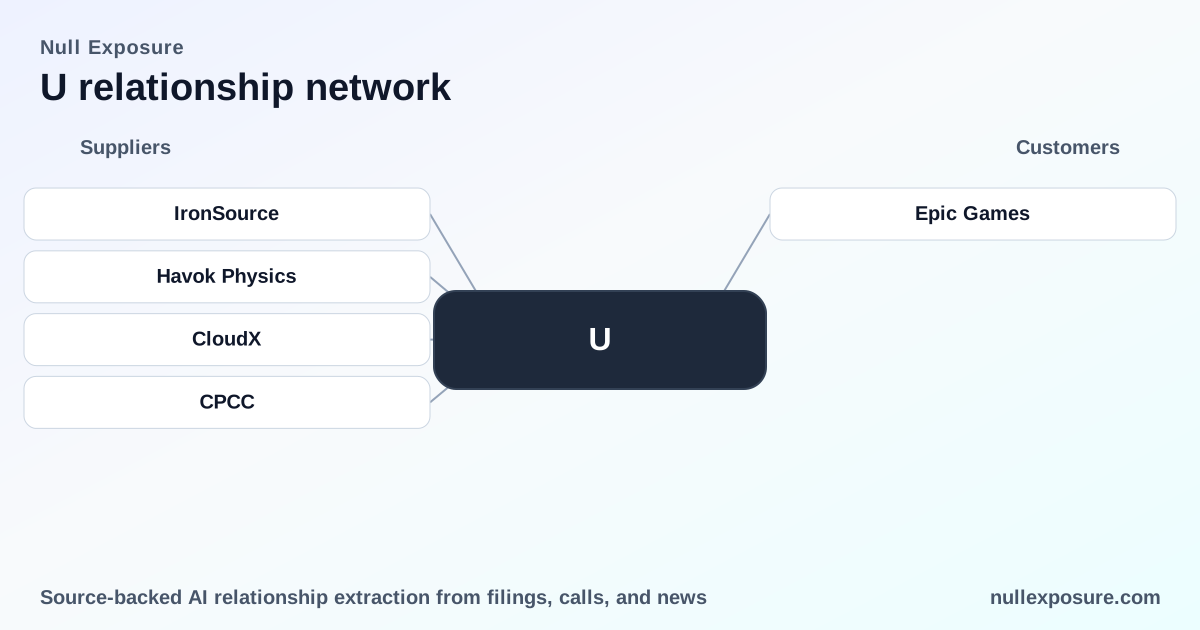
The following relationships are pulled from recent coverage and earnings commentary; each is summarized in plain language with source context.
IronSource — ad stack embedded into the editor
Unity has integrated advertising tools like IronSource directly into the editor, which reduces friction for developers to route monetization through Unity’s ad network rather than third parties; this strengthens Unity’s ad yield control and increases platform monetization stickiness. A BarChart news analysis covering Unity sentiment noted the IronSource integration as a strategic embed (March 10, 2026 — BarChart).
Source: BarChart report, March 10, 2026.
Havok Physics — premium tier removal increases modularity risk
Unity disclosed that some premium tiers tied to the Unity 6.3 long-term support release will drop Havok Physics, signaling a product architecture decision that reduces dependency on third-party physics middleware for certain customers but introduces transition and compatibility work for developers who relied on Havok. This is a product-level change with implications for developer support costs and partner negotiations.
Source: Tech news report, TS2.Tech coverage of Feb/Mar 2026 earnings commentary (reported March 10, 2026).
CloudX — demand partnership inside the ad ecosystem
Unity described CloudX as one of its demand partners, highlighting that Unity pairs with external ad demand platforms to expand demand-side liquidity and optimize yield. This partnership is operationally relevant because demand partners directly affect ad fill rates and effective CPMs for developers.
Source: Q4 2025 earnings call transcript coverage on InsiderMonkey (March 10, 2026).
Stripe — payments economics and platform commerce
Unity referenced its partnership with Stripe in investor Q&A when discussing the economics of payment-enabled solutions, indicating Stripe handles parts of the payment and commerce flow and influences Unity’s take-rate mechanics and settlement timelines. Payments integration affects developer onboarding speed and reduces friction for in-app transactions.
Source: Q4 2025 earnings call transcript coverage on InsiderMonkey (March 10, 2026).
What these relationships imply for contracting and financial exposure
Unity’s supplier landscape blends embedded ad partners, modular middleware, third-party demand channels, and payment rails. Investors should focus on four practical exposures:
- Revenue capture: Embedding ad SDKs like IronSource inside the editor shifts revenue capture upstream to Unity; this increases dependence on ad-tech partners’ agreement terms and revenue shares.
- Platform migration costs: Removing a middleware vendor from premium tiers (Havok) reduces licensing spend but creates migration and support costs for affected customers, with possible short-term churn.
- Operational uptime and margin pressure: Multi-cloud hosting reduces single-vendor outage risk but keeps Unity exposed to large cloud providers’ price changes and variable usage bills; cloud costs will remain a margin lever.
- Payments timing and take-rates: Stripe’s role in payments governance affects cash flow timing, chargeback exposure, and effective net take for Unity on marketplace transactions.
These are not hypothetical—Unity’s own filings and investor Q&A lay out these vectors (company filings and Q4 2025 call commentary).
Visit https://nullexposure.com/ for a supplier risk dashboard built for investors assessing platform-exposed software companies.
Active negotiation points for corporate and investor diligence
When preparing vendor diligence or negotiating terms, prioritize these clauses and metrics:
- Revenue share caps and audit rights for embedded ad SDKs to protect long-term yield.
- Transition support and compatibility warranties when deprecating third-party middleware to limit developer churn.
- Cost pass-through and outage SLAs in cloud contracts to stabilize gross margin sensitivity to provider price moves.
- Payment settlement cadence and indemnities with Stripe or alternative rails to control working capital and fraud exposure.
These negotiation levers are the practical next steps for operators and procurement teams managing Unity-related supplier risk.
Bottom line and calls to action
Unity’s supplier relationships are simultaneously strategic drivers and operational levers: ad integrations drive monetization, middleware choices alter product stickiness, cloud providers control margin volatility, and payment partners shape cash flow dynamics. Investors and operators should track these relationships continuously because they affect both near-term yield and the long-term economics of the platform.
For ongoing monitoring and supplier-centric intelligence on Unity and comparable platform providers, go to https://nullexposure.com/. If you want tailored supplier exposure analysis for your portfolio or vendor stack, start at https://nullexposure.com/ and request a briefing.