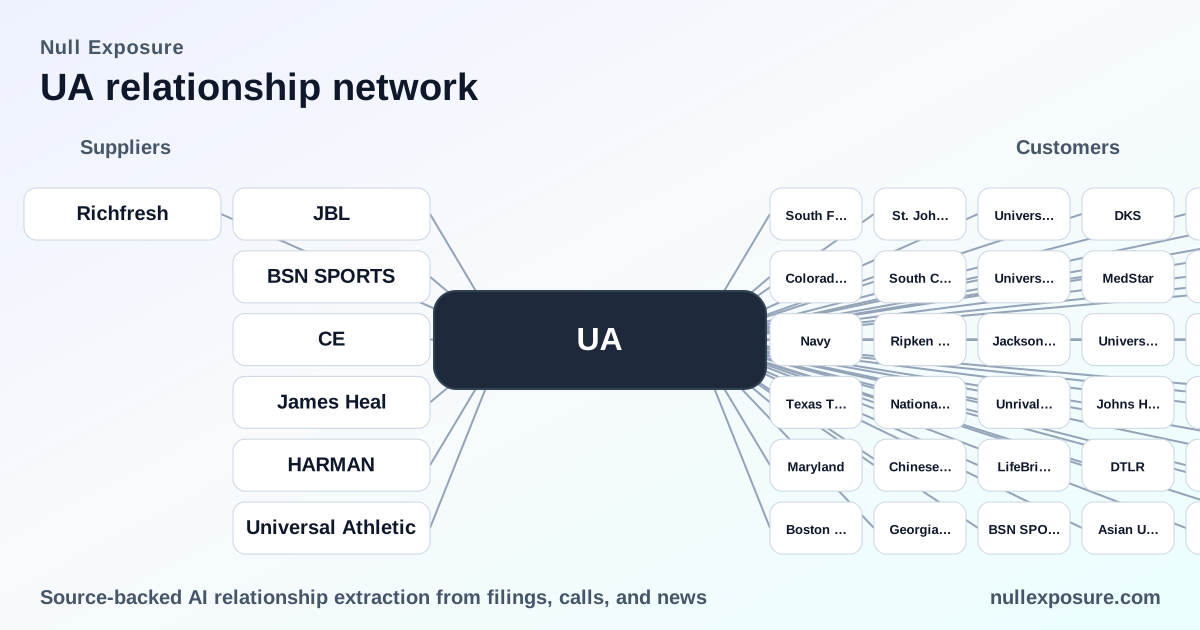
Under Armour (UA) — Supplier relationships and operational constraints investors must price
Under Armour manufactures and sources most of its product through third-party contract manufacturers and sells through wholesale, direct-to-consumer and licensed channels; the company monetizes by selling apparel, footwear and accessories, licensing team and branded products, and leveraging co-branded product placements to support premium pricing. Manufacturing and fabric partnerships drive product differentiation and working capital commitment, while distribution partners and licensing expand reach into team and experiential channels. Explore deeper supplier risk profiles at https://nullexposure.com/.
The operating model you need to understand now
Under Armour operates an asset-light manufacturing model: substantially all product is made by unaffiliated contract manufacturers and the company secures capacity and materials with fixed or minimum-quantity purchase commitments. Key company-level signals for investors and operators:
- Concentration and geography: A material share of footwear and apparel is manufactured in APAC (notably Vietnam, Indonesia, Cambodia and Jordan), and the top fabric suppliers supply ~38% of fabric needs, concentrating supply chain risk in specific countries.
- Contracting posture and lead times: Orders are placed generally four to six months ahead of expected sales, with open purchase orders that include fixed quantities and determinable prices — the company lists roughly $1.15 billion in product purchase obligations, indicating >$100m effective spend bands and significant committed working capital.
- Distribution footprint: The company uses third‑party logistics providers for markets such as Canada and Mexico, creating operational dependencies outside manufacturing.
- Service relationships and non-manufacturing spend: Under Armour records service and lease arrangements (including an aircraft lease) that reflect broader vendor exposure beyond manufacturing.
- Operational stage and maturity: Supplier relationships are active and longstanding in many cases, supporting product launches, licensed manufacturing, and material co‑development.
These constraints imply high operational leverage to manufacturing continuity and input availability; inventory and supplier contract management are central to near‑term margin and cash flow outcomes.
How each supplier relationship fits into Under Armour’s playbook
Below I cover every supplier relationship flagged in the record set and summarize its role and source.
JBL
Under Armour collaborates with JBL to produce Project Rock over‑ear training headphones engineered for intense workouts and co‑branded with Dwayne Johnson, supporting UA’s lifestyle and training accessory strategy. Source: Harman / JBL product release (Project Rock launch tied to FY2021) — https://news.harman.com/releases/designed-tested-and-approved-by-dwayne-the-rock-johnson-under-armour-over-ear-training-headphones-engineered-by-jbl-have-arrived
HARMAN
HARMAN (parent of JBL) publicly framed the co‑development and branding of the Project Rock headphones, indicating Under Armour’s approach to licensing premium audio accessories with strategic partners. Source: Harman press release (FY2021) — https://news.harman.com/releases/designed-tested-and-approved-by-dwayne-the-rock-johnson-under-armour-over-ear-training-headphones-engineered-by-jbl-have-arrived
BSN SPORTS
Under Armour expanded its wholesale partnership with BSN SPORTS to license UA team sports uniforms and appointed BSN as an official manufacturer of UA‑sublimated uniforms beginning January 2026, scaling UA’s entry into organized team apparel distribution. Source: Under Armour corporate communications (announcing BSN partnership expansion; FY2022 / FY2025 notices) — https://about.underarmour.com/en/stories/2022/12/under-armour-announces-stephanie-linnartz-as-president-and-ceo.html and https://about.underarmour.com/en/stories/2025/01/under-armour-launches-shadow-3.html
Celanese Corporation (CE)
Celanese co‑developed NEOLAST™, a new fiber for performance stretch fabrics used in UA apparel, representing a strategic materials partnership that underpins product performance differentiation. Source: Under Armour corporate posts and product launch notes (multiple mentions across FY2018–FY2025) — https://about.underarmour.com/en/stories/2022/10/introducing-ua-slipspeed--under-armour-s-most-versatile-training.html and https://about.underarmour.com/en/stories/2025/01/under-armour-launches-shadow-3.html
James Heal
Under Armour partnered with James Heal, a precision textile testing supplier, to implement award‑winning test methods and quality controls for fabric performance, signaling emphasis on standardized QC and material validation in product development. Source: Under Armour product and corporate stories (mentions across FY2018–FY2025) — https://about.underarmour.com/en/stories/2022/12/under-armour-announces-stephanie-linnartz-as-president-and-ceo.html and https://about.underarmour.com/en/stories/2025/01/under-armour-launches-shadow-3.html
Universal Athletic
Universal Athletic appears as a regional servicing and distribution partner (local servicing entity) for Under Armour in collegiate or regional accounts, illustrating UA’s use of regional service partners to execute local market programs. Source: UMD athletics partnership announcement (FY2021) — https://umdbulldogs.com/news/2021/9/30/general-umd-athletics-extends-partnership-with-under-armour-through-2028.aspx
Richfresh
Under Armour partnered with tailor/designer Richfresh to outfit athletes with tailored suits, an example of UA’s premium apparel and PR collaborations aimed at athlete-facing brand experiences. Source: Under Armour corporate release (FY2019) — https://about.underarmour.com/en/stories/2019/05/under-armour-reports-br-first-quarter-2019-results.html
Risk and opportunity mapped to investment levers
Investors should price these supplier signals into three core vectors:
- Supply concentration risk: With manufacturing and fabric supply concentrated in APAC and the top fabric suppliers providing ~38% of fabric, disruption in Vietnam/Indonesia/Taiwan/China/Malaysia would have an outsized earnings impact given the company’s purchase commitments.
- Working capital exposure: The approximately $1.15 billion of product purchase obligations and the four‑to‑six month order cadence create predictable but sizable cash outflows that compress liquidity when sales slow.
- Product differentiation and margin upside: Materials co‑development with Celanese (NEOLAST™) and co‑branded accessories (JBL/HARMAN, Project Rock) are clear levers for premium pricing and margin expansion if distribution and inventory execution remain intact.
- Channel diversification through licensing: The BSN SPORTS licensing and manufacturing arrangement broadens wholesale reach into team sports and institutional buyers, creating a route to scale volume without incremental manufacturing ownership.
Midway check: if you want comprehensive supplier analytics and exposure scoring tied to these signals, review our model at https://nullexposure.com/.
What operators and analysts should monitor next
Operational diligence should focus on three actionable items:
- Track procurement and fabric supplier concentration metrics and any shifts in the top‑five supplier mix.
- Monitor inventory aging and the cadence of open purchase orders versus incoming sales to quantify working capital risk.
- Evaluate licensing and materials partnerships (BSN, Celanese, JBL/HARMAN) for revenue contribution and margin impact in next‑quarter reporting.
Bottom line: Under Armour is a brand‑led apparel company that outsources manufacturing at scale, creating both an opportunity from materials and co‑brand partnerships and a concentrated operating risk tied to APAC manufacturing and committed purchase obligations. For investors, the immediate questions are whether innovation partnerships will drive sustainable ASP/margin gains and whether purchase commitments will strain cash if revenue growth lags.
For a deeper supplier risk assessment and exposure scoring that ties these relationships to balance sheet impact, visit https://nullexposure.com/.
Final takeaway: supplier strategy is central to UA’s path to margin recovery — monitor fabric concentration, committed spend, and the commercial rollout of licensed manufacturing (BSN) as leading indicators of operational stability and upside.