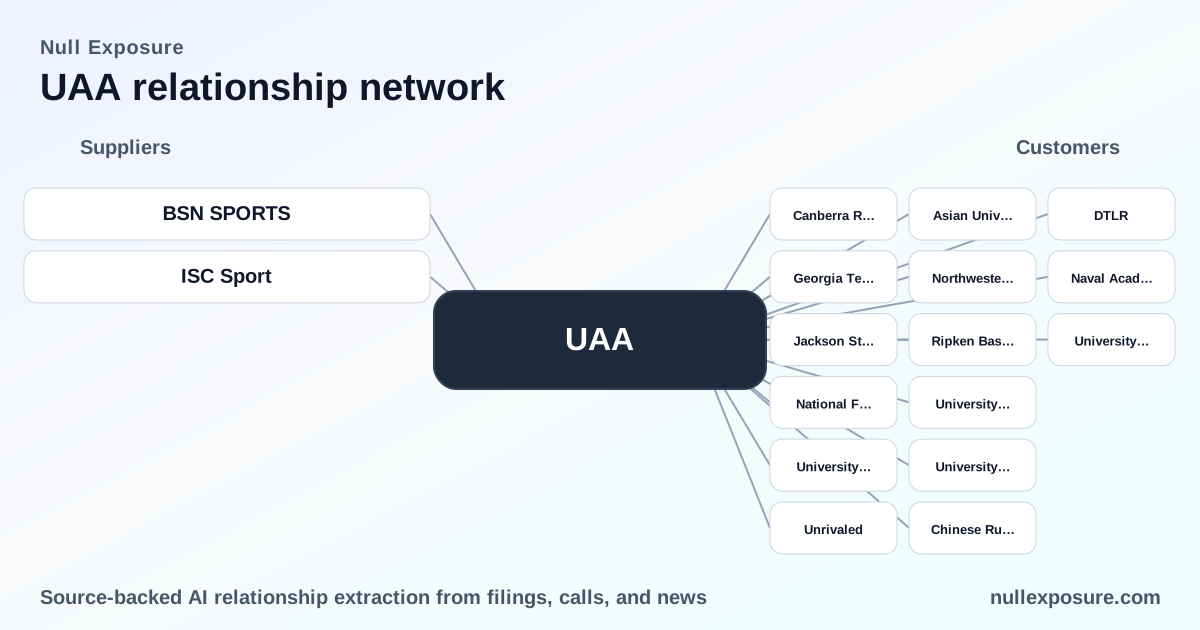
Under Armour (UAA) — supplier relationships and what they mean for investors
Under Armour operates as a brand-led apparel and footwear company that monetizes by designing and marketing performance apparel while outsourcing the bulk of its manufacturing to third-party partners. Revenue streams come from wholesale distribution, direct-to-consumer retail, and licensed product programs; the company’s supplier posture and contractual mix therefore directly influence inventory flow, margin stability, and go-to-market flexibility. For investors evaluating supplier risk and operational leverage, the key questions are concentration, geography, contract tenor, and the degree to which suppliers are critical manufacturers versus ancillary service providers.
If you want a concise, investor-grade supplier risk briefing, start here: https://nullexposure.com/
High-level read: how Under Armour contracts and where that creates leverage
Under Armour’s supplier profile combines long-term real estate and facility leases with predominantly outsourced product manufacturing contracted on relatively short procurement cycles. Company disclosures show a dual contracting posture: operating leases for warehouses and retail spaces that run through the late 2030s, and product purchase obligations that reflect short-term procurement commitments. This hybrid model gives Under Armour flexibility to scale production, but it also places execution risk squarely in the supply base.
Geography matters. Fabric sourcing is concentrated in APAC — Taiwan, China, Malaysia and Vietnam — which centralizes execution risk and exposes the company to regional supply-chain disruption and labor cost variability. The firm-level disclosure that its top five suppliers provided approximately 38% of apparel fabric in Fiscal 2025 signals material supplier concentration and therefore meaningful vendor bargaining power or disruption risk.
Other company-level signals from filings and disclosures:
- Manufacturing is outsourced: “Substantially all” products are made by unaffiliated manufacturers, and orders are placed 4–6 months ahead of expected sales, which fixes lead time and inventory planning assumptions.
- Mixed materiality levels: Top suppliers cover a large share of fabric demand (38% in FY2025), indicating a material component of supplier risk.
- Spend cadence varies: Examples in disclosures include multi‑million dollar one‑off purchases (land for $70.3 million) and recurring mid‑single‑million lease payments (aircraft lease payments ~ $1.7 million in FY2025), suggesting a spend profile that includes both capital and operating commitments across different vendors.
Taken together, these characteristics make supplier performance a direct lever on gross margin and inventory turns: outsourced manufacturing reduces fixed capital intensity but raises operational concentration and timing risk.
Explore a practitioner view of these supplier dynamics at https://nullexposure.com/
Supplier-by-supplier read from the available results
BSN SPORTS — FY2025 (Under Armour press release)
Under Armour announced that BSN SPORTS will become an official manufacturer of UA-sublimated uniforms beginning January 2026, positioning BSN to serve organizations that partner with both BSN SPORTS and Under Armour. This is a manufacturing partnership aimed at expanding capacity and channel reach for team uniforms. Source: Under Armour press announcement (July 2025) — https://about.underarmour.com/en/stories/2025/07/under-armour-launches-ua-sola.html.
ISC Sport — FY2025 (RetailBiz reporting)
Under Armour entered a multi‑year collaboration with ISC Sport to combine Under Armour’s brand and ISC’s local manufacturing expertise for apparel aimed at players and supporters, reflecting a strategic local-manufacturing alliance in APAC markets. Source: RetailBiz coverage of the five‑year partnership announcement (reported March 2026) — https://www.retailbiz.com.au/latest-news/under-armour-signs-five-year-partnership-with-canberra-raiders/.
BSN SPORTS — FY2023 (Earlier Under Armour content)
An earlier Under Armour communication (February 2023) also references BSN SPORTS in the context of future manufacturing arrangements, reinforcing that the BSN relationship is not a one‑off press item but part of a multi-year manufacturing alignment. This earlier mention predates and supports the FY2025/2026 operational roll‑out. Source: Under Armour press content (February 2023) — https://about.underarmour.com/en/stories/2023/02/under-armour-disrupts-nyc-market-with-innovative-new-retail-expe.html.
What these relationships imply for investors — practical takeaways
- Manufacturing partnerships are tactical and capacity-driven. Both BSN SPORTS and ISC Sport are positioned as manufacturing partners, underscoring Under Armour’s strategy of contracting external producers to manage seasonal and channel-specific demand without building equivalent in-house capacity. This reduces fixed costs but raises concentration risk when top suppliers supply large shares of critical inputs.
- APAC sourcing concentration is a strategic lever and a risk factor. The company-level note that fabric suppliers are primarily in Taiwan, China, Malaysia and Vietnam, combined with the partnerships above, means investors should treat regional disruptions or tariff/labor shifts as meaningful margin events.
- Contract tenor is mixed and intentional. Short-term purchase obligations for products coexist with long-term leases for facilities — a structure that preserves distribution footprint while keeping manufacturing commitments flexible. Monitor inventory and order-book signals to see if the short-term procurement cadence tightens or loosens as demand forecasts change.
- Materiality demands monitoring. With roughly 38% of fabric sourced from the top five suppliers in FY2025, any operational or financial stress at those vendors would have immediate implications for supply continuity and cost.
Key investor checklist (actionable items):
- Monitor inventory days and backlog disclosures around each quarter-end.
- Track announcements and operational readouts from BSN SPORTS and ISC Sport and whether capacity targets are met in early 2026.
- Watch APAC labor, freight and tariff headlines for near-term margin pressure.
Final assessment and next steps
Under Armour’s supplier posture is deliberately outsourced, geographically concentrated, and operationally material. That structure delivers brand and capital efficiency while concentrating execution risk in a handful of manufacturers and regions. For investors, the story is clear: growth and margin upside require reliable supplier execution; downside is concentrated and measurable.
If you want ongoing, investor-focused signal monitoring and concise supplier risk briefs, start with the homepage at https://nullexposure.com/.
To act on this analysis, review Under Armour’s next quarterly filing for updates on supplier concentration percentages and look for operational commentary regarding the BSN SPORTS ramp and the ISC partnership in APAC. For tailored briefings and real‑time supplier relationship monitoring, visit https://nullexposure.com/ for more.