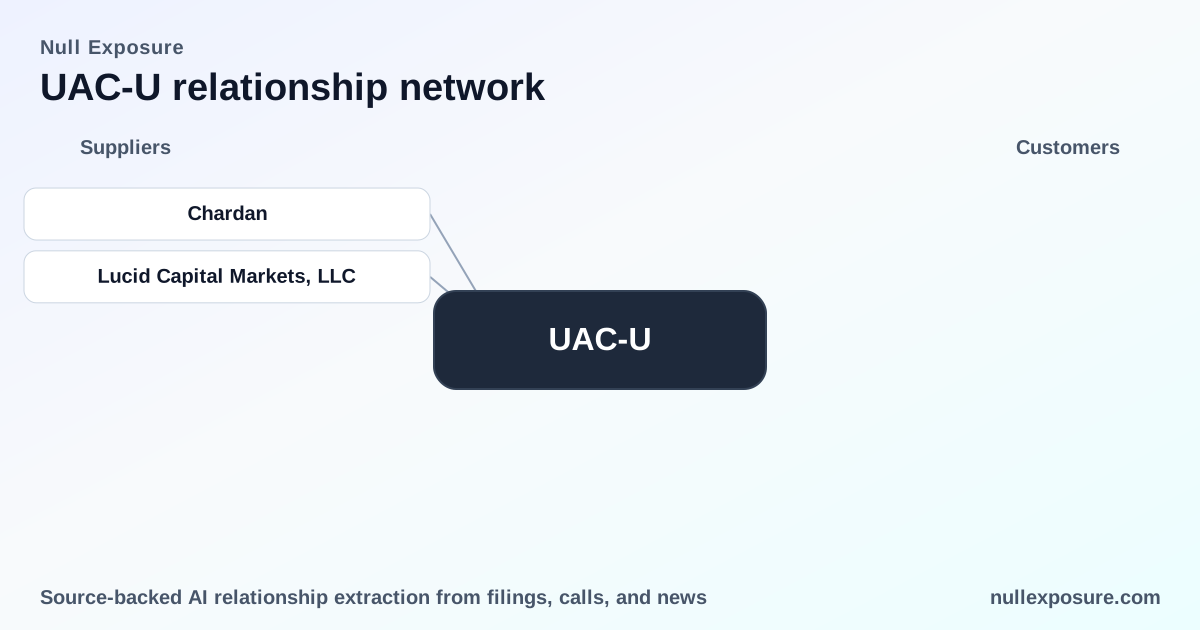
UAC-U supplier map: who’s getting paid and what it signals for investors
United Acquisition Corp I operates as a special-purpose acquisition vehicle that raises capital through an initial public offering and monetizes through deal execution and sponsor economics tied to completing a business combination. The company’s supplier posture is transactional and issuer-centric: it hires placement agents and book-runners to underwrite and distribute the IPO, and these relationships directly determine deal execution quality and fee economics. For investors and operators evaluating UAC-U, the relevant question is not only who is on the syndicate but how concentrated and repeatable those supplier relationships are—and what that implies for underwriting strength and timing risk.
Explore more supplier intelligence and company signals at https://nullexposure.com/.
The immediate deal: underwriting partners that carry the IPO
United Acquisition Corp I priced a $100 million initial public offering with Lucid Capital Markets, LLC and Chardan acting as joint book-running managers. That underwriting construct concentrates distribution responsibility into two firms, which makes their distribution capacity and institutional relationships central to the success of the raise. According to The Globe and Mail (March 10, 2026), the two firms were explicitly named as joint book-runners in the offering announcement.
What the supplier roster tells you about operating posture
United Acquisition’s supplier footprint is short-term, high-stakes, and distribution-focused:
- Contracting posture — transactional: The engagement of joint book-runners for an IPO is a finite, fee-for-service arrangement that is highly outcome-driven; banks are compensated primarily through underwriting and distribution fees tied to the offering’s execution.
- Concentration — relatively concentrated: Two joint book-runners share primary responsibility, which concentrates execution risk and amplifies the importance of their sales networks.
- Criticality — high: Underwriters determine pricing, allocation, and investor reach; their performance directly affects the SPAC’s capital base and the sponsor’s optionality to pursue targets.
- Maturity — experienced counterparties: The named firms are established players in middle-market IPO execution, signaling a conventional underwriting approach rather than experimental distribution channels.
These are company-level signals grounded in the observed supplier choices and how SPAC underwriting is structured in practice; the primary data point supporting this conclusion comes from the offering announcement reported by The Globe and Mail on March 10, 2026.
Concise relationship summaries (every supplier in the public record)
-
Chardan: Chardan was named as a joint book-running manager on United Acquisition Corp I’s $100 million IPO, sharing underwriting and distribution responsibilities for the offering. According to The Globe and Mail (March 10, 2026), Chardan is paired with Lucid on the syndicate.
-
Lucid Capital Markets, LLC: Lucid Capital Markets, LLC served as a joint book-running manager for United Acquisition Corp I’s IPO, carrying co-equal responsibility for pricing and placing the deal with investors. The Globe and Mail’s coverage of the offering (March 10, 2026) lists Lucid alongside Chardan as book-runners.
Each relationship above is drawn from the public press coverage of the IPO pricing announcement reported on March 10, 2026.
How these suppliers shape financing economics and risk
Underwriters do more than sell shares—they set pricing and create investor demand. With the underwriting concentrated in two firms:
- Execution speed and pricing discipline are centralized, so a single weak distribution day can materially affect the offering’s pricing and secondary aftermarket.
- Fee negotiation power is asymmetric; the sponsor’s ability to push on underwriting fees and secondary commitments depends on market demand for the SPAC sector and on the alternative placement channels available to the issuer.
- Deal concentration elevates counterparty operational risk—any execution or reputational issue at a book-runner will have outsized consequences for the SPAC’s timetable.
For investors, the underwriting roster is also a proxy for syndicate strength: strong, well-networked book-runners increase the probability of full subscription and orderly aftermarket trading, which preserves the trust value that underpins a blank-check vehicle.
Find deeper supplier profiles and tracking at https://nullexposure.com/.
Practical implications for investors and operators
Operationally and strategically, assess UAC-U through three focused lenses:
- Governance and covenant protection: Ensure trust mechanics and redemption windows are clearly disclosed in offering materials; underwriting strength cannot replace deal-level protections.
- Syndicate diversification for future deals: Repeated reliance on the same two firms concentrates execution risk; operators should consider expanding placement channels for follow-on financings or PIPEs.
- Timeline sensitivity: Because underwriters govern pricing and allocation cadence, monitor book-building reports and syndicate updates for signs of retail vs. institutional demand shifts.
Key actions:
- Verify underwriting commitments and fee schedules in the prospectus before sizing positions.
- Track book-runner reputational developments during the underwriting phase.
Final takeaways and next steps
United Acquisition Corp I’s supplier set for its $100 million IPO is streamlined: Chardan and Lucid Capital Markets, LLC are the joint book-runners, a configuration that confers both clarity and concentration of execution risk. The supplier choices indicate a conventional, transactional underwriting model where distribution muscle and pricing discipline will determine near-term capital outcomes. According to reporting in The Globe and Mail (March 10, 2026), the underwriting announcement was explicit on these roles.
For investors and operators conducting diligence, prioritize underwriting strength, fee terms, and contingency plans for distribution shortfalls. For ongoing supplier monitoring and to see how these relationships evolve across filings and market activity, visit https://nullexposure.com/.
If you want a supplier-level briefing or ongoing monitoring for UAC-U and similar issuers, start at https://nullexposure.com/ and request tailored coverage.