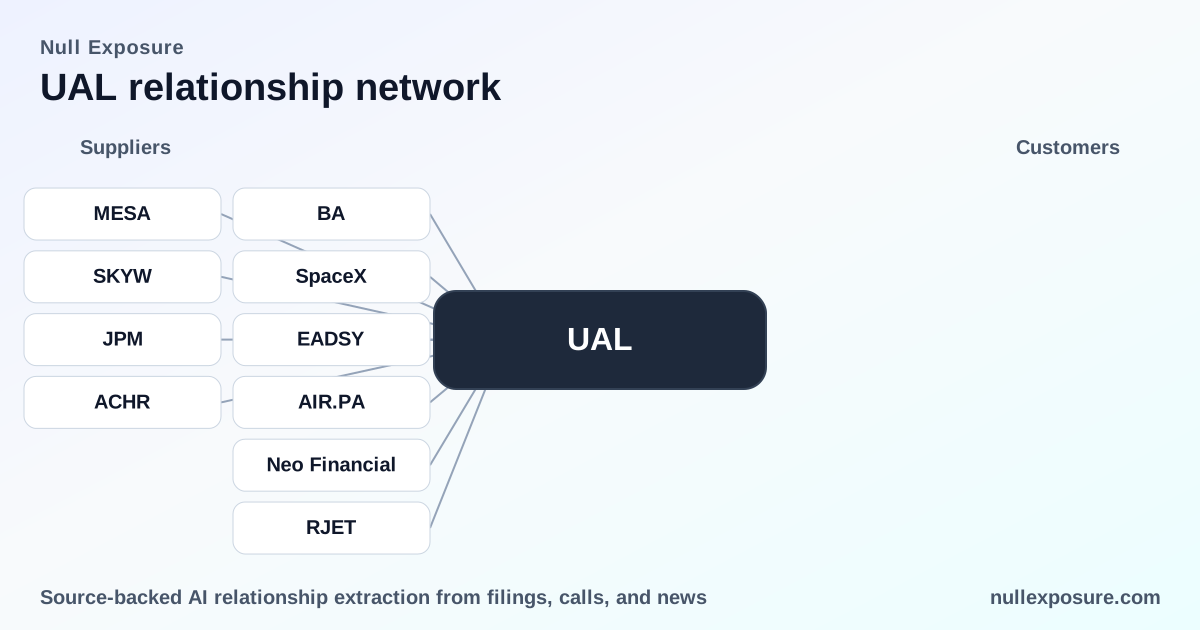
United Airlines (UAL) — Supplier Map and Strategic Risk Profile
United Airlines operates a global passenger and cargo airline business that monetizes through ticket sales, ancillary services, and a high-margin loyalty franchise (MileagePlus) that sells points to partners. The airline funds and scales capacity through a mix of owned assets, long-term leases, and regional capacity purchase agreements, while monetizing customer engagement through co-branded credit cards and onboard connectivity products. For investors, supplier relationships drive capital intensity, margin volatility and strategic optionality across fleet, fuel and loyalty revenue streams.
Explore supplier intelligence at https://nullexposure.com/.
How United organizes suppliers and what that means for investors
United’s supplier posture is a mix of long-term capital contracts and variable, usage-based service arrangements. Company signals show aircraft leases with remaining terms up to 12 years and multi-year commitments under capacity purchase agreements with regional carriers, indicating a durable capital footprint that locks in network scale and maintenance obligations. At the same time, regional carriers are paid under CPAs with variable fees tied to operating metrics (block hours, departures), creating operational flexibility but also volatility linked to utilization.
Fuel and connectivity are critical inputs. United disclosed roughly $11.4 billion in fuel expense for the year ended December 31, 2025, underscoring fuel as a multi-billion-dollar, price-sensitive operating line. The firm also contracts with third-party service providers across cybersecurity, airport facilities (long-dated leases) and insurance, adding layers of operational dependence that are non-trivial to replace quickly.
Taken together, these company-level signals point to a supplier model that is:
- Contractually mature (multi-year aircraft leases and manufacturer orders).
- Operationally variable (usage-based CPAs that link payments to activity).
- Concentration-sensitive (large exposure to fuel and to OEM delivery schedules).
- Service-dependent (outsourced regional feed, connectivity, and ancillary service partnerships).
Relationship-by-relationship: who supplies United and what matters
Boeing — delivery timing reshapes fleet economics
Delays in certification for the Boeing 737 MAX 10 have forced United to lease additional aircraft and adjust its capacity plans; reporting in March 2026 links ongoing MAX 10 certification and quality issues to forced short-term fleet pivots and cost pressure. Boeing is a strategic manufacturer whose delivery schedule materially affects United’s capacity and replacement strategy. (FinancialContent research, March 2026.)
Airbus — diversification and transatlantic niche expansion
United has diversified orders with Airbus, notably the A321XLR, and the airline’s initial A321XLR deliveries in 2026 enable profitable “thin” transatlantic routes such as Newark to secondary European cities. Airbus provides capacity that unlocks new market economics and reduces United’s dependence on widebody assets for certain long-haul routes. (FinancialContent reporting, March 2026.)
SpaceX — gate‑to‑gate connectivity as a product differentiator
United began a fleet-wide rollout of SpaceX’s Starlink in late 2025, offering free, high-speed gate-to-gate Wi‑Fi. Starlink is a product-level investment that supports customer experience, ancillary differentiation and potential revenue uplift from premium onboard services. (FinancialContent coverage, late 2025 / March 2026.)
Neo Financial — loyalty monetization in Canada
United partnered with Neo Financial to launch a co-branded MileagePlus credit card for Canadian customers, expanding the loyalty program’s distribution and high-margin points sales. Neo Financial functions as a distribution partner that broadens MileagePlus monetization outside the U.S. (SimplyWall St, March 2026.)
Mesa Air Group — regional feed under capacity purchase arrangements
Mesa Air Group operates as a regional carrier for United under a capacity purchase agreement, providing feeder flights that route passengers into United’s hubs. Mesa’s role is service-critical to network connectivity for smaller markets under United Express branding. (NationalToday coverage, March 4, 2026.)
Mesa (MESA) — same operational role, separate mention in reporting
Industry reporting also references Mesa as one of the regional carriers feeding United’s network; the company is one node in United’s multi-carrier United Express strategy. Multiple mentions of Mesa across sources underscore the operational dependence on regional carrier partners. (FinancialContent analysis, March 2026.)
SkyWest — scale provider for United Express
SkyWest is cited as a member of United Express that carries regional traffic into major hubs. SkyWest is a large-scale service provider whose performance and contract economics influence United’s regional reliability and cost structure. (FinancialContent reporting, March 2026.)
JPMorgan Chase — the core credit‑card partner for MileagePlus
JPMorgan Chase partners with United on MileagePlus credit cards, a multi-billion-dollar asset that generates high-margin revenue through card partnerships and third-party sales. JPMorgan is a principal monetization partner for MileagePlus, directly affecting non-ticket revenue and loyalty economics. (FinancialContent research, March 2026.)
Archer Aviation — investment in green mobility and eVTOL
United has strategic initiatives with Archer Aviation tied to environmental policy response and development of eVTOL technology as part of carbon mitigation and future mobility investments. Archer represents United’s exposure to frontier solutions for decarbonization and alternative aircraft technologies. (FinancialContent commentary, March 2026.)
What these partnerships imply for risk, capital allocation and monitoring
- Fleet delivery risk is a direct earnings lever. OEM execution (Boeing/Airbus) shapes near-term capacity, leasing needs and unit costs — an area investors must watch closely through delivery schedules and lease-backed financing.
- Fuel is a systemic expense and a critical supplier risk. With fuel expense around $11.4 billion in 2025, shifts in fuel pricing or hedging effectiveness translate into immediate margin pressure.
- Regional CPAs create mixed operational leverage. Usage-based payments provide flexibility when demand contracts but transfer utilization risk into variable carrier fees when flying resumes.
- Loyalty partnerships drive high-margin cash flow. Credit-card partners like JPMorgan and Neo Financial are key levers for recurring non-ticket revenue and customer lifetime value.
For proactive monitoring, track OEM delivery calendars, regional partner contract renewals and MileagePlus card issuance trends as primary early indicators of cost or revenue inflection.
Explore deeper supplier risk analytics at https://nullexposure.com/ to integrate these signals into investment models.
Actionable takeaways for investors and operators
- Prioritize analysis of OEM cadence and lease maturity schedules to model capacity-related capex and short-term leasing risk.
- Model fuel sensitivity explicitly in cash-flow scenarios given the multibillion-dollar spend band reported for 2025.
- Treat MileagePlus partner metrics (card originations, partner payouts) as high-leverage drivers of non-ticket margins.
- Monitor regional carrier performance and CPA terms to assess on-time metrics and variable cost exposure.
Visit https://nullexposure.com/ for structured supplier intelligence and tailored monitoring feeds that map these relationships into portfolio risk frameworks.
United’s supplier mix combines entrenched, long-dated capital commitments with flexible service relationships and high-margin monetization partners. The interplay between OEM delivery execution, regional service contracts, fuel exposure and loyalty partnerships defines United’s near-term margin trajectory and long-term strategic optionality. Investors should weigh these supplier vectors as central inputs when modeling UAL’s earnings and balance-sheet sensitivity.