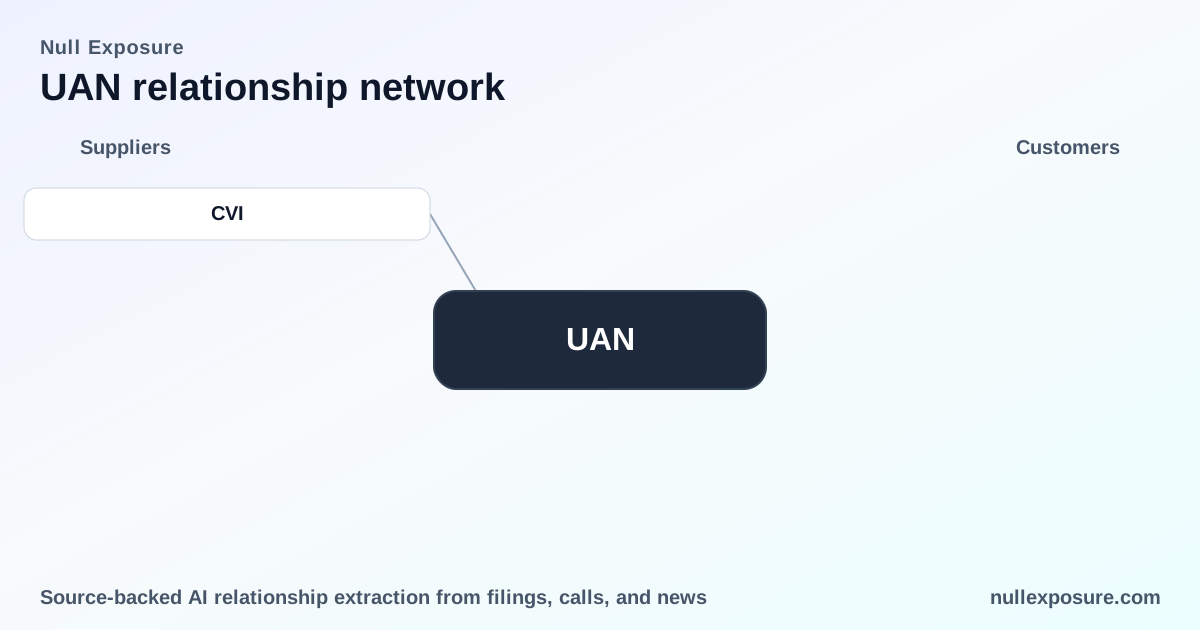
UAN supplier profile: how CVR Energy fits into the feedstock and services chain
Thesis: UAN sources a meaningful portion of the pet coke and related feedstocks that power its Coffeyville facility from CVR Energy’s Coffeyville refinery under a mix of long‑term and short‑term purchase arrangements, and it also operates under a framework Corporate MSA that channels related‑party services and costs through its General Partner; UAN monetizes through fertilizer production where feedstock procurement, logistics, and related‑party service costs directly drive margins and capital allocation decisions. Investors should treat CVR Energy as a commercially material supplier and related‑party service provider whose contract structure, concentration, and cost pass‑throughs are central to UAN’s operating leverage. For a full map of supplier relationships and governance disclosures, visit https://nullexposure.com/.
Operational snapshot: UAN purchases significant volumes of pet coke and natural gas to run its gasifiers and production units, pays its General Partner and affiliates for corporate and support services under a Corporate MSA, and distributes finished product via rail, truck, and barge logistics that are consistent with heavy industrial commodity operations. Feedstock concentration, short-term purchasing posture for fuel, and embedded related‑party service reimbursements are the principal procurement risks to monitor.
What the filings say about CVR Energy’s role
CVR Energy (CVI) supplies pet coke to UAN’s Coffeyville facility and is also a related‑party under the Corporate MSA that supplies corporate services. According to UAN’s FY2024 Form 10‑K, the Coffeyville facility obtained an average of 42% of its pet coke from CVR Energy’s Coffeyville refinery over the past five years, and the company sources pet coke both under a long‑term agreement with CVR Energy and under third‑party supply agreements that the filing shows are scheduled to end in December 2025 (UAN Form 10‑K, FY2024). The same filing discloses related‑party cost reimbursement mechanics under a Corporate MSA that governs how the General Partner and CVR Energy’s affiliates are reimbursed for corporate staff and support services (UAN Form 10‑K, FY2024).
One‑by‑one: every supplier relationship disclosed in the filing
- CVR Energy (CVI): UAN sources a large share of pet coke from CVR Energy’s Coffeyville refinery—about 46% in 2024 and consistently above 40% in prior years—and buys that material under a long‑term agreement while also relying on third‑party contracts that the filing shows are scheduled to expire in December 2025. The filing additionally documents reimbursements to CVR Energy under a Corporate MSA for corporate and support services. (UAN Form 10‑K, FY2024)
How the relationship structure shapes UAN’s operating characteristics
Contracting posture — UAN combines long‑term offtake for a core supplier with short‑term, fixed‑price and index‑priced contracts for fuel and gas: the company explicitly states it has commitments to purchase pet coke and natural gas through a mix of short‑term, fixed and index price contracts (UAN Form 10‑K, FY2024). This hybrid posture limits long‑dated price certainty for a portion of feedstock and leaves UAN exposed to near‑term commodity volatility while retaining a baseline of supply from its long‑term CVR arrangement.
Concentration and criticality — CVR Energy is a material supplier. UAN reported that approximately 46%, 43% and 47% of its pet coke supply came from the Coffeyville refinery in 2024, 2023 and 2022 respectively, signaling a durable dependency that is operationally critical because pet coke is a core gasifier feedstock (UAN Form 10‑K, FY2024). Investors should treat this as a concentration exposure that amplifies counterparty and regional operational risk.
Service and related‑party overlay — The Corporate MSA routes corporate staff and support costs through CVR Energy and the General Partner; the filing notes UAN is not entitled to a refund of disputed costs unless they are ultimately determined unreasonable, which creates asymmetric cost recovery risk and governance friction between the Partnership and CVR Energy (UAN Form 10‑K, FY2024). For 2024, total amounts paid to the General Partner and affiliates — including payments under the Corporate MSA — were approximately $17.2 million, which is a meaningful run‑rate corporate service spend for a mid‑market industrial operator (UAN Form 10‑K, FY2024).
Maturity and procurement flexibility — The company’s public disclosures show short‑term purchase commitments for fuel and gas alongside the long‑term feedstock contract; purchase commitments are presented in the filing and the reconciliations indicate meaningful multi‑year invoices and commitments consistent with heavy industrial procurement practices. The mix suggests operational flexibility to shift some volume in the near term but persistent baseline exposure to the Coffeyville supply source.
Spend profile and financial impact — The analysis in the Form 10‑K places UAN’s supplier spend into the mid‑range band, consistent with a $10M–$100M annual spend band for materially contracted suppliers, and the filing lists purchase commitments and payments to related parties consistent with that scale (UAN Form 10‑K, FY2024). Feedstock economics and related‑party cost allocations are direct drivers of EBITDA per ton and capital allocation decisions.
If you want the full breakdown of supplier interdependencies, governance provisions, and contract expirations, explore the supplier map at https://nullexposure.com/.
Risk and value considerations for investors
- Concentration risk: A near‑50% share of pet coke from a single refinery concentrates operational exposure to a single counterparty and a single regional asset base; any operational disruption at Coffeyville would immediately stress utilization and margins.
- Price and procurement exposure: The short‑term component of fuel and gas contracts leaves UAN exposed to spot and index volatility; hedging and working capital management will determine how that exposure flows through to reported margins.
- Related‑party governance: The Corporate MSA framework creates asymmetric cost recovery and related‑party reimbursement dynamics that can amplify corporate overhead and obscure true operating profitability if not closely monitored in quarterly disclosures.
- Logistics and distribution: UAN’s distribution via Union Pacific, BNSF, truck and barge—documented in the filing—reflects standard heavy industrial logistics but also exposes the business to rail and river congestion risk that can influence working capital and delivery reliability (UAN Form 10‑K, FY2024).
Mid‑article note: for comparative supplier analytics and scenario modeling of counterparty disruption, review the analytical tools and relationship views available at https://nullexposure.com/.
Investment implications and monitoring checklist
- Monitor contractual milestones: expiration of third‑party supply agreements (noted to run through December 2025) and any renewal terms or volume re‑allocations away from CVR Energy.
- Track corporate service expense trends: quarterly disclosures of amounts paid to the General Partner and affiliates and any changes in the Corporate MSA terms.
- Watch feedstock sourcing percentages: any material shift away from Coffeyville will reduce concentration risk but could also change unit economics.
- Stress‑test margins to short‑term gas and pet coke price spikes given the hybrid contracting posture.
Bottom line for operators and investors
CVR Energy is both a material feedstock supplier and a related‑party service provider for UAN; the relationship is governed by long‑term and short‑term contracts plus a Corporate MSA that channels significant corporate costs. That structure creates a predictable base of supply but concentrates counterparty risk and embeds related‑party cost dynamics into UAN’s P&L. For active diligence and supplier scenarios, start your supplier due diligence at https://nullexposure.com/.
Sources: UAN Form 10‑K for the fiscal year ended December 31, 2024 (relationship and Corporate MSA disclosures; supplier percentages and payments to General Partner and affiliates).