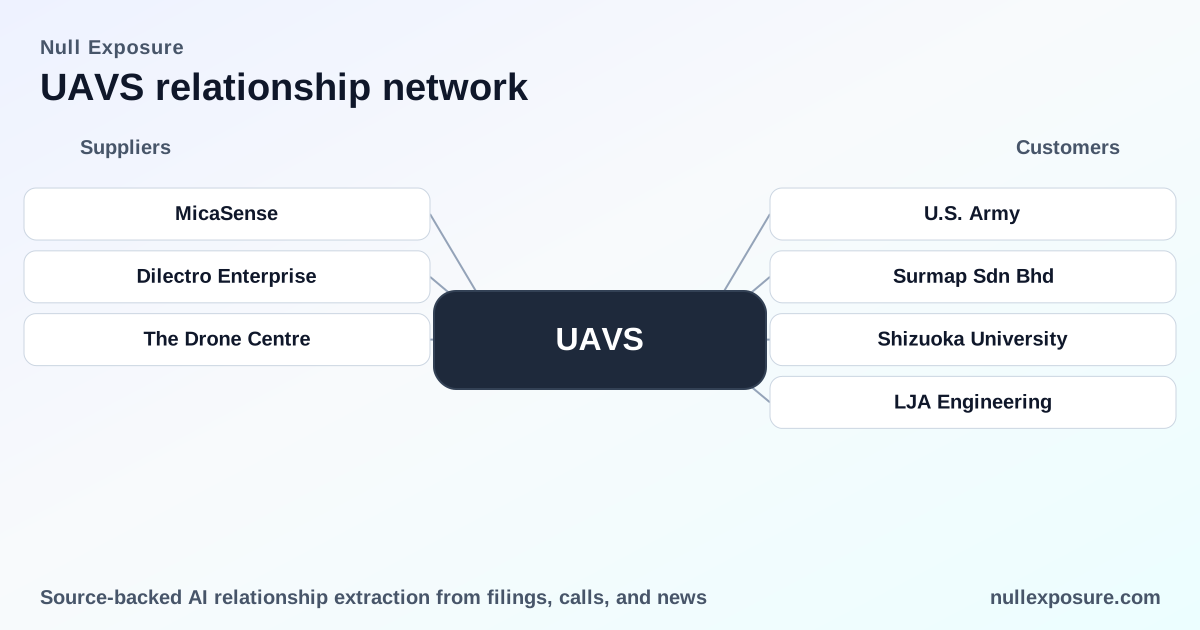
EagleNXT (UAVS) supplier map: what investors need to know
EagleNXT (NYSE: UAVS) operates as a full‑stack drone company that sells fixed‑wing platforms, multispectral sensors, and supporting software and services to commercial and government customers; the business monetizes through hardware sales, sensor product rollouts, recurring software/support contracts, and channel‑enabled deliveries in international markets. The supplier relationships documented in recent company communications show a deliberate partner strategy that accelerates sensor adoption and enables in‑country deployments, while leaving the firm exposed to concentrated purchase commitments and third‑party execution risk. For a concise view of these ties and actionable signals, review the supplier summaries below — and visit https://nullexposure.com/ for broader counterparty intelligence.
Supplier snapshots that drive deliveries and revenue
The following relationships are drawn from EagleNXT press reporting in FY2026 and are presented so investors can judge who executes sales, who supports customers on the ground, and which suppliers influence product success.
MicaSense — supplier of the RedEdge‑P Green multispectral sensor
EagleNXT reported commercial sales activity for the newly launched MicaSense RedEdge‑P Green multispectral sensor since its August 2025 launch, positioning the sensor as a product sales driver for crop and vegetation monitoring. According to a GlobeNewswire release on January 27, 2026, the company highlighted sensor sales growth following the August 2025 launch (GlobeNewswire, Jan 27, 2026: https://www.globenewswire.com/de/news-release/2026/01/27/3226421/0/en/eaglenxt-highlights-rededge-p-green-sensor-sales-growth-following-august-2025-launch.html). Takeaway: sensor supplier performance is a near‑term revenue lever for EagleNXT.
Dilectro Enterprise — in‑country partner for Poland (sales and support)
EagleNXT sold six eBee TAC tactical mapping drones to Polish customers through Dilectro in December 2025, and the company identifies Dilectro as a pivotal in‑country partner responsible for customer success, including training and support. GlobeNewswire reported these developments on February 25, 2026, citing both the transactional sale and Dilectro’s role in customer delivery and support (GlobeNewswire, Feb 25, 2026: https://www.globenewswire.com/de/news-release/2026/02/25/3244566/0/en/EagleNXT-Advances-Defense-Initiatives-in-Poland-Amid-Market-Expansion.html and https://www.globenewswire.com/fr/news-release/2026/02/25/3244566/0/en/index.html). Takeaway: channel partners such as Dilectro convert product availability into deployed systems and after‑sale services.
The Drone Centre — UAE partner enabling follow‑on deliveries
A follow‑on delivery for eBee VISION drones in the UAE was facilitated with support from EagleNXT’s in‑country partner, The Drone Centre (a FEDS company), underscoring reliance on local distributors to execute complex government and commercial deployments. EagleNXT disclosed this support in a GlobeNewswire release on January 7, 2026 (GlobeNewswire, Jan 7, 2026: https://www.globenewswire.com/news-release/2026/01/07/3214532/0/en/EagleNXT-Delivers-Mission-Critical-Support-to-eBee-VISION-Drone-Operations-in-the-UAE.html). Takeaway: local partners are operationally critical for international scale.
What the supplier footprint signals about EagleNXT’s operating model
The relationship evidence and company excerpts point to a defined operating posture. Presenting these as company‑level signals:
- Contracting posture — partner‑centric execution. EagleNXT relies on third‑party service providers and distributors to perform work it is contractually obligated to deliver, including training, support, and field deployments; this is a deliberate channel model rather than pure direct sales.
- Concentration and spend scale — modest committed spend but material to operations. The firm reported purchase commitments of approximately $1.72 million as of December 31, 2024, which are expected to be realized in the following year; this places committed supplier spend in the $1M–$10M band, enough to influence near‑term margins and working capital.
- Criticality and maturity — supplier services are operationally critical but not necessarily single‑source. Multiple overseas partners (Poland, UAE) indicate a geographically distributed supply and delivery model, which reduces single‑country concentration but increases dependency on partner execution quality.
- Geographic posture — global partner network. Company commentary references strong supplier relationships in the U.S. and U.S.‑allied countries, signaling an international procurement and delivery footprint that supports defense and commercial customers.
These signals combine to form a partner‑enabled go‑to‑market strategy: product innovation (sensors) plus channel reach (local partners) drives deployments, while supplier spend and service provider reliance create execution risk that is measurable and monitorable.
For a deeper supplier risk profile and counterparty scoring, explore our analyst portal at https://nullexposure.com/.
Investment implications: upside and where the P&L is exposed
- Upside: Successful sensor rollouts (RedEdge‑P Green) and repeat orders through local partners can accelerate revenue growth with relatively low incremental SG&A for direct sales; channel partners convert product introductions into installations and recurring service contracts. The Poland and UAE sales cycles show defense and government channels are accessible through the partner network.
- Execution risk: Reliance on service providers for customer‑facing obligations concentrates operational risk outside the company’s direct control and places premium importance on partner training, logistics, and contractual clarity. The ~$1.72M in purchase commitments is material to working capital for a company of this scale and will influence cash flow timing in the year they are realized.
- Monitoring triggers: Watch partner‑reported delivery timelines, sensor ASPs and attach rates, contract terms with distributors (warranty and support obligations), and any suppliers that receive a disproportionate share of purchase commitments.
Bold risk factor: a partner failure or late supplier delivery in key international contracts can delay revenue recognition and produce warranty or support costs that compress margins.
Actionable next steps for investors and operators
- For investors: track follow‑on sensor sales and partner statements for quantifiable adoption metrics; review quarterly disclosures for updates on purchase commitments and geographic partner performance. Consider scenario analysis that stresses partner execution risk against gross margin sensitivity.
- For operators and procurement teams: prioritize contractual clarity with partners on responsibilities for training, spare parts, and support; diversify suppliers where possible to reduce single‑point execution failures.
- For due diligence: request copies of major distributor agreements and SLAs, and validate fulfillment timelines tied to the $1.72M purchase commitments.
Learn more about counterparty risk and supplier intelligence at https://nullexposure.com/ — our platform aggregates partner disclosures and press evidence to help investors and operators convert supplier signals into actionable insight.
EagleNXT’s supplier pattern is clear: product innovation plus distributed partners equals deployable solutions, but value realization depends on partner execution and supplier spend discipline. Monitor partner performance and committed spend closely to separate durable growth from execution volatility.