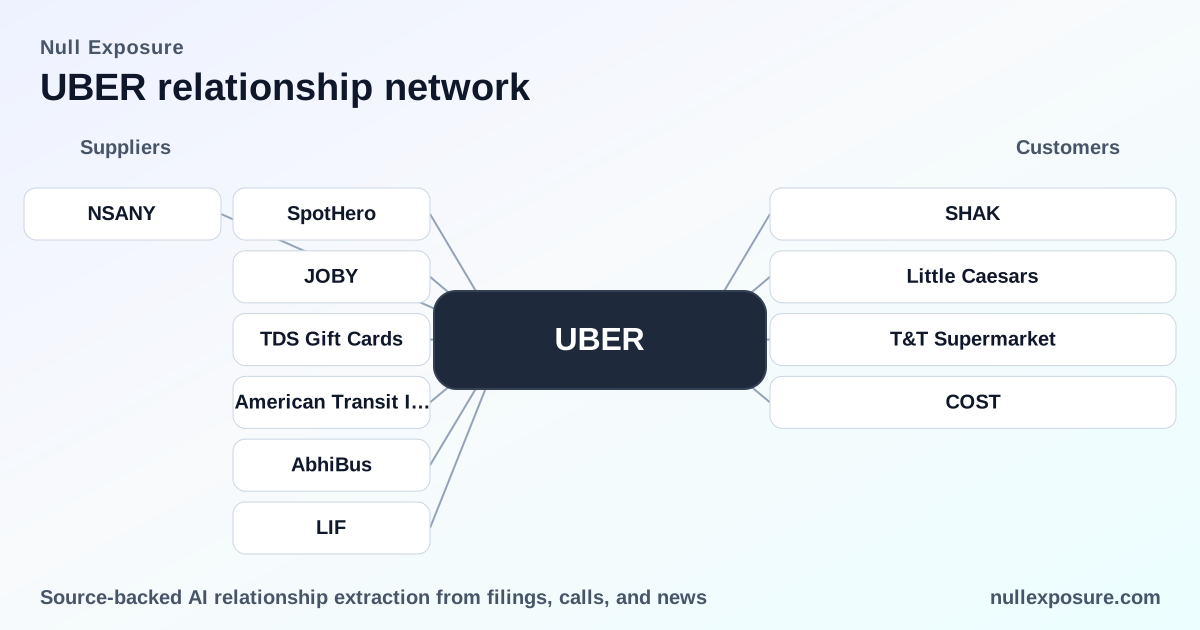
Uber’s supplier map: strategic partners that extend the platform and the risks beneath
Uber is a platform business that monetizes by connecting demand (riders, diners, shippers) with supply (drivers, couriers, carriers) and taking a fee on transactions, while expanding addressable markets through strategic partnerships and embedded services that increase engagement and take-rate. The company combines marketplace economics with platform-led product extensions—payments, logistics, and new mobility modes—so supplier relationships function both as cost inputs and as distribution/monetization levers. For an investor or procurement executive, the question is whether these suppliers are scalable revenue enablers or single points of operational risk. Learn more about supplier risk analytics at the Null Exposure homepage: https://nullexposure.com/.
How Uber’s supplier posture shows up in practice
Uber operates with a hybrid contracting posture: the company runs both short‑term, high‑flexibility arrangements and multi‑year commercial technology commitments. Public disclosures document an aggregate commitment of at least $2.5 billion through November 2029, with a $412 million short‑term tranche—a structure that supports rapid product experiments while locking in critical infrastructure spend. These contract signals indicate a procurement strategy optimized for platform agility but underpinned by sizable, committed vendor relationships.
Uber’s operating model concentrates critical dependencies in a handful of categories: cloud infrastructure, mapping, payment processing, and marketplace distribution (app stores). The filing-language evidence frames these as critical third-party dependencies—interruptions to hosting, mapping, or payments would materially impair platform delivery. Those are company-level signals about concentration and criticality rather than attributes tied to any single supplier.
Other structural characteristics: relationships are largely service-provider oriented (software, cloud, payments), the supplier base includes distributors (app marketplaces) for customer acquisition, and most partnerships described in recent coverage are active and tactical—product integrations, market launches, and legal disputes that change economics or risk exposure in the near term.
Quick read: every supplier relationship surfaced in recent coverage
Below are plain-English one- to two-sentence summaries for each counterparty found in the compiled results, with concise source references.
- SpotHero — Uber plans to introduce a native, in‑app parking reservation feature powered by SpotHero to address commuter, event, and airport parking demand, extending Uber’s urban mobility wallet beyond rides and delivery. Reported in TradingView coverage (news aggregation, March 10, 2026).
- Joby Aviation (JOBY) — Uber’s “Uber Air” integration with Joby lets riders book Joby’s all‑electric eVTOL flights through the Uber app; the service launched commercially in Dubai, signaling an adjacent mobility market and the potential for higher‑margin platform revenue if scaled. Covered across MarketBeat instant alerts and filings summaries (March 2026).
- TDS Gift Cards — TDS Gift Cards provides prepaid gift card services used by blue‑chip clients including Uber, suggesting another payments/revenue channel and employee or reward distribution mechanism. Mentioned in an InsiderMonkey transcript summary of Q4 2025 company remarks (reported March 2026).
- American Transit Insurance Co. — A New York judge sided with Uber in litigation that accused American Transit Insurance of failing to defend Uber in crash cases involving drivers, a legal outcome that reduces near-term indemnity exposure and clarifies insurer responsibilities. Reported by Insurance Journal (March 4, 2026).
- AbhiBus — Uber added pan‑India intercity bus ticketing via a partnership with AbhiBus, a low‑capital product extension to widen addressable market penetration in India and drive more platform usage across non‑owned transport inventory. Covered in regional press and MarketBeat summaries (March 2026).
- Life360 (LIF) — Life360 and Uber announced an integration designed to help families stay connected on trips, representing a cross‑platform consumer feature that increases stickiness for family and group travel use cases. Noted in Finviz news wire (March 2026).
- Nissan — Reporting indicates Nissan and Uber are near a deal to deploy autonomous ride‑hailing vehicles, underscoring OEM partnerships as a route to owning less capital while accessing shared autonomy platforms. Described in market commentary on Finviz (March 2026).
What these relationships imply for investors and operators
Collectively these suppliers demonstrate Uber’s two‑track supplier strategy: product‑led growth through low‑capital, revenue‑generating integrations (SpotHero, AbhiBus, Life360) and strategic technology or industrial tie‑ups that materially change the TAM (Joby, Nissan). The American Transit Insurance ruling represents a legal/reputational inflection that reduces certain contingent liabilities.
Key operating-model takeaways for investors:
- Contracting posture: A mix of short‑term financing mechanisms and long‑term technology commitments lets Uber iterate quickly while protecting access to critical cloud and mapping services. The stated $2.5 billion aggregate commitment through 2029 is a signal of meaningful future spend and supplier lock‑in.
- Concentration and criticality: Uber relies on a small number of infrastructure and payments providers for global platform delivery; interruptions to those services would be material to operations—this is an explicit company‑level risk signal.
- Supplier role and maturity: Most named partners function as active service providers or distribution partners; some relationships (Joby, Nissan) are strategic and multi‑year in nature, while others are tactical feature integrations that expand monetization channels.
- Spend profile: Documented commitments place certain vendor spend in the >$100M band overall, indicating material procurement exposure in cloud, mapping, and payments services.
For procurement leaders and investors, the commercial implication is straightforward: monitor supplier concentration and contract duration, and focus diligence on vendors that are both revenue enablers and operational single points of failure.
Explore supplier risk scoring and third‑party dependency analytics on the Null Exposure platform: https://nullexposure.com/.
Investment implications and closing view
These supplier signals position Uber as a platform aggressively extending product breadth while accepting concentrated infrastructure risk. Partnerships like Joby and Nissan are strategic bets on future high‑margin mobility revenue, whereas integrations with SpotHero, AbhiBus, and Life360 are efficient ways to increase engagement and take rates today. Legal developments such as the insurance ruling are de‑risking events that improve unit economics.
For active investors and operators, the priority is to track (1) the commercial scale of strategic mobility partnerships, (2) the renewal and pricing terms for cloud and payments providers, and (3) legal/regulatory outcomes that shift insurer or driver liability. These factors will determine whether supplier relationships are growth accelerators or concentration risks to value.
If you want a concise supplier risk brief tailored to Uber or a comparable platform, request a supplier exposure assessment at Null Exposure: https://nullexposure.com/.