UBS Supplier Relationships: A Practical Guide for Investors and Operators
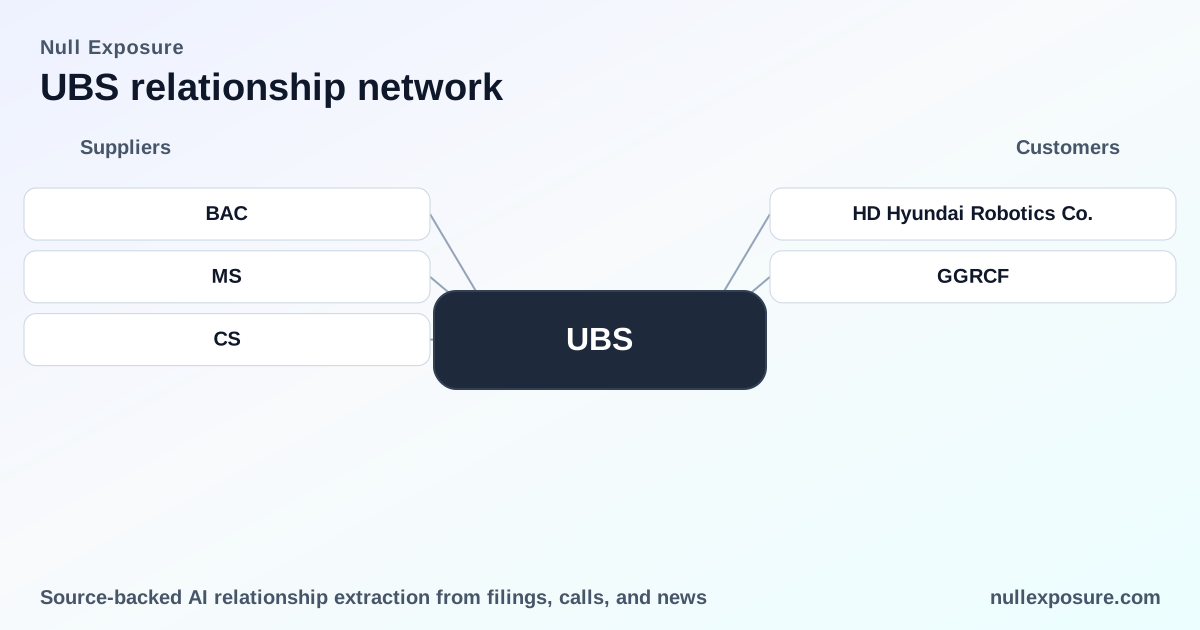
UBS Group AG is a global wealth manager and diversified bank that monetizes through advisory fees, asset and wealth management, trading revenues and interest income across private, institutional and corporate clients; the firm reports roughly $49.6 billion in trailing revenues and a market capitalization above $118 billion, underpinning a stable platform for both client flows and talent-led growth. For investors evaluating UBS’s supplier posture, the next sections dissect recent personnel inflows from competitors, a legacy credit adjustment tied to Credit Suisse instruments, and what those linkages imply for operational concentration, contracting posture and regulatory attention.
Explore deeper supplier intelligence at https://nullexposure.com/.
Recent moves that change the supplier map
UBS’s supplier relationships in the last 12 months have been defined by acquisition of advisory talent and a measurable earnings impact from legacy credit instruments. Each relationship below is covered with a concise, sourced read for investor diligence.
Merrill Lynch — advisers switching to UBS
UBS hired a team that managed approximately $1 billion in client assets from Merrill Lynch in Puerto Rico, reflecting ongoing advisor-level recruitment as a channel to capture assets and fee income (reported March 10, 2026). According to AdvisorHub, this is part of a broader push to onboard productive teams and expand regional private-banking footprint (https://www.advisorhub.com/elevation-point-nabs-1-3-billion-ubs-team-in-georgia/).
Morgan Stanley — individual broker hire adds scale
In January, UBS added a broker who brought roughly $600 million in managed assets from Morgan Stanley in Washington state, illustrating UBS’s continued reliance on lateral hires to grow advisory AUM and recurring fee streams (AdvisorHub, March 10, 2026; https://www.advisorhub.com/elevation-point-nabs-1-3-billion-ubs-team-in-georgia/).
Credit Suisse — legacy debt buyback dents revenue
UBS recorded net negative revenue adjustments of $54 million attributed to the buyback of legacy Credit Suisse debt instruments, a direct P&L impact tied to integration and legacy asset remediation (earnings highlights, Q4 2025 commentary reported March 10, 2026; https://www.gurufocus.com/news/8582189/ubs-group-ag-ubs-q4-2025-earnings-call-highlights-strong-profit-growth-amid-strategic-challenges?mobile=true).
What these relationships reveal about UBS’s operating posture
These interactions collectively reflect a company-level operating model that is growth-by-acquisition of talent, active remediation of legacy balance-sheet items, and diversified revenue generation.
- Contracting posture: UBS operates with a selective, relationship-driven contracting stance. The firm recruits high-net-worth advisory teams and individual brokers directly, preferring employment and team integrations rather than arms-length vendor arrangements. This increases control but raises integration costs upfront.
- Concentration: Revenue streams remain diversified across wealth management, investment banking and markets, so supplier concentration is moderate — the firm is not dependent on a single external provider for core flows, but it is sensitive to shifts in advisor networks that drive asset inflows.
- Criticality: Talent relationships are highly critical to revenue trajectory in wealth management; a single productive team can shift regional AUM and recurring fees. Conversely, legacy liabilities — such as Credit Suisse debt instruments — are operationally critical because remediation events carry direct P&L and regulatory consequences.
- Maturity: UBS’s supplier network is mature in terms of established recruiting channels and integration playbooks, but legacy remediation still imposes uneven near-term impacts on margins and capital allocation.
If you want a structured due-diligence checklist to assess supplier risk at financial firms, see more at https://nullexposure.com/.
Implications for investors and operators
These relationships produce immediate and medium-term implications that merit attention when modeling UBS’s earnings and operational risk.
- Earnings mix: Lateral hires accelerate fee income growth but carry short-term onboarding costs; count on incremental recurring fees rather than instant margin expansion.
- Integration risk and capital usage: Legacy asset buybacks (Credit Suisse instruments) generate discrete negative adjustments and can constrain capital deployment until resolved.
- Talent dependency: Wealth-management growth is sensitive to advisor retention and recruitment cycles; monitor net advisor flows and regional wins as early indicators of fee momentum.
- Regulatory and reputational exposure: Legacy remediation events attract regulator and market scrutiny; the $54 million adjustment is a reminder that balance-sheet clean-up can affect reported revenue.
For investors focused on supplier exposure and counterparty relationships, additional analysis and signals are available from specialized coverage at https://nullexposure.com/.
Operational checklist for risk teams and procurement
Operators evaluating supplier and partner risk at UBS should prioritize these controls and metrics:
- Track advisor-team migration trends and average AUM transferred per hire to forecast fee growth.
- Monitor legacy liability remediation schedules and the related P&L impact line items.
- Require integration KPIs for onboarded teams: client retention, net flows after 12 months, and cross-sell penetration.
- Maintain scenario models for regulatory capital impacts under different remediation outcomes.
These are practical, not theoretical, inputs that inform procurement posture and vendor contracting strategies.
Bottom line: what to watch next
UBS’s supplier dynamics are defined by targeted talent acquisition and active management of legacy credit exposures. Talent hires provide steady, predictable fee accretion when successfully integrated; legacy instrument buybacks create episodic earnings noise and capital usage. For investors, the core lens is how effectively UBS converts lateral hires into stickier, higher-margin relationships while containing the P&L and capital impact from legacy remediation.
- Watch advisor inflows and retention metrics for early signs of sustainable wealth-management growth.
- Monitor disclosures around legacy instrument remediation for potential future adjustments to revenue and regulatory capital.
If you want regular updates on supplier relationships and how they affect bank economics, visit https://nullexposure.com/ for ongoing coverage and alerts.