United Community Banks (UCB): supplier relationships, funding posture, and operational risk for investors
United Community Banks monetizes through a traditional regional banking model: interest spread on loans and securities, fee income from mortgage and wealth services, and disciplined acquisition-driven expansion across the Southeast. The bank’s profitability profile—supported by a trailing EPS of 2.62, a return on equity near 9.3%, and a dividend yield above 3%—depends as much on funding and credit execution as on the reliability of third-party infrastructure and wholesale funding partners. For investors evaluating supplier relationships, the critical questions are funding diversification, vendor concentration for core systems, and the operational resiliency of outsourced platforms.
Explore deeper supplier intelligence at https://nullexposure.com/.
How UCB’s operating model converts into revenues and vendor reliance
United Community Banks runs a classic community/regional bank playbook: lend locally, fund via deposits and secured wholesale channels, and cross-sell fee products (mortgage origination, wealth management). This model generates recurring net interest income and fee revenue; it also requires stable access to short-term liquidity and highly available processing platforms for deposits, loan servicing, and online banking.
- Funding sensitivity is a central business driver. Wholesale lines and advances are meaningful complements to core deposits during growth or market stress.
- Operational outsourcing is embedded in the model. The company explicitly outsources major systems such as data processing, loan servicing, deposit processing, and online banking platforms, which turns supplier performance into a direct operational risk factor.
Given those dynamics, UCB’s supplier posture is operationally strategic: vendors that run payments, servicing, or liquidity facilities are de facto critical infrastructure partners for earnings continuity. If you want to benchmark UCB’s supplier exposures, start with funding counterparties and major systems vendors. Learn more about supplier coverage at https://nullexposure.com/.
The supplier relationships the record shows (what investors need to know)
The public signals in UCB’s FY2026 disclosures and press coverage identify a clear, high-priority funding relationship and confirm the bank’s reliance on third-party service providers for core systems.
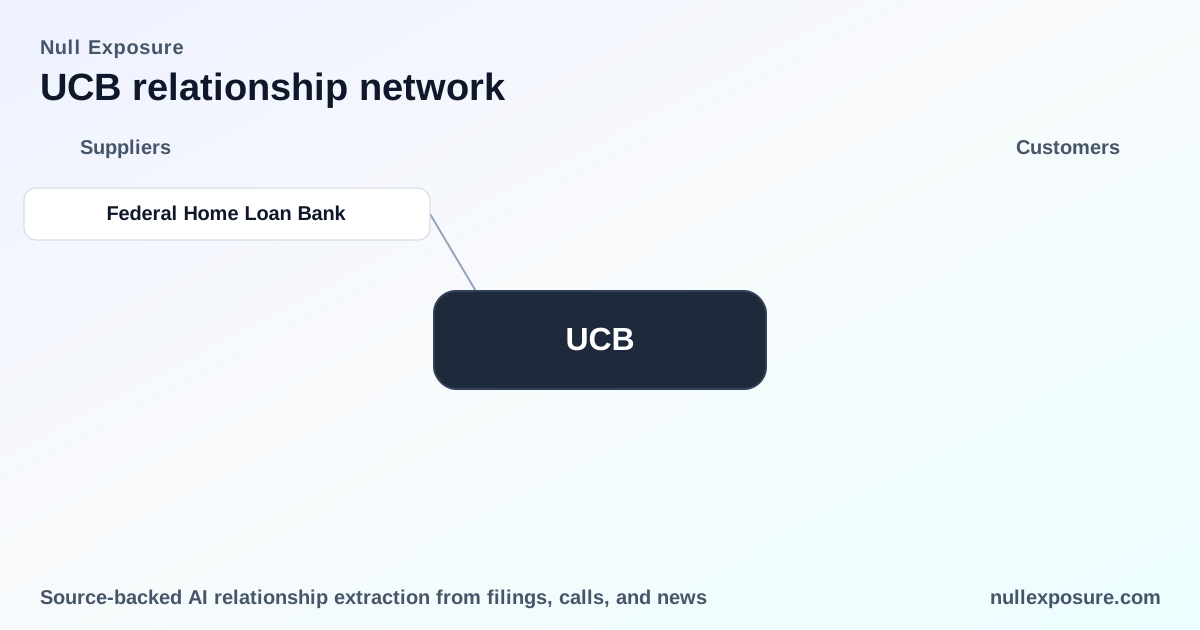
- Federal Home Loan Bank — United Community Banks discloses advances from the Federal Home Loan Bank in its FY2026 earnings materials, listing FHLB advances in the disclosure table of funding sources. According to UCB’s earnings release distributed via GlobeNewswire (Jan 14, 2026) and replicated in other outlets, FHLB advances are reported among the bank’s advance balances for FY2026. (GlobeNewswire Jan 14, 2026; Yahoo Finance coverage of the same release.)
Why this matters: the Federal Home Loan Bank system is a common and essential wholesale liquidity source for regional banks. UCB’s explicit reporting of FHLB advances confirms that wholesale secured funding is an active part of the balance sheet mix, alongside core deposits.
The constraints disclosed and what they signal about supplier risk
UCB’s public constraints, drawn from management commentary, provide two investment-relevant signals at the company level.
- Management categorizes derivative interest-rate hedging risk as immaterial to financial condition, indicating that treasury and ALM practices are sufficiently robust that derivative exposure does not present a material supplier or counterparty risk in current disclosures. This is a company-level signal of risk tolerance and hedging effectiveness.
- UCB states that it relies on third-party providers for major systems—data processing, loan servicing, deposit processing and online banking platforms. That language signals a deliberate outsourcing posture: the bank uses external technology and operations partners for critical functions rather than vertically integrating them.
Taken together, these constraints imply a business model with mature hedging governance but meaningful operational reliance on service providers. For investors, that translates to two priorities: monitor the diversity and contractual terms of critical vendors, and track the bank’s liquidity access channels.
Contracting posture, concentration, criticality, and maturity — investor implications
- Contracting posture: outsourced and vendor-dependent for key processing systems; vendor SLAs and continuity plans therefore have direct earnings implications.
- Concentration: UCB’s disclosures do not enumerate all vendors, but the explicit reliance on "major systems" points to a small number of high-impact providers rather than a long tail of immaterial suppliers. That concentration increases single-vendor criticality.
- Criticality: very high for deposit processing, loan servicing and online banking; any extended outage or transition costs would hit operations and likely impair fee generation and customer retention.
- Maturity: Funding relationships such as those with the Federal Home Loan Bank are established and conventional, reflecting institutionalized access to secured liquidity.
These characteristics mean investors should treat vendor governance and funding counterparties as first-order risk factors when sizing thesis and downside scenarios.
Practical checklist for investors evaluating UCB supplier exposure
- Confirm the maturity and tenure of any major systems vendor contracts and the presence of transition provisions that limit disruption costs.
- Quantify the share of short-term liquidity that relies on FHLB advances versus deposits and other secured lines.
- Review operational resilience metrics: incident history, redundancy, and recovery SLAs for online banking and core processing.
- Monitor regulatory disclosures for third-party risk management enhancements or remediation plans.
Key takeaway: funding diversity and vendor resiliency are material to UCB’s earnings durability even if management labels derivative hedging risk as immaterial.
Final read: what investors should do next
United Community Banks runs a profitable regional-banking model that leans on both wholesale funding and outsourced operational platforms. For equity holders and credit analysts, the critical monitoring points are the composition of short-term funding (including FHLB exposure) and the health of vendor relationships that underwrite deposit and servicing systems. Track quarterly filings and earnings release tables for changes in advance balances, and prioritize vendor disclosures or regulatory filings for signs of concentration or remediation.
For a structured view of supplier risk and to compare UCB’s vendor posture across peers, visit https://nullexposure.com/ and review our supplier intelligence offerings. Stay proactive: demand clear vendor disclosures in investor calls and follow the bank’s filings for any material changes to funding lines or outsourcing arrangements.