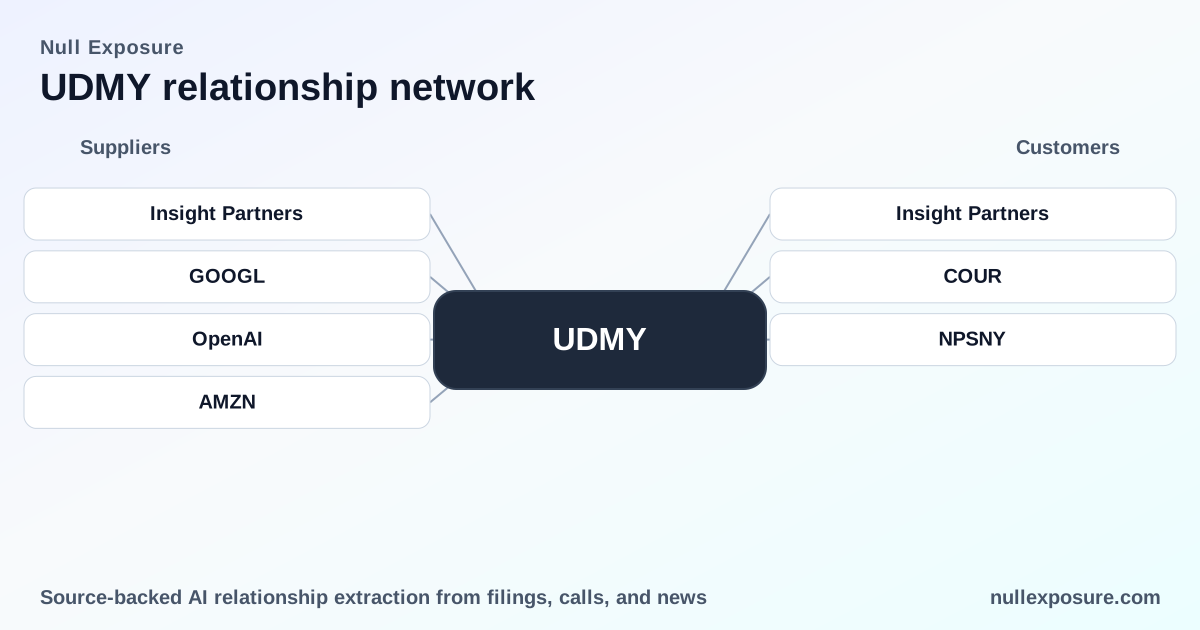
Udemy Inc (UDMY) — supplier relationships that shape content, distribution and cost
Udemy is a global learning platform that monetizes by selling individual courses, subscription access and enterprise learning solutions, collecting revenue from learners and organizations while outsourcing content production and certain technology components. With roughly $790 million in trailing revenue, a thin operating margin and a marketplace model, Udemy’s supplier relationships — content partners, cloud providers and technology integrators — directly influence its product breadth, go‑to‑market reach and gross margin profile. For an investor evaluating supplier risk and strategic optionality, the recent partnerships with Google, OpenAI and AWS plus the company’s disclosures about affiliated vendors and multi‑year commitments deserve focused attention.
For a practical lens on counterparty exposure and supplier criticality, visit https://nullexposure.com/ for detailed supplier mapping and screening.
Why these supplier ties matter for returns and risk
Udemy operates a two‑sided marketplace: instructors and content creators supply courses while learners and enterprise customers purchase access. That structure makes Udemy inherently dependent on external technology partners for distribution, tooling and infrastructure, and on third‑party vendors that enable enterprise features and credentialing. Partnerships with major cloud and AI players convert into distribution lifts, product differentiation and potentially higher lifetime value for learners — but they also introduce dependence on external platforms and recurring procurement commitments that compress flexibility.
Key finance signals:
- Revenue scale is meaningful (TTM revenue $789.8M; gross profit $518.4M), but margins remain slim (operating margin ~0.15%), so supplier‑cost control and favorable commercial terms are material to profitability.
- Valuation and market sensitivity are high (trailing P/E ~159; forward P/E ~44; beta 1.7), which amplifies investor focus on execution against these supplier relationships.
- Enterprise and infrastructure commitments are multi‑year, creating predictable cost baselines but reducing short‑term flexibility.
If you need a supplier‑first view of Udemy’s exposures and how they translate to margin risk, check the supplier profiles at https://nullexposure.com/.
Each supplier relationship — what they do and why it matters
Insight Partners
Udemy’s 2024 Form 10‑K notes that Insight Partners is affiliated with certain vendors that provide technology and software solutions to Udemy, indicating the investor’s ecosystem overlaps with operational vendors and could influence vendor selection or favorable access to software services. According to Udemy’s FY2024 10‑K filing, Insight’s affiliation with vendors is disclosed as part of related‑party/vendor commentary. (Source: Udemy 2024 Form 10‑K)
Google
Udemy launched an AI training program in partnership with Google that bundles access to Google AI Pro alongside Google‑designed courses to give learners hands‑on experience and credential pathways, positioning Udemy to sell premium AI learning products tied to Google tooling. News coverage in March 2026 described the program as a multi‑month offering that leverages Google’s AI expertise to tighten Udemy’s product fit for employer demand. (Source: Intellectia / March 2026; Finviz / March 2026)
OpenAI
Udemy announced a deal to make its course content available inside the ChatGPT interface via a dedicated app, effectively embedding Udemy learning assets into a dominant conversational platform and opening another distribution channel for course consumption and discovery. Media reports in February–March 2026 documented the ChatGPT integration as a strategic distribution and discovery play for Udemy content. (Source: InsiderMonkey / Feb 2026; Finviz / March 2026)
AWS (Amazon Web Services)
Udemy’s collaboration with AWS focuses on pathways for skill validation and industry‑recognized credentials, helping learners earn cloud and technical credentials through Udemy content tied to AWS services — a direct value proposition for both enterprise customers and individual learners seeking career outcomes. Coverage in March 2026 explained how the tie‑up aims to increase the marketability of learners’ qualifications. (Source: Intellectia / March 2026)
What the company‑level contract signals tell investors
Udemy’s constraint disclosures convey a long‑term contracting posture in two areas that matter to suppliers and margin calculus:
- Real estate leases: During Q2 2024 Udemy recognized $9.8 million of additional operating lease right‑of‑use assets primarily from lease extensions through fiscal 2029, signaling multi‑year occupancy commitments for offices or facilities. This is a direct operating commitment that reduces short‑term flexibility in SG&A cost management. (Company disclosure, FY2024)
- Cloud infrastructure commitments: Udemy committed to spend at least $45.0 million between January 2023 and December 2025 under a third‑party cloud infrastructure agreement, with a $12.0 million minimum purchase commitment each year, and noted $12.0 million of non‑cancelable contractual commitments that were not included in the schedule because the remaining term was not in excess of one year. This is a tangible, multi‑year procurement liability that anchors a portion of COGS/hosting expense. (Company disclosure, FY2024)
Together these signals show material, multi‑year supplier cost commitments that are baked into Udemy’s operating base — advantageous for vendor stability and negotiation leverage, but constraining if usage patterns or pricing dynamics change rapidly.
Strategic takeaways and investor implications
- Partnerships with Google, OpenAI and AWS are strategic win‑conditions: they extend Udemy’s product reach, add premium content and credential pathways, and diversify distribution beyond the core marketplace. These deals materially increase addressable audience and product differentiation. (News coverage, Feb–Mar 2026)
- Related‑party vendor links merit governance scrutiny: the Insight Partners affiliation with vendors is a governance consideration for procurement independence and potential preferential vendor arrangements disclosed in the FY2024 10‑K.
- Cost commitments lower upside from rapid margin expansion: long‑term leases and minimum cloud spend create fixed expense floors that cap margin sensitivity to revenue increases in the short term.
Financial profile context: Udemy’s price‑to‑sales multiple (~0.88) and forward P/E (~44) reflect expectations for growth; however, very thin operating margins and multi‑year supplier commitments imply that margin improvement depends on successful monetization of these partnerships and disciplined vendor management.
If you want a supplier‑centric risk map and peer comparisons that translate these relationships into quantifiable exposure, explore our tools at https://nullexposure.com/.
Final verdict — where supplier risk converges with opportunity
Udemy has executed strategic partnerships with the largest cloud and AI platforms to expand content, distribution and credentialing — a clear positive for revenue expansion and product differentiation. Those same ties create dependence on external platforms and fixed procurement commitments that limit margin elasticity. For investors, the tradeoff is straightforward: partnership‑driven growth potential is real, but valuation and margin risk hinge on Udemy’s ability to convert those partnerships into sustainable, higher‑value enterprise and subscription revenue while managing long‑term supplier costs.
For a deeper supplier due diligence briefing and interactive counterparty exposure analysis, visit https://nullexposure.com/ and request the full supplier report.