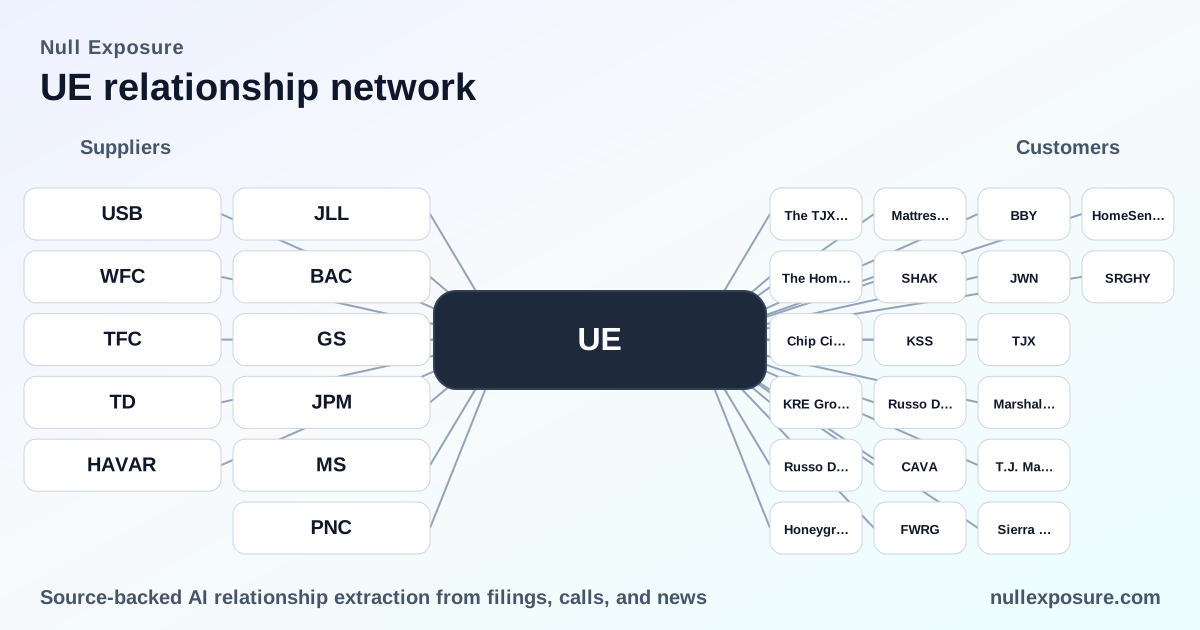
Urban Edge Properties (UE): A concise supplier‑counterparty read for investors
Urban Edge Properties is a New York‑centric retail REIT that generates cash flow through leasing, active portfolio rotation (acquisitions and dispositions), and selective redevelopment of shopping centers. The company monetizes primarily via stabilized rental income in the New York metropolitan area, supplemented by gain‑recognition on property sales and value creation from redevelopment. Urban Edge funds these activities through a mix of unsecured credit facilities, bank syndications and opportunistic asset transactions; its FY2025–FY2026 disclosures make clear that bank financing and capital‑markets counterparties are central to execution. For a quick supplier risk snapshot and counterparty listing, visit https://nullexposure.com/.
Market context: UE is a mid‑cap REIT (market cap roughly $2.8bn, revenue TTM ~$472m, EBITDA ~$251m) with a concentration in retail assets and a financing posture that relies on a broad bank syndicate rather than a single lender.
How UE’s operating model shapes supplier risk
- Contracting posture: Urban Edge uses syndicated credit facilities and external capital markets partners to fund growth and liquidity; the company’s public notice of a revolver upsizing signals an active relationship management approach with senior lenders.
- Concentration and criticality: Rental revenues are geographically concentrated in the New York metro, and the company’s ability to refinance, upsize or replace credit via its bank partners is critical to working‑capital flexibility and development timelines.
- Maturity and redundancy: The list of participants on the revolving facility — administrative agent, syndication agent, joint lead arrangers, passive arrangers and documentation agents — shows redundancy across major global and regional banks, reducing single‑counterparty concentration risk.
- Operational implications: For investors, the key read is that bank relationships are a core operational dependency; asset sales and broker relationships are secondary but important for capital recycling and redevelopment execution.
If you want a structured counterparty map and exposure scoring for UE, see the supplier coverage at https://nullexposure.com/.
What the recent announcements reveal about execution capability Urban Edge’s recent activity combines portfolio disposals and secured facility management. The company sold a suburban parcel for redevelopment and concurrently moved to upsize its revolving credit facility, supported by a broad group of major banks and investment‑bank lending arms. These moves are consistent with a REIT that actively monetizes non‑core land and uses bank facilities to maintain liquidity around redevelopment and acquisitions.
Explore UE’s full supplier network and named counterparties on our platform: https://nullexposure.com/.
Detailed counterparty list and one‑line takeaways Below is a concise, relationship‑by‑relationship summary of every counterparty mentioned in the source set, each tied to the primary press coverage.
-
JLL — JLL represented Urban Edge on the sale of the Bergen Town Center parcel and acted as broker/agent in transaction marketing, demonstrating UE’s use of large brokerage firms for disposition execution. According to a Re‑NorthJersey report (March 2026), JLL senior directors and managing directors were the named representatives on the deal. Source: Re‑NJ coverage of the Bergen Town Center sale (March 2026).
-
JLL Capital Markets — JLL Capital Markets publicly announced the sale of the Bergen Town Center land site, confirming the brokerage channel and buyer/seller negotiation process for that asset disposition. DailyVoice reported JLL Capital Markets’ press release describing the 426‑unit multifamily development transaction (March 2026). Source: DailyVoice press notice on Bergen Town Center sale (March 2026).
-
Bank of America, N.A. — Bank of America is listed as a participant in Urban Edge’s upsized revolving credit facility, reflecting its role as a syndicate lender providing committed liquidity. The participation was disclosed in a Yahoo Finance release about the facility upsizing (March 2026). Source: Yahoo Finance announcement (March 2026).
-
Goldman Sachs Bank USA — Goldman Sachs Bank USA participated as a lender in the revolver syndicate that supports Urban Edge’s working capital and refinancings, per the company’s upsizing announcement. Source: Yahoo Finance announcement (March 2026).
-
JPMorgan Chase Bank, N.A. — JPMorgan is named among the revolver participants, indicating a conventional bank lending relationship that supports UE’s financing flexibility. Source: Yahoo Finance announcement (March 2026).
-
Morgan Stanley Bank, N.A. — Morgan Stanley Bank, N.A. is likewise recorded as a participant in the revolving credit facility, providing additional capital market linkages for the REIT. Source: Yahoo Finance announcement (March 2026).
-
PNC Bank, National Association — PNC continues in a syndication role and is named as the Syndication Agent for the facility, signifying a structured role in allocating commitments across the bank group. The company’s press release identified PNC as Syndication Agent (March 2026). Source: Yahoo Finance announcement (March 2026).
-
PNC Capital Markets LLC — PNC Capital Markets LLC served as a Joint Lead Arranger and Joint Bookrunner alongside Wells Fargo Securities, confirming investment‑banking execution support on the revolver upsizing. Source: Yahoo Finance announcement (March 2026).
-
Wells Fargo Bank, National Association — Wells Fargo Bank remains the Administrative Agent for the revolving credit facility, a central operational role that places Wells Fargo at the center of covenant administration and facility draws. Source: Yahoo Finance announcement (March 2026).
-
Wells Fargo Securities, LLC — Wells Fargo Securities, LLC acted as a Joint Lead Arranger and Joint Bookrunner for the revolving credit facility, confirming the bank’s structuring and placement responsibilities. Source: Yahoo Finance announcement (March 2026).
-
U.S. Bank National Association — U.S. Bank is named among the Passive Joint Lead Arrangers and documentation agents role‑set, underlining a complementary but material participation in the syndicate. Source: Yahoo Finance announcement (March 2026).
-
Truist Securities Inc. — Truist Securities was listed as one of the Passive Joint Lead Arrangers, showing regional bank syndication support for the facility. Source: Yahoo Finance announcement (March 2026).
-
TD Bank, N.A. — TD Bank, N.A. is identified as one of the Documentation Agents for the revolver, a role tied to legal and administrative document flow for the facility. Source: Yahoo Finance announcement (March 2026).
-
TD Securities (USA) LLC — TD Securities (USA) LLC was named among the Passive Joint Lead Arrangers, confirming its involvement in underwriting/allocating the facility. Source: Yahoo Finance announcement (March 2026).
-
Truist Bank — Truist Bank is recorded as a Documentation Agent, aligning the commercial‑bank arm with legal and operational support for the revolving facility. Source: Yahoo Finance announcement (March 2026).
-
Harvard — Urban Edge purchased Brighton Mills Retail Plaza from Harvard in late October for $39 million, illustrating UE’s active acquisition pipeline in suburban retail markets to complement its urban holdings. The Crimson reported the sale as a transaction completed in late 2025 (December 2025). Source: The Harvard Crimson coverage (December 2025).
What investors should watch next
- Liquidity stance and covenant profile: With a multi‑bank revolver that was recently upsized, the immediate focus for investors is whether the syndicate’s terms preserve covenant headroom through industry cycles and fund redevelopment without expensive equity issuance.
- Disposition cadence: Urban Edge is using brokered dispositions (JLL) to recycle capital; tracking the pace and pricing of such sales will indicate whether NOI growth will be organic or reliant on capital recycling.
- Counterparty concentration: The syndicate is broad and includes major global and regional banks, which reduces counterparty concentration risk but raises the importance of monitoring macro credit conditions that could compress syndication capacity.
For a deeper counterparty exposure map and scoring model that integrates these relationships with covenant timelines, check our supplier intelligence hub at https://nullexposure.com/.
Conclusion and action points Urban Edge’s recent public activity shows a financing strategy executed through a diversified bank syndicate and a disposition program supported by top brokerage firms. The firm’s bank counterparties are strategic and comprehensive, and asset sales such as the Bergen Town Center parcel and the Brighton Mills purchase are core levers for liquidity and redeployment. Investors should monitor covenant detail, syndicate appetite and sale execution quality. If you need a tailored supplier risk briefing for UE or comparable REITs, start here: https://nullexposure.com/.