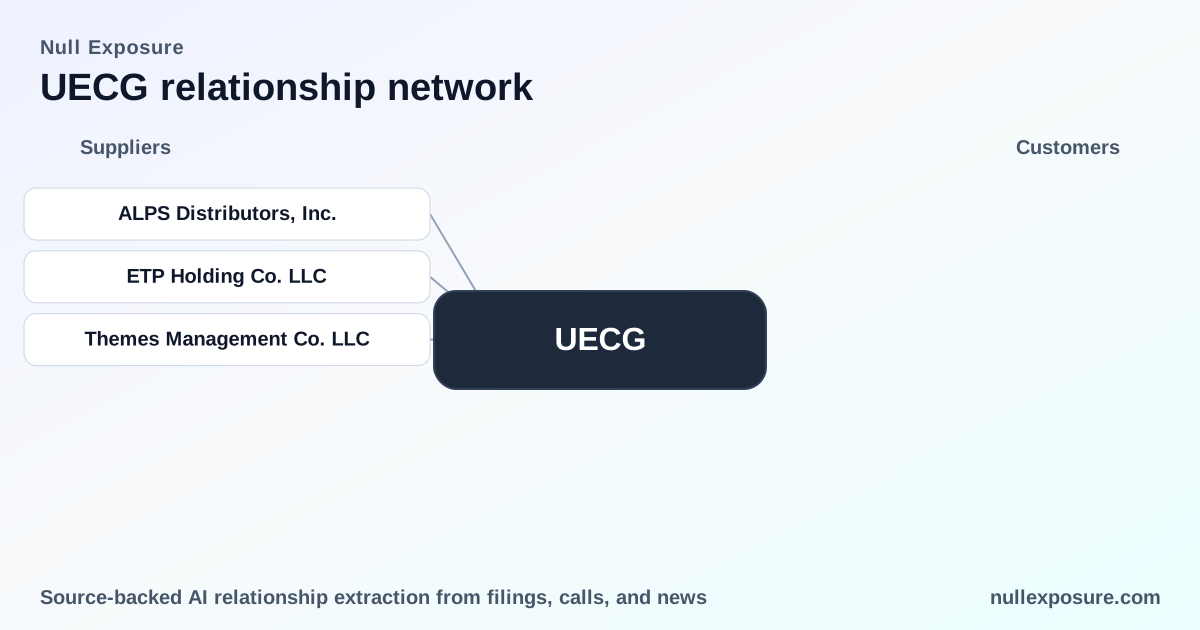
UECG supplier relationships: distribution, issuance and advisory links that move revenue
UECG operates as a supplier that monetizes through intermediated distribution and structured-issuance relationships: the company supplies products or services that are sold to end customers via third‑party distributors, issued through an issuing vehicle, and supported by an external adviser that shapes investor-facing positioning. Investors should view UECG’s revenue profile as intermediary-dependent, with margin capture driven by supplier contracts and partner channel effectiveness. For further vendor-mapping and counterparty intelligence, see https://nullexposure.com/.
How to read UECG’s partner map — what the relationships imply about the business model
UECG’s public relationship set shows a clear operating posture: outsourced commercialization and delegation of issuance and advisory responsibilities. That pattern yields several company-level signals relevant to valuation and operational risk:
- Contracting posture: UECG uses third parties to reach market and to structure offerings, which implies supplier agreements and fee splits rather than direct retail distribution. This produces predictable topline scaling if partners perform, but requires tight contract enforcement and revenue sharing arrangements.
- Concentration: With a compact set of named relationships, distribution and go‑to‑market concentration is elevated; a disruption or contract renegotiation with any partner would have outsized revenue effects.
- Criticality: Distributor and issuer partners are operationally critical — they control customer access and legal issuance mechanics. Advisory relationships shape product placement and investor demand.
- Maturity and market role: The FY2026 timestamps on partner mentions indicate these arrangements are current and active; they align UECG with an asset-or product-supplier role rather than a vertically integrated issuer or retailer.
These company-level constraints are derived from the relationship roles reported and should be treated as governance and counterparty risk signals rather than granular contract terms. If you want a deeper counterparty risk scan or legal‑contract mapping, start your due diligence at https://nullexposure.com/.
Who UECG works with — the named counterparties and what they do
ALPS Distributors, Inc.
ALPS Distributors is listed as a Distributor associated with UECG in the public relationship record, indicating ALPS handles distribution or placement of UECG’s products to investors or intermediary channels. This role positions ALPS as a commercial gateway for sales and client reach (TradingView listing for BOATS-UECG, first seen March 10, 2026: https://www.tradingview.com/symbols/BOATS-UECG/).
ETP Holding Co. LLC
ETP Holding Co. LLC is identified as an Issuer, which signals that UECG’s products or securities are issued through an issuing vehicle or special purpose entity tied to ETP Holding. That structure centralizes legal issuance and regulatory filings with the named issuer (TradingView listing for BOATS-UECG, first seen March 10, 2026: https://www.tradingview.com/symbols/BOATS-UECG/).
Themes Management Co. LLC
Themes Management Co. LLC is recorded as Primary advisor, indicating it provides advisory services that shape product themes, marketing, or investment positioning that influence investor demand. This advisory role directly affects product design and go‑to‑market narratives (TradingView listing for BOATS-UECG, first seen March 10, 2026: https://www.tradingview.com/symbols/BOATS-UECG/).
What these relationships mean for investors: risk, concentration, and levers
The trio of partners reveals a compact ecosystem where distribution, issuance, and advisory functions are parceled out to specialists. That model offers clear operational advantages — scalable customer access, regulatory separation of issuance, and expert product positioning — but it concentrates several core risks:
- Counterparty concentration risk: With a small set of designated partners, any dispute, termination, or performance failure at the distributor or issuer level will have direct revenue impact. Investors should quantify revenue attributable to each channel when possible.
- Commercial dependency: UECG’s growth depends on partner effectiveness in sales and distribution. Contract terms that limit marketing rights, impose minimums, or allow unilateral termination could materially affect recurring revenue streams.
- Operational control versus commercial reach: Delegation to a primary advisor and distributor improves market reach but reduces direct control over client relationships and messaging; governance and oversight mechanisms in supply contracts are therefore a valuation lever.
- Regulatory and structural risk: Use of a named issuer company concentrates regulatory and compliance obligations into a legal vehicle that can introduce complexity (filings, capital requirements). Investors should evaluate the issuer’s corporate structure and governance for legal risk.
These are not abstract concerns: the FY2026 relationship mentions indicate these are active, not historical, arrangements. For a tactical follow-up — contractual intelligence, clause benchmarking, or counterparty financial health — visit https://nullexposure.com/.
Practical next steps for due diligence
- Request revenue attribution across ALPS Distributors, ETP Holding Co. LLC, and Themes Management Co. LLC to quantify concentration exposure.
- Review master services and distribution agreements for termination provisions, revenue share mechanics, and exclusivity language.
- Examine the corporate and regulatory filings tied to the issuer (ETP Holding Co. LLC) to assess legal isolation and contingent liabilities.
- Validate Themes Management’s advisory mandate and compensation structure to understand how product messaging and investment positioning are being controlled.
These operational checks translate directly into valuation adjustments: higher concentration and weaker contractual protections reduce multiple; strong, long‑dated agreements with clear revenue waterfalls support premium multiples.
Conclusion: investable signals and action items
UECG’s supplier map is concise and telling: distribution, issuance, and advisory are outsourced to named specialists, creating an efficient go‑to‑market but concentrating counterparty risks. For investors, the primary tasks are to quantify revenue dependency on each named partner, inspect the contractual protections that guard those revenue streams, and evaluate the issuer vehicle for regulatory and legal risk. If you need structured sourcing or a rapid counterparty briefing, start with a tailored engagement at https://nullexposure.com/.
Bold takeaway: UECG’s business is channel‑driven and contract‑dependent — strength of partner agreements determines both cash flow stability and valuation multiple.