Uni‑Fuels Holdings (UFG): supplier relationships that define a capital‑light fuel reseller
Uni‑Fuels Holdings Limited operates as a Singapore‑based marketer, reseller and broker of marine fuels, monetizing through transactional margins on physical fuel sales and brokerage commissions while selectively accessing capital markets to fund working capital and growth. The company’s revenue model is volume‑driven with razor‑thin margins, supported by a concentrated set of capital and certification partners that shape its ability to scale in low‑margin commodity distribution. Explore a supplier‑centric view of those partners and what they imply for investors and operators at https://nullexposure.com/.
A concise commercial snapshot investors need to own
Uni‑Fuels reports roughly $195.6 million in trailing revenue with gross profit around $3.8 million and negligible net margins, reflecting the economics of commodity resale and brokerage in marine fuels. The enterprise is a newly public, small‑cap firm (market capitalization ≈ $32.5 million) with high insider ownership (45%) and very low institutional ownership, indicating founder control and limited passive investor liquidity. Quarterly revenue grew strongly year‑over‑year, but profitability and cash generation remain constrained: EBITDA is small relative to revenue, and EV/EBITDA is elevated, consistent with an early‑stage public trading profile.
Who Uni‑Fuels transacts with — the relationships you must track
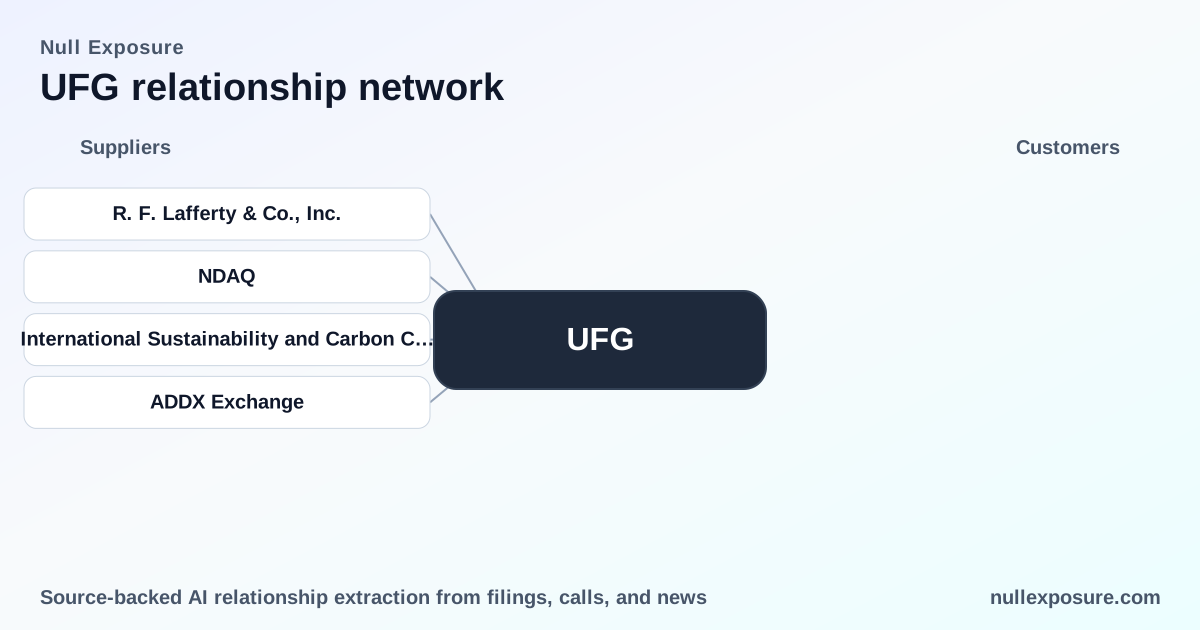
R. F. Lafferty & Co., Inc. — the underwriter that took them public
R. F. Lafferty served as the sole book‑running manager for Uni‑Fuels’ initial public offering, underwriting and pricing the deal that brought Class A Ordinary Shares to market in January 2025. This concentrated underwriting relationship indicates a narrow capital‑market distribution channel for the company’s IPO execution (GlobeNewswire, January 14–15, 2025; Quiver Quant, January 2025).
Nasdaq — the exchange hosting UFG liquidity
Uni‑Fuels commenced trading on the Nasdaq Capital Market under the ticker UFG on January 14, 2025, establishing its primary market liquidity conduit and regulatory overlay for reporting and investor access (MacauBusiness coverage of the listing, January 2025).
International Sustainability and Carbon Certification (ISCC) — sustainability credentialing
Uni‑Fuels’ wholly‑owned subsidiary, Uni‑Fuels Pte Ltd, received ISCC EU and ISCC PLUS certifications on February 12, 2025, enabling the company to source, market and certify lower‑carbon marine fuel products and to participate in sustainability‑oriented supply chains (OpenPR coverage, February 12, 2025). This certification is a commercial enabler for selling certified fuels to counterparties that require verified sustainability credentials.
ADDX Exchange — alternative liquidity channel for commercial paper
Uni‑Fuels Singapore completed its first commercial paper issuance of US$3 million through ADDX Exchange, a Singapore‑regulated private market platform, demonstrating the company’s use of private‑market short‑term funding to supplement working capital (OpenPR release, 2025). Using ADDX signals an operational willingness to tap regulated private market platforms rather than relying solely on traditional bank credit.
What the relationship map tells investors about Uni‑Fuels’ operating posture
Uni‑Fuels presents the profile of a volume‑dependent reseller with concentrated capital and credentialing partners. The sole book‑running manager relationship in the IPO points to limited underwriting distribution, which can constrain pricing power and public float depth at IPO. Listing on Nasdaq supplies necessary liquidity and transparency, but the small float and high insider ownership create potential trading illiquidity and governance concentration.
The ISCC certification is operationally critical: it unlocks sustainable fuel markets where buyers require certified supply chains, directly impacting revenue mix and customer access. The ADDX commercial paper issuance shows prudent short‑term funding diversification, but also signals that bank lines or larger capital sources are not the only -- or primary -- funding option for working capital.
There are no explicit supplier constraints recorded in the reviewed relationship data; that absence itself is a company‑level signal that contractual encumbrances with named suppliers or platform partners are not publicly disclosed in these sources. Investors should therefore treat current partner disclosures as informative but incomplete relative to counterparty concentrations in fuel sourcing and offtake.
How these relationships translate into risk and upside
- Risk: concentrated capital access and ownership. With a single book‑runner for the IPO and 45% insider ownership, Uni‑Fuels is exposed to narrow capital distribution and control risks that can amplify price moves and reduce external governance pressure.
- Risk: margin sensitivity and liquidity mismatch. The business model is high volume, low margin, so any disruption to fuel sourcing, certification status, or short‑term funding can compress free cash flow quickly.
- Upside: certification‑led differentiation. ISCC EU and ISCC PLUS credentials give Uni‑Fuels access to sustainability‑focused counterparties and premium channels for certified marine fuels.
- Upside: diversified short‑term funding experiments. The use of ADDX for commercial paper demonstrates nimbleness in funding strategy that operators can scale if issuance terms remain favorable.
Due diligence and operational follow‑ups investors should prioritize
- Request detailed counterparty concentration schedules for fuel suppliers and major customers to identify single‑counterparty exposure.
- Validate the terms and maturity profile of the ADDX commercial paper and any other short‑term commitments to quantify rollover risk.
- Monitor ISCC certification renewal terms and scope; certification expiration or scope reduction directly reduces access to premium sustainable fuel buyers.
- Track share float evolution post‑IPO and any lock‑up expiries that will affect liquidity and governance.
For a concise, supplier‑centric intelligence package and to monitor these counterparties continuously, visit https://nullexposure.com/ and sign up for focused supplier relationship alerts.
Bottom line: what operators and investors should act on now
Uni‑Fuels is a small, newly public player in marine fuel resale whose near‑term valuation and operational trajectory are driven by volume control, certification credentials, and short‑term funding flexibility. The underwriter relationship, Nasdaq listing, ISCC certification and ADDX issuance together form a coherent picture: Uni‑Fuels is building commercial credibility while relying on concentrated capital and governance structures that create both execution leverage and concentration risk. Active monitoring of certification status, funding rollovers, and counterparty concentrations is required to assess downside risk and upside capture.
Take the next step: explore continuous supplier relationship monitoring and tailored research at https://nullexposure.com/ to convert these signals into investment action.