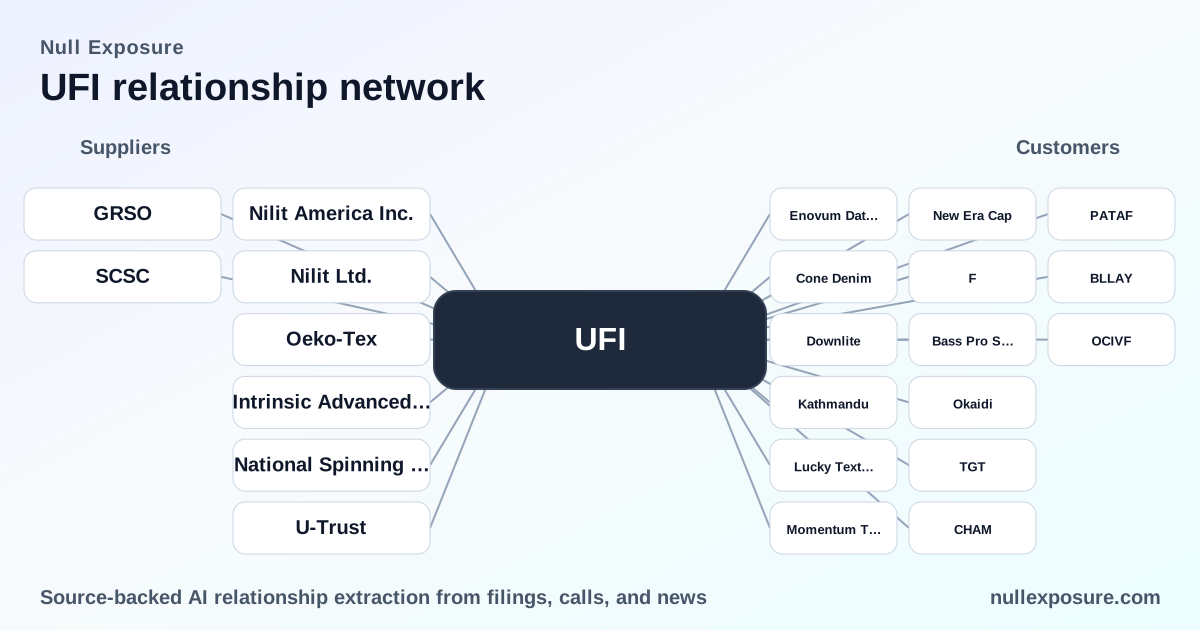
Unifi (UFI) — Supplier Map and Commercial Signals for Investors
Unifi operates a vertically integrated textiles business that manufactures and sells synthetic and recycled polyester and nylon products, monetizing through sale of branded yarns (notably Repreve), staple and filament yarns, and intermediate chip and POY products across the U.S., Brazil, China and international markets. Revenue is driven by a mix of in-house production from recycling centers and purchased raw materials, while certification and traceability programs underpin premium positioning in recycled-content supply chains. For the quickest access to an indexed supplier view, visit the NullExposure homepage: https://nullexposure.com/.
Why supplier relationships matter for valuation and execution
Unifi’s operating model blends manufacturing, recycling and outsourced inputs. The firm produces a portion of its own polymer chips in the REPREVE Recycling Center but continues to buy the remainder from third parties, creating a hybrid supply posture where internal capabilities lower cost but external suppliers preserve capacity flexibility. Unifi also relies on third-party production services and independent sales agents in certain markets, which shapes both cost structure and commercial reach.
These characteristics produce three investment-relevant constraints:
- Contracting posture: Unifi uses separate supply and services agreements with third-party processors and material suppliers rather than full vertical ownership, indicating a contracting approach that prioritizes operational flexibility.
- Spend profile and maturity: Documented ongoing purchase orders and service contracts are small and routine in aggregate, signalling established, low-value recurring relationships rather than large, single-vendor concentration.
- Customer/market criticality: Certification and traceability partners are strategically important to product differentiation and customer access to sustainability programs, supporting premium pricing on recycled-content products.
For a consolidated supplier intelligence view and relationship scoring, explore https://nullexposure.com/.
Direct supply and production partners
Nilit America Inc.
- Nilit America supplies raw materials and production services to Unifi under separate supply and services agreements, indicating a contracted production relationship that supplements Unifi’s internal capacity. According to Unifi’s FY2025 10‑K filing, raw material and production services for UNFA are provided by Nilit America under separate agreements.
Nilit Ltd.
- Nilit (Israel-based) provides raw material and production services to Unifi operations outside the U.S., reflecting multinational sourcing arrangements under formal contracts. That arrangement is disclosed in Unifi’s FY2025 10‑K where raw material and production services for UNF were provided by Nilit under separate supply and services agreements.
National Spinning Co. Inc.
- National Spinning’s dyed yarn business and assets were acquired by Unifi’s domestic subsidiary as part of a strategic capacity move, strengthening Unifi’s dyed staple and filament yarn position. A Sourcing Journal report covering the FY2018 transaction described Unifi’s acquisition of the dyed yarn business and assets of National Spinning Co. Inc.
Intrinsic Advanced Materials
- Intrinsic Advanced Materials partnered with Unifi to introduce biodegradable Repreve fibre using CiCLO technology, representing a product-innovation link that advances Unifi’s sustainability roadmap. Knitting Industry reported in FY2025 that Repreve with CiCLO technology was developed in partnership with Intrinsic Advanced Materials, a joint venture between Parkdale Advanced Materials and Intrinsic Textiles Group.
Certification and traceability partners that support pricing and market access
Oeko‑Tex
- Oeko‑Tex certification provides independent verification of textile safety and supports Unifi’s recycled-content claims for Repreve and ThermaLoop, which helps access apparel customers with strict product safety requirements. A Just‑Style article (March 2026) lists Oeko‑Tex among certifications applied to Repreve filament yarn and ThermaLoop.
U‑Trust
- U‑Trust provides traceability verification used with Unifi’s FiberPrint tracking, enabling customers to trace recycled content through the supply chain and reinforcing Repreve’s value proposition. Just‑Style’s March 2026 coverage notes that Repreve and ThermaLoop are traceable with FiberPrint and certified by U‑Trust.
GRS (Global Recycled Standard)
- GRS certification verifies recycled content across Unifi’s recycled products and is cited as part of product certification for Repreve and ThermaLoop, strengthening buyer confidence in sustainability reporting. A Just‑Style report (March 2026) notes GRS certification for these products.
SCS (Scientific Certification Systems)
- SCS certification is used alongside GRS and Oeko‑Tex to validate recycled content claims, giving Unifi additional third‑party attestations for sustainability-conscious customers. Just‑Style’s March 2026 coverage lists SCS as one of the certifications applied to Repreve and ThermaLoop.
What the documented constraints signal about operational risk
Unifi’s constraint excerpts indicate several company-level operational signals that investors must price:
- Service-provider posture is material. The FY2025 filing describes a mix of outsourced manufacturing services, consumables, and third‑party finished goods purchases, and the constraints metadata classifies “service_provider” with high confidence. This translates into operating leverage where supplier disruptions or price swings in outsourced services can compress margins quickly.
- Hybrid buyer/seller role. Unifi simultaneously buys raw materials and sells finished and intermediate products, reflecting a vertically integrated but open-sourcing model; the constraints tag “buyer” and “seller” captures that dual role and explains why supply contracts and inventory management are core execution risks.
- Low-average purchase order size. Open non-capital purchase orders are modest (documented in the filing as approximately $13,218 at fiscal‑end and individual obligations often ranging from $1,000 to $10,000 per annum), signaling a large number of small-value recurring contracts rather than a few concentrated supplier exposures. That structure reduces single-vendor concentration risk but increases complexity and administrative overhead.
Collectively, these constraints indicate operational maturity with established partner networks, constrained vendor concentration, and execution sensitivity to commodity and service cost swings rather than single-vendor failure.
Risk, upside and next steps for investors
- Upside: Certifications and new material innovations (CiCLO biodegradable fibre) support pricing power in the recycled-content segment and broaden addressable markets in sustainability-conscious apparel and industrial customers.
- Risk: Margin sensitivity to polymer feedstock prices and outsourced service costs is higher where Unifi does not internally produce chip requirements; routine purchase orders are small but numerous, which increases process complexity and exposure to aggregate supplier inflation.
- Catalysts to watch: Progress in scaling CiCLO-enabled Repreve, shifts in the share of internal chip production versus purchases, and any material changes to supplier agreements with Nilit or other production partners.
For a structured supplier risk assessment and to monitor changes in Unifi’s partner network, visit https://nullexposure.com/ for tracking, scoring, and alerts.
Bottom line
Unifi’s supplier map shows a deliberate balance between internal recycling capacity and contracted production relationships, supplemented by certification partners that protect premium positioning. Investors should underwrite both the pricing benefits of certified recycled content and the operational exposure that comes from a mixed buy/produce model. For ongoing supplier intelligence and to integrate these relationships into portfolio risk models, check NullExposure’s supplier pages at https://nullexposure.com/.